"What wakes me up is not the alarm clock, but coffee!"
"If you feel life is bitter, then have a cup of coffee!"
A pick-me-up during weekdays, a social currency on weekends, coffee plays an increasingly important role in the hearts of young people. According to statistics, China has nearly 110,000 coffee shops, with almost one within a 15-minute living circle near everyone's home or workplace.
In fact, before coffee reaches your hands, it goes through a long process of planting, transportation, and production, each step generating different amounts of carbon emissions.
All of this starts with a fart.
01
"A Small Fart" Is the Main Source of Latte's Carbon Emissions
In the town of Rasdorf in central Germany, a bizarre incident occurred where 90 cows collectively farted and belched, causing methane to accumulate in the cowshed, leading to an explosion that damaged the farmhouse and injured the cows.
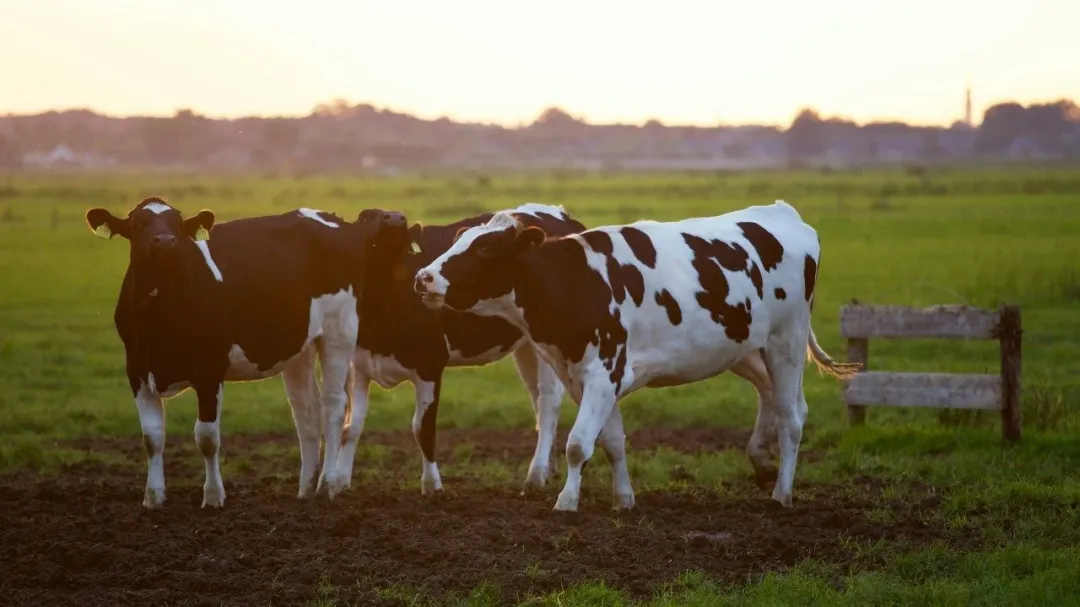
As ruminants, cows have four stomachs. Microorganisms in the first stomach, the rumen, break down the cow's food, and cows release the "byproducts," carbon dioxide and methane, through belching and farting. Methane can cause a greenhouse effect 28 times greater than an equivalent amount of carbon dioxide! A single cow can emit up to 500 liters of methane daily.
"If all the cows in the world were a country, their annual carbon emissions would be around 5 billion tons, almost equal to the United States' annual emissions."

According to calculations by Carbonstop, a latte made from South American coffee beans produces approximately 495 grams of carbon emissions (equivalent to driving a car about 1.87 kilometers). The carbon emissions from milk account for 47% of the total carbon emissions of a latte!
Surprised?
But many people still love milk coffee. Don't worry; you can do many things to offset or reduce the carbon emissions from milk, such as riding a shared bike three and a half times, theoretically neutralizing the carbon footprint of the milk in a latte. Alternatively, you could choose carbon-neutral organic milk, or oat milk, which emits only 28% of the carbon emissions of regular milk!
02
Carbon Emissions from Coffee Beans Vary Widely
When you and a friend order two cups of coffee at a café, one made from "South American coffee beans" and the other from "Yunnan coffee beans," you might not know that their carbon emissions can differ by up to five times.
The transportation, planting, and processing methods of coffee beans all affect carbon emissions, especially transportation! A cup of Americano coffee from South America consumed in Shanghai may have up to 50% of its carbon emissions from air freight to China. To simplify, common transportation methods rank in terms of carbon emissions from highest to lowest as follows: air transport > diesel road transport > new energy road transport > sea transport.
Besides transportation, more organic farming practices use less nitrogen fertilizer, reducing carbon emissions; in coffee bean processing, naturally dried beans are generally lower in carbon emissions than those processed using the "washed" method.
So, the next time you order coffee, you can "check the distance, ask about the farming, and see the processing" to choose your favorite W0W coffee beans!
Let's take a look at how Carbonstop helped Yuangqi Zhanli create a "zero-carbon" coffee and complete its "carbon journey."
03
Coffee Grounds Are Far from "Trash"
According to statistics from the International Coffee Organization in London, the world consumes at least 400.6 billion cups of coffee annually. However, only 0.2% of the coffee bean is used in each cup, with the remaining 99.8%, about 8 million tons of coffee grounds, being discarded as waste. These seemingly harmless grounds produce large amounts of methane when landfilled, exacerbating greenhouse gas emissions.
Are the coffee grounds you discard completely useless? In fact, the potential value of coffee grounds is much greater than we imagine.
To show the true face of these "ground beans," today, all items made from coffee grounds in the Low-Carbon Hero Mall will be available at limited-time discounted prices.
Check out what they can do; they are far from ordinary "trash."
- Organic fertilizer, made by fermenting coffee grounds with soil to provide nutrients for plant growth
- Exfoliating scrub, as the natural oils in coffee grounds can form a protective layer on the skin
- Deodorizer, placed in refrigerators, microwaves, new houses, etc., to remove odors
- Placed in ashtrays to absorb smoke odor
Starbucks launched reusable cups and notebooks made from coffee grounds in 2020 and planned to recycle coffee grounds for use in store furniture. In 2021, Starbucks and Manner both introduced "ground tubes," straws made from coffee grounds.
Zhalabo (Ground Bean Research Institute) has expanded its research from coffee to coffee grounds, aiming to minimize the environmental impact and burden on coffee lovers during the enjoyment of coffee. All coffee cups are made using safe, biodegradable new materials (PLA) combined with coffee grounds, extending the life of coffee.
Recently, KAFFTEC Cafa, under the help of Carbonstop, launched its first carbon-neutral product—the Ground Bean Cup, a star product loved by many, successfully reducing carbon emissions by 20.50% in raw materials!
Each particle of coffee grounds collides, aggregates, and fuses, reshaping into new forms, reborn, embracing new possibilities.
When the coffee grounds in your hand are no longer just waste thrown into the trash, but become a powerful tool in our fight against climate change, the life of coffee truly begins to continue and evolve.