


 919
919From Compliance to Competitiveness: The Business Case for GHG Accounting
Greenhouse gas accounting is no longer just a box-ticking exercise. It has evolved into a core business function and a form of corporate carbon accounting that sits alongside financial reporting. These days measuring and verifying emissions is a prerequisite for doing business, attracting investors, and staying ahead of the competition.
For example, new regulatory frameworks such as CSRD, CBAM, and ISSB are turning climate disclosure into a formal requirement. At the same time, large multinationals require their suppliers to share Scope 3 data to keep their place in the value chain. Investors are treating emissions data as decision-grade financial information rather than narrative ESG disclosure.
The implications for corporates are clear: accurate, auditable GHG accounting is no longer optional. It can only be delivered by systems designed for accuracy, traceability, and assurance.
 What GHG Accounting Really Means
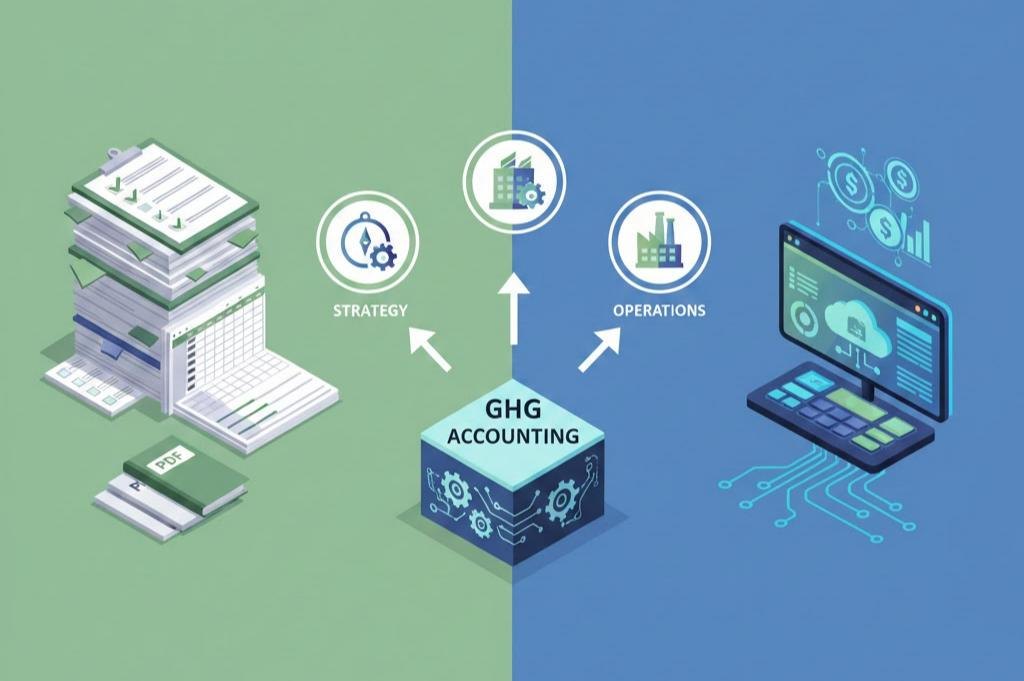
Corporate GHG accounting measures the emissions generated by a company’s operations and its supply chain. Understanding how GHG accounting works requires following a structured process outlined in established frameworks such as the GHG Protocol. These set the guidelines for how companies identify, calculate, and report their emissions.
A credible GHG emissions inventory is about more than the final number. It is about the 'audit trail' that supports it. It is the evidence that demonstrates that the data, the methodology used, the quality checks, and the governance approaches are reliable.
Carbon accounting is not just about carbon. It includes a much broader family of greenhouse gases, such as methane, nitrous oxide, and various fluorinated gases. These gases are then converted into 'carbon dioxide equivalent' (tCO2e) based on their specific warming potential. This gives businesses a single metric to track progress and compare results across the sectors.
 Why Measurement Comes Before Management
Accurate corporate carbon accounting forms a basis for reducing emissions. Carbon accounting is the essential founding block for every decision, from establishing a credible baseline and setting targets to transition planning and supplier engagement.
Robust accounting allows companies to identify emission "hotspots", helping them distinguish between minor issues and the high-impact areas that matter. This level of clarity ensures that resources are not just spent, but strategically invested where they will result in the greatest emissions reduction.
This is why leading companies no longer view GHG accounting as a reporting task. They treat it as a key process that informs their most important strategic, operational, and financial decisions.
 The Forces Driving the Shift: Why Now?
The Regulatory Wave: We are seeing a massive shift in how the world expects companies to talk about their footprint. It’s no longer enough to just "tell a good story" about sustainability. New rules like the EU’s CSRD and CBAM, along with global ISSB standards, are turning climate disclosure and greenhouse gas accounting into a rigorous, "investor-grade" process.
In short: emissions data is being treated with the same level of scrutiny as financial data. If you operate in or trade with these markets, reporting your Scope 3 emissions isn't just a best practice—it's becoming a legal requirement for doing business.
Market and Supply Chain Reality Beyond the law, there is a very practical commercial pressure at play. Large multinational corporations now need your data to satisfy their own climate targets. If you are a supplier, being able to provide transparent Scope 3 data is quickly becoming a condition for staying on the "approved" list.
At the same time, banks and ESG rating agencies are using these metrics to decide who gets access to capital. We are reaching a point where carbon intensity is weighed just as heavily as price or quality. If a company can’t produce credible, auditable data, they aren't just failing a green test—they are risking their access to markets and the funding they need to grow.
 Putting GHG Accounting into Practice
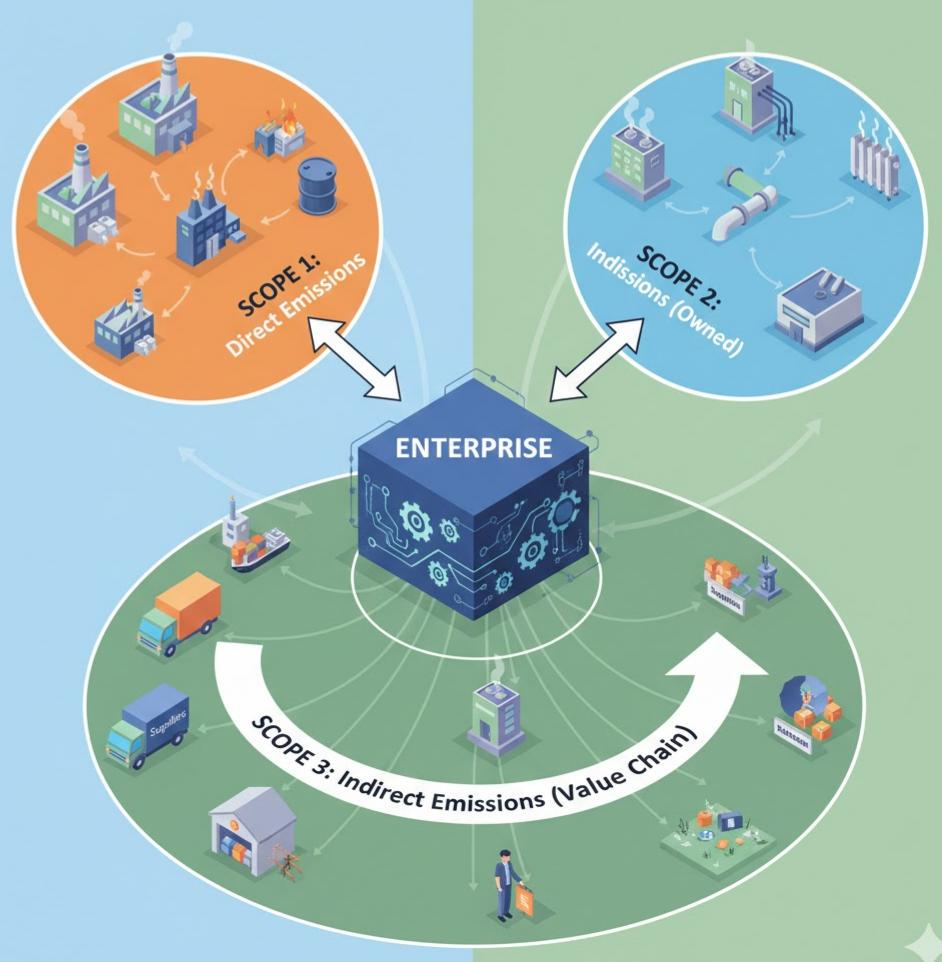
Think of GHG accounting as a specialised branch of financial bookkeeping. Instead of tracking dollars, you’re tracking GHG emissions. It follows a structured, standards-based approach defined by the GHG Protocol. At its core, organisations must first define organisational boundaries, typically using either an equity share or control approach to determine which emissions fall within scope.
Emissions are then categorised into Scope 1 (direct emissions), Scope 2 (purchased energy), and Scope 3 (value chain emissions). For most enterprises, Scope 3 represents the largest and most complex share of total emissions, often spanning suppliers, logistics, and product use.
This framework ensures consistency, avoids double counting, and provides the foundation for credible reporting, assurance, and decision-making.

How Emissions Are Calculated
GHG emissions are calculated by combining activity data with appropriate emission factors. To calculate emissions, enterprises use a combination of data:
- Activity-based data, which delivers the highest accuracy and reflects real operational performance.
- Spend-based estimates, typically used where primary data is unavailable, particularly in early Scope 3 assessments.
Mature organisations use both types of data within their GHG accounting programs. They prioritise activity-based data for material emissions while using secondary estimates for less relevant emission sources. The credibility of results depends less on the method and more on data quality, factor selection, and methodological consistency over time.
This is why digital tools and platforms are essential. They enable scalable data management, transparent documentation, and audit readiness.

Data Quality: The "Secret Sauce"
Beyond simply having gaps in data or poor quality data, the biggest mistake a company can make in greenhouse gas accounting is using the wrong Emission Factors. These are the multipliers that turn "activity" into "carbon."
They vary significantly by geography, technology, energy mix, and year. Applying generic or misaligned factors can materially distort results. For example, using a global average for electricity is going to give the wrong answer if manufacturing activity takes place in China. The grid in a coal-heavy province looks very different from one powered by hydro or wind.
This is why tools like Carbonstop’s China Carbon Database (CCDB) are so critical. By providing granular, region-specific data for power, materials, and logistics in China, it allows companies to stop guessing and start reporting "defensible" data that can stand up to a rigorous audit.

Why Digital Infrastructure is No Longer Optional
Manual GHG accounting doesn't scale. It also poses a significant risk for companies that try to expand their calculation approaches across business units, processes, and products. Spreadsheets are notoriously prone to error and struggle to provide the "audit trail" that regulators now demand. With the shift toward third-party assurance, organisations need a single source of truth—one that tracks data lineage and maintains consistency across different entities and years. Replacing manual processes with dedicated carbon management platforms isn’t just about efficiency; it’s about making your climate data defensible.

How Enterprise Platforms Enable Scalable, Audit-Ready GHG Accounting
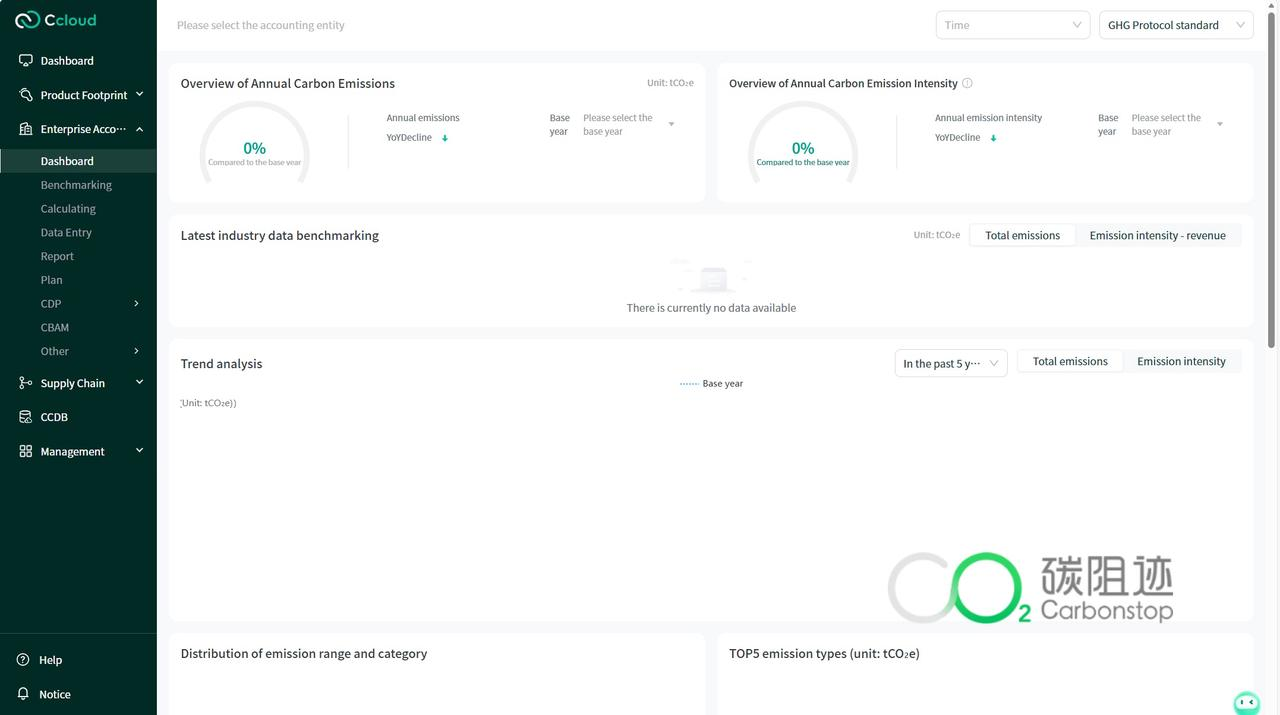
Enterprise carbon management platforms provide the infrastructure required for reliable GHG accounting. Core capabilities include:
- A centralised data model serving as a single source of truth
- Automated emission factor matching aligned with geography and activity
- Supplier engagement workflows to collect and manage Scope 3 emissions
- AI-enabled validation to identify anomalies and data gaps
- Audit-ready traceability aligned with GHG Protocol, CSRD, ISSB, and CDP
Carbonstop’s Carbon Cloud (Ccloud) platform exemplifies this approach, enabling enterprises to manage complex emissions data across operations and value chains with accuracy and confidence.

From Accounting to Action: Turning Data into Decarbonisation
At the end of the day, GHG accounting isn't just about "counting carbon"—it’s about creating a roadmap for change. High-quality data allows organisations to stop guessing and start acting. It shows exactly where to prioritise efforts, how to talk to suppliers, and how to align climate goals with overall business strategy.
To help navigate this journey, Carbonstop uses the CREOS framework (Calculate, Reduce, Engage, Offset, Spread). It’s a structured, common-sense pathway that takes you from your first measurement all the way to meaningful, sustained emission reductions.

Getting Started: A Practical Roadmap for the Enterprise
Scaling your GHG accounting is a journey, not a one-time project. To get it right, we recommend this five-step approach:
- Defining the boundary: Successful programmes begin with clarity on organisational boundaries.
- Establishing a Credible Baseline: A credible baseline is the starting point of any decarbonisation strategy. Without it, it is impossible to measure progress over time.
- Transitioning from Spreadsheets to Systems: Moving to a digital platform early in the process prevents the "manual data trap." Professional systems save time and ensure that data is consistent, traceable, and ready for audit.
- Focus on material issues: An effective approach directs focus and resources on the most carbon-intensive suppliers and business units. This targeted approach ensures that resources are allocated where they can achieve the most significant impact.
- Preparing for External Scrutiny: As climate data moves toward the same standards as financial reporting, organisations must ensure their internal governance and documentation are robust enough to withstand third-party verification and regulatory review.

Conclusion: The New Foundation of Business
GHG accounting has moved out of the sustainability office and into the boardroom. It’s no longer a "specialist project"—it is now foundational business infrastructure. As carbon becomes more scrutinised, the ability to produce accurate, auditable data will define a company's resilience.
The businesses that invest today in high-quality data, digital systems, and deep supplier engagement are doing more than just staying compliant. They are building a competitive advantage. They will be ready for whatever the regulators throw at them next, turning a reporting requirement into a strategic edge.
Ready to move from measurement to management? See how Carbonstop helps you scale your GHG accounting with China-specific emission factors, AI-powered validation, and audit-ready workflows that turn complex data into clear action.

Frequently Asked Questions (FAQ)
1.What is the hardest part of GHG accounting for big companies?
Assessing Scope 3 emissions is probably the hardest part of GHG accounting. These Scope 3 emissions happen outside the corporate own walls and often cover thousands of suppliers across the globe. Many businesses do not have direct control over this data. Furthermore, data is dispersed across different systems, making collection a challenge. Getting it right requires a real strategy for engaging suppliers, efficient data collection methods and processes, consistent rules for how they report, and reliable calculation methods.
2.What is the difference between GHG accounting and a carbon footprint?
Think of it like the difference between accounting and a bank statement.
- The carbon footprint is the final number—the "bottom line" showing your total emissions in tonnes (tCO2e).
- GHG accounting is the entire system used to get there. It includes setting your boundaries, collecting data, choosing the right math, and keeping an audit trail. In short: the footprint is the result; accounting is the rigor that makes that result believable.
3.Can Excel be used for corporate GHG accounting?
Technically, yes—but you probably shouldn't. For a small organisation with a simple footprint, using a spreadsheet is fine. But for a large enterprise, Excel quickly becomes a liability. It’s hard to audit, prone to data entry or calculation errors, and new emission factors need to be updated manually. If you’re facing requirements like CSRD or CBAM, you need a system with a "paper trail" that Excel simply wasn't built to provide.
4.How often should a company perform GHG accounting?
Most regulations require an annual report, but waiting until the end of the year to look at your data is a bit like checking your GPS after you’ve finished the trip. If you actually want to lower your emissions, you need to see them more often. Many leading companies now track their data quarterly or even monthly so they can make adjustments in real-time.
5.How can companies ensure the emission factors they use are accurate?
Accuracy is all about context. If you use a European electricity factor for a factory in China, your final number will be wrong—period. Factors change based on the year, the technology, and the local power grid. This is why we built the China Carbon Database (CCDB) into our platform; it automatically matches your activity to the most specific, up-to-date regional data so you aren't stuck with "best guesses."
6.How does this help us pass an audit?
Regulators and auditors aren't just looking at your final number; they’re looking at your process. Good GHG accounting gives you:
- Data Lineage: You can point to any number and show exactly where it came from.
- Consistency: You’re measuring the same way this year as you did last year.
- Alignment: Your reports are already formatted for standards like CSRD, ISSB, and CDP. Essentially, it turns a high-stress audit into a routine "fact-check."


