


 2180
2180Recently, Carbonstop and Southern University of Science and Technology published research findings on the "carbon footprint of the catering industry" in an SCI international journal. This study not only enriches data information in the catering industry but also provides new perspectives and solutions for the low-carbon development of the global catering industry.
With the promulgation and implementation of China's policies on "peak carbon emissions" and "carbon neutrality," the catering industry, as a significant component of resident consumption, still lacks adequate low-carbon research. The assessment of the carbon footprint in China's catering industry requires ongoing in-depth studies. Currently, there is a lack of in-depth analysis in academia regarding the carbon emissions associated with different dining methods. This article specifically focuses on the three common dining methods: "cooking at home, dining in restaurants, and ordering takeout," conducting a comprehensive lifecycle carbon footprint study from both industry-wide and specific dish perspectives.
This study examines the carbon footprint contributions of four stages of dining: "upstream raw material and product production, platform empowerment, consumer dining, and waste disposal." It finds that, from an industry-wide perspective, the lifecycle carbon emissions for the three dining methods are: dine-in (2.9564 kgCO2e per person) > takeout (2.5073 kgCO2e per person) > cooking at home (2.2778 kgCO2e per person). For specific dishes, the results can differ; for example, the lifecycle carbon emissions for "honey barbecue pork" are: dine-in (6.5483 kgCO2e per person) > cooking at home (6.4721 kgCO2e per person) > takeout (5.6718 kgCO2e per person).
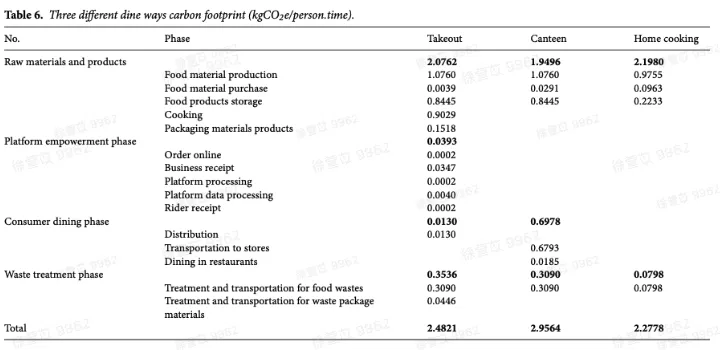
The stage with the highest carbon emissions for all three dining methods is the production of raw materials and products, which accounts for approximately 65.95% to 96.5% of total emissions. The main sources of emissions are the production of food raw materials, storage of food products, and cooking. From the industry-wide data, the carbon emissions from the storage and cooking processes of food products account for about 30% of the total emissions for dine-in and takeout services.
The research findings by Carbonstop and Southern University of Science and Technology provide effective evidence and data support for scientific carbon reduction. The study suggests that, concerning food procurement and preparation, businesses can use new energy-saving technologies and equipment; promote the adoption of energy-saving technologies and products in areas such as restaurant building decoration design, indoor air conditioning and lighting, and various equipment usage and water resource utilization to effectively improve energy efficiency and reduce emissions. Additionally, local sourcing of ingredients can reduce carbon emissions associated with the transportation of food materials.
We look forward to this research attracting more attention and discussion, contributing to the development of the catering industry and even the global sustainability cause.
Original article link 👉Research on carbon emissions of urban residents’ three types of dining based on the whole life cycle


