


 961
961Recently, the China Environmental Protection Federation released the Technical Guidelines for Food Carbon Footprint Evaluation (T/ACEF 072-2023), aimed at quantitatively assessing carbon emissions throughout the lifecycle of food products.
Carbonstop, as one of the main drafting entities, leveraged its extensive experience in carbon footprint quantification and professional guidance in areas such as food consumption and processing, providing constructive opinions and suggestions on carbon footprint calculations, data collection, and recommendations for greenhouse gas-related data.
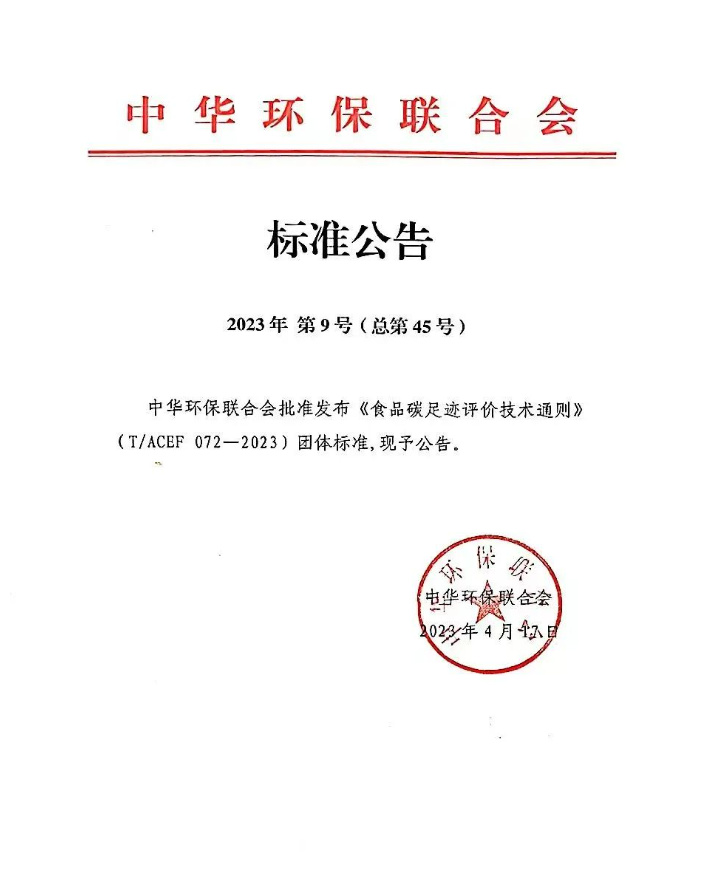
Greenhouse gas emissions from the entire food industry chain account for about one-quarter of the global total, making it an industry with high energy consumption and emissions. The existing international standards do not fully reflect the real situation in the life cycle of China's food industry, so it is necessary to develop targeted and operable food industry carbon footprint evaluation standards based on the basic conditions of China's food industry.
Carbonstop, as a global leading provider of carbon management software and consulting solutions, this time worked together with Beijing Technology and Business University, China Green Food Association, China Food and Drug Enterprise Quality and Safety Promotion Association, Institute of Food and Nutrition Development of the Ministry of Agriculture and Rural Affairs, China Agricultural University, Yili Group, COFCO, New Hope Group, Angang Yeast, Yuanqi Forest, Xiao Hudu Xian Liquor, Lee Kum Kee, and 22 other institutions and enterprises as co-drafting entities to draft and formulate the Technical Guidelines for Food Carbon Footprint Evaluation (T/ACEF 072-2023).
The release of these guidelines fills the gap in the standardization of food industry carbon footprint evaluation in China, providing a theoretical foundation and practical basis for carbon neutrality in food production, sales, and related industrial chains.
Carbonstop also hopes that by establishing a technical system and standards for carbon footprint evaluation related to food, it can promote the low-carbon transformation and upgrading of the food industry, while promoting green trade, guiding public low-carbon consumption, enhancing the green competitiveness of the food industry, and achieving green and sustainable development in the food industry.


