


 5530
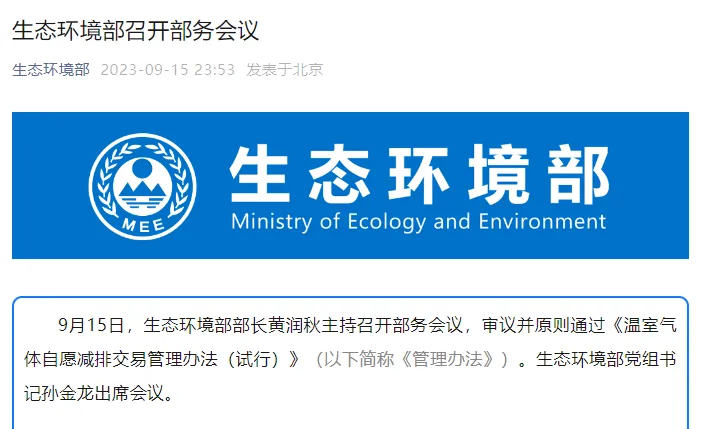
5530Late on September 15, the Ministry of Ecology and Environment announced a significant message on its WeChat official account: Minister of Ecology and Environment Huang Runqiu presided over a ministerial meeting, during which the Management Measures for Voluntary Greenhouse Gas Emission Reduction Trading (Trial) (hereinafter referred to as the Management Measures) was reviewed and approved in principle.
Although the draft for comments was released in July, the formal approval remains highly significant, as the Management Measures serve as the overarching document defining the basic framework of the voluntary emission reduction trading market (i.e., the CCER market). It acts as the guiding principles and action blueprint for the CCER market, and its approval signifies that the resumption of CCER is drawing closer.
01
/ Development of China's Voluntary Greenhouse Gas Emission Reduction Trading Mechanism /
2012
China began to establish a domestic voluntary carbon trading market, with the carbon credit being CCER (Chinese Certified Emission Reductions). The National Development and Reform Commission (NDRC) issued the Trial Management Measures for Voluntary Greenhouse Gas Emission Reduction Trading.
2015
The NDRC launched the voluntary emission reduction trading information platform, marking the beginning of the CCER trading phase.
March 2017
The NDRC indicated issues with CCER, including low trading volumes and some projects not being standardized, leading to the suspension of project registration, which has not yet been resumed.
December 2022
Director Li Gao of the Department of Climate Change under the Ministry of Ecology and Environment stated that China aims to improve the national carbon trading market and restart the CCER market as soon as possible.
March 2023
The Ministry of Ecology and Environment issued a notice soliciting suggestions for methodologies for voluntary greenhouse gas emission reduction projects, signaling the active advancement of the construction of a unified national greenhouse gas voluntary emission reduction trading market.
June 29, 2023
A routine press conference was held by the Ministry of Ecology and Environment. Spokesperson Liu Youbin stated that the construction of systems for CCER, selection of methodologies, and preparation of trading platforms are progressing smoothly, with expectations of a full resumption of CCER by the end of the year.
July 7, 2023
The Climate Department of the Ministry of Ecology and Environment released a notice soliciting public opinions on the Management Measures for Voluntary Greenhouse Gas Emission Reduction Trading (Trial), marking the first official management document text released after multiple signals from press conferences about the resumption of CCER.
August 17, 2023
The Beijing Green Exchange issued notices regarding the opening of accounts for the national voluntary greenhouse gas emission reduction trading system and arrangements for related trading services, stating that the system would begin accepting applications for registration and trading accounts.
September 15, 2023
Minister Huang Runqiu of the Ministry of Ecology and Environment presided over a ministerial meeting, during which the Management Measures for Voluntary Greenhouse Gas Emission Reduction Trading (Trial) was reviewed and approved in principle.
The competent authority has already sent strong signals, indicating that the resumption of CCER is imminent. The recently approved Management Measures for Voluntary Greenhouse Gas Emission Reduction Trading (Trial) has undergone significant revisions and optimizations compared to the previous Trial Management Measures for Voluntary Greenhouse Gas Emission Reduction Trading, aligning with the national direction of streamlining administration, delegating power, and improving services (SAS), and proposing clearer requirements for the supervision of relevant departments and the responsibilities of stakeholders.
02
/ Comparison Between Old and New Versions /
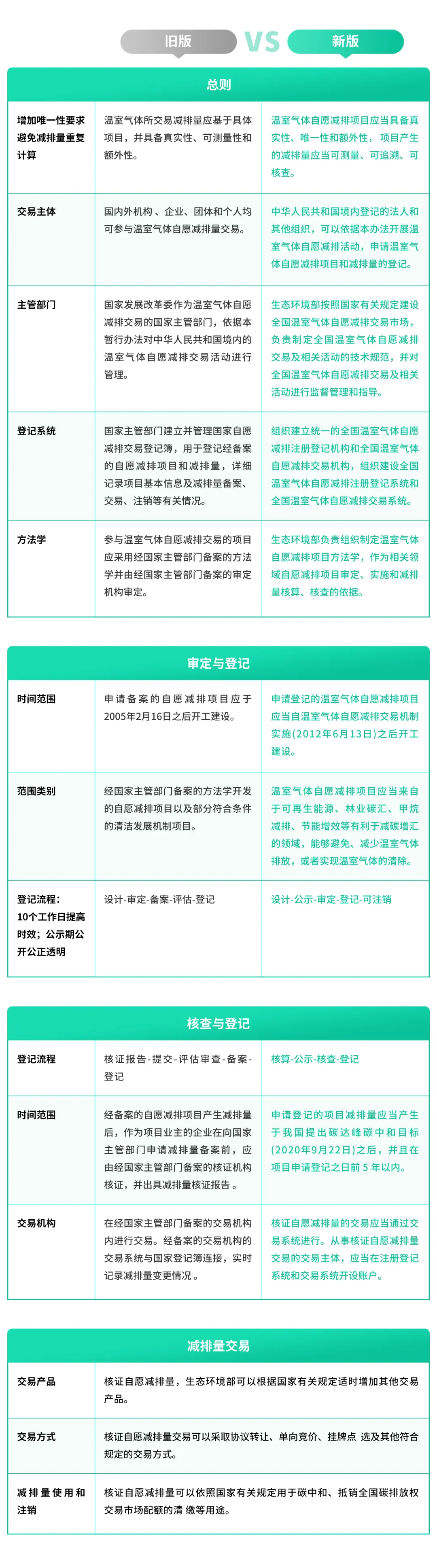
The management of verification and certification institutions has raised the entry threshold. In the old version of the Measures, only a certain number of auditors with rich experience in their audit fields and no adverse records were required. In the new version, specific requirements are given for the office premises, number and qualifications of auditors, audit management systems, and financial support capabilities of verification institutions. These measures help prevent weaker third-party verification institutions with insufficient professional capabilities from entering the market, thereby tightening control over project quality from the side.
03
/ Issues to Be Addressed /
Although the draft has optimized the management methods for the five registration matters of the original voluntary greenhouse gas emission reduction—methodologies, projects, emission reductions, verification and certification institutions, and trading institutions—many issues remain unresolved. For example, the institutional system of the voluntary emission reduction trading market needs further improvement, and supporting management systems such as project design and implementation norms, project verification and certification rules, and registration and trading rules still need to be published.
Methodologies are the foundation for designing and calculating voluntary greenhouse gas emission reduction projects and are the first step in developing CCER projects. They involve various types of reduction projects, such as renewable energy, forest carbon sinks, methane reduction, and energy efficiency improvements. The variety of methodologies has become the primary focus of the entire market.
Third-party verification institutions are a crucial link in the voluntary greenhouse gas emission reduction mechanism. To some extent, they hold the "power of life and death" over CCER projects and have the most direct impact on project quality control. Before and after the suspension of CCER in 2017, 12 institutions obtained third-party verification and certification qualifications. With changes in regulations, how verification institutions will adjust is also one of the main concerns of the industry.
04
/ Opportunities and Challenges for Enterprises /
Since the NDRC suspended the acceptance of CCER methodology, project, and emission reduction registration applications in 2017, CCER project development has been on hold for more than six years. As the countdown to resumption begins, it is a golden period that enterprises must seize.
An announcement for the "nation's first mangrove conservation carbon sink auction" was issued, with 3,875 tons of mangrove carbon credits to be publicly auctioned today. The starting price was 183 yuan per ton, and ultimately, a company in Shenzhen won the bid at 485 yuan per ton, setting a new record for domestic carbon credit prices. Despite the high price, many enterprises participated, demonstrating the market enthusiasm for mangrove carbon credits as a scarce resource.
Announcements for the "nation's first mangrove conservation carbon sink auction" were recently issued, with 3,875 tons of mangrove carbon credits to be publicly auctioned on September 26, starting at 183 yuan per ton. Even at this high price, many enterprises participated, showing the market enthusiasm for mangrove carbon credits as a scarce resource.
The national carbon market emission allowance CEA price achieved four consecutive monthly increases, with the latest price in September reaching a high of 75 yuan per ton. Trading volume has also grown alongside the price; data shows that combined CEA trading volumes for July and August exceeded 16 million tons, while the total trading volume for the first half of the year was only 8 million tons. The surge in both volume and price in the CEA market is due to the second compliance period of the national carbon market, and it also serves as a barometer for CCER prices, with current market prices ranging from 60 to 90 yuan per ton for different project types.
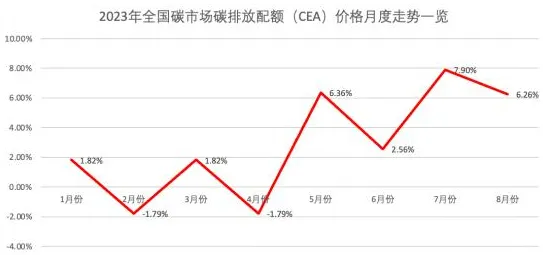
As a supplement to quota trading, CCER prices should theoretically be slightly lower than quota prices to be reasonable. It is predicted that the increase in supply after resumption will impact market prices, causing them to gradually fall below quota levels. However, in the short term after resumption, due to imbalances in supply and demand, CCER prices will likely remain high for a period. If enterprises can complete the preliminary work for their projects before resumption and register and issue the first batch of CCERs upon resumption, they can still complete transactions at optimal prices.
According to recent reports from informed sources, the Ministry of Ecology and Environment is reviewing and is expected to announce the first batch of voluntary greenhouse gas emission reduction methodologies soon, possibly including afforestation carbon sinks (including bamboo forests), mangrove restoration, grid-connected offshore wind power generation, and grid-connected solar thermal power generation. Projects that meet the criteria can now proceed with design and calculation work according to the methodologies.
While this is insider information, various signs suggest a high level of credibility. It also indirectly confirms that the competent authorities will control the scale of projects after resumption to prevent a large influx of CCERs from impacting the market. For other projects involving renewable energy, methane reduction, and energy efficiency improvements, there is no need to rush, as the formulation and publication of methodologies is an ongoing process. Another insider source suggests that the second batch of methodologies will be announced soon. Let us prepare and wait with anticipation.

At this point, everyone might boldly speculate: apart from methane reduction projects like livestock manure treatment and low-concentration coal mine gas utilization, and distributed photovoltaic projects rumored to be on hold, what other types of projects could resume within the year?
Regardless, for participants holding projects, it is essential to seize the opportunity, quickly identify and initiate preliminary development work to welcome the imminent resumption of CCER.
Carbonstop has been deeply involved in the carbon industry for 12 years, dedicated to promoting carbon emission management and carbon asset project development across industries. Through scientific carbon management solutions, we aim to empower enterprises to quantify and reduce emissions and gain carbon asset benefits. In the future, Carbonstop will actively participate in industry development and contribute to addressing climate change and achieving China's "dual carbon" goals through technological innovation.


