


 4950
4950On August 17, 2023, the "New Batteries Regulation" (NBR) officially came into effect. The regulation aims to impose mandatory requirements on almost all types of batteries placed on the EU market, covering indicators such as lifecycle carbon footprint disclosure, sustainability, safety, due diligence, battery passports, and waste battery management. This regulation is a significant outcome under the framework of the European Green Deal, promoting the circular economy through increased battery recycling and mandatory carbon footprint disclosure, thus advancing the EU's goal of achieving climate neutrality by 2050.
According to Article 7 and Annex II of the NBR, future electric vehicle batteries, rechargeable industrial batteries with a capacity greater than 2 kWh, and light mobility transport (LMT) batteries must disclose their product carbon footprint information to enter the EU market. The NBR stipulates that the calculation rules for battery carbon footprints must follow the latest version of the EU Commission's EU Product Environmental Footprint (PEF) method and relevant PEF Category Rules (PEFCRs), reflecting the latest technical and research advancements in life cycle assessment (LCA).
How will future power batteries change the world? Want to know how they obtain a "green passport"? This article will guide you through the European Product Environmental Footprint (PEF) to help battery-related professionals better cope with the impact of the EU's New Batteries Regulation.
01
/ Background of the EU PEF /
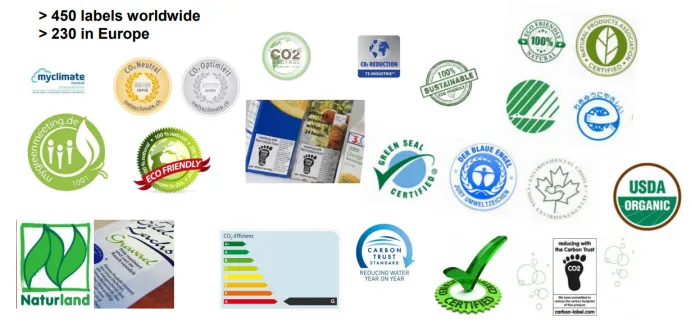
The EU PEF is a methodology system based on LCA used to quantify the environmental footprint of products (goods or services). The EU is one of the earlier regions to develop product carbon labeling, and in recent years, the market has seen a proliferation of carbon labels following different standards, with varied content and formats, adding extra certification costs for producers. The diversity of carbon labels also complicates consumer purchasing decisions (see Figure 1). To address this issue, the European Commission proposed the concept of assessing the product environmental footprint (PEF) to explore a common method for measuring the environmental footprint of products.
02
/ Development of the PEF /
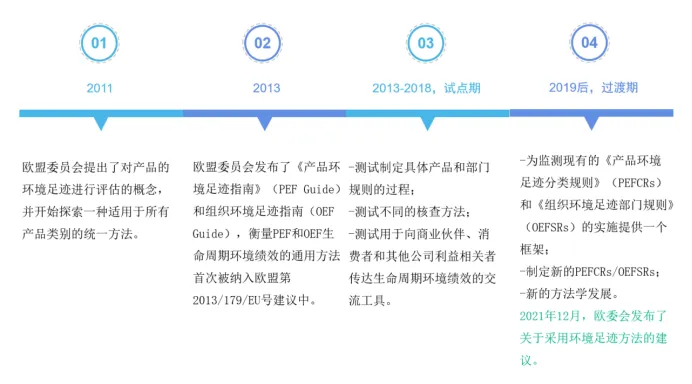
In 2013, the European Commission published the "Product Environmental Footprint Guide" (PEF Guide), which was first included in the European Commission Recommendation 2013/179/EU (see Figure 2). Subsequently, the European Commission initiated the PEF pilot phase, during which from 2013 to 2018, 19 PEFCRs were developed for different industry products and organizations, mostly consumer-oriented end products, including batteries, T-shirts, dairy products, pet food, etc. (see Figure 3). After 2019, the EU PEF entered the transition phase, with the main goal of developing a framework to monitor the implementation of existing PEFCRs and Organization Environmental Footprint Sector Rules (OEFSRs), while also developing new PEFCRs and OEFSRs. In December 2021, the European Commission issued a recommendation ((EU) 2021/2279) on using the environmental footprint method to assess the environmental performance of products and organizations throughout their lifecycle, recommending that the PEF method be adopted when the EU formulates public policies based on LCA.
03
/ Main Content of the PEF /
Characteristics and Principles:
The EU PEF is an independent set of rules established for products and services in the EU market based on the LCA concept, designed to evaluate the full lifecycle environmental footprint. The EU has developed specific category rules (PEFCRs) for particular product categories, selecting representative products for each category and setting benchmarks to represent the average environmental performance of those products in the EU market. The EU PEF adheres to five principles: relevance, completeness, consistency, accuracy, and transparency.
Research Methodology:
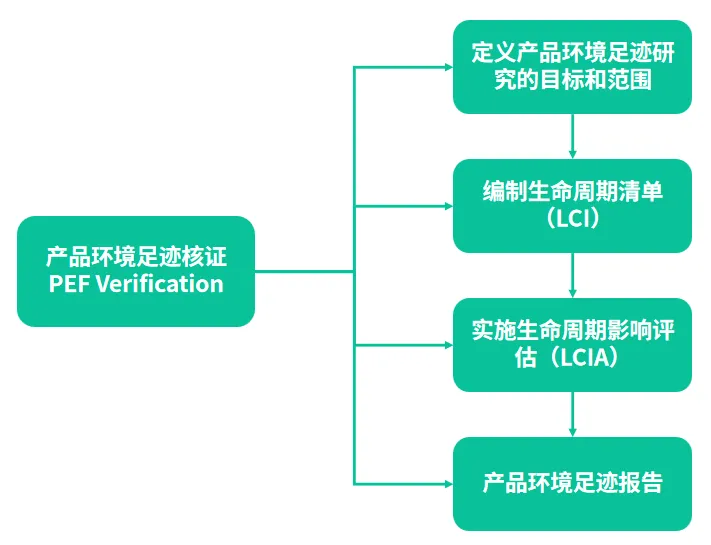
The EU PEF research methodology is largely consistent with other LCA-based methodologies, including steps such as defining scope and objectives, lifecycle inventory analysis, lifecycle impact assessment, interpretation of PEF results, and PEF reporting (see Figure 4).
System Boundaries:
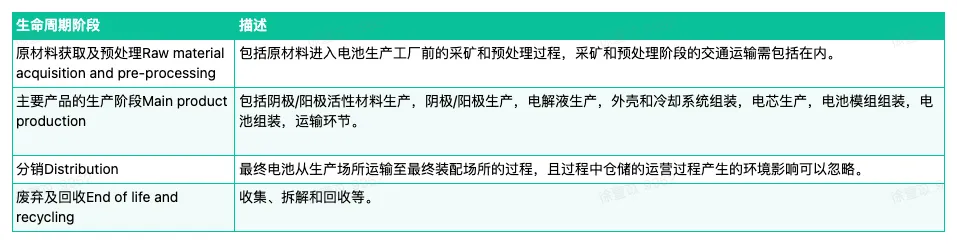
When conducting lifecycle studies using the EU PEF methodology, the system boundaries follow the conventional product supply logic, including five stages: raw material acquisition and pre-treatment, production and manufacturing, distribution, use, and end-of-life treatment. According to the "Suggestions for Updating the Product Environmental Footprint (PEF) Method" published by the Joint Research Centre (JRC) of the EU in 2019, whether the use phase should be included in the PEF study depends on whether the use phase is independent of the product. In the context of the new EU Battery Regulation, when conducting lifecycle carbon footprint studies for battery products, since battery usage is not directly influenced by manufacturers, the use phase need not be considered unless there is evidence that design choices made by the manufacturer significantly impact this phase (see Table 1).
In the PEFCRs of various products, detailed research contents for each lifecycle stage are specified. By default, the PEF study follows a cradle-to-grave approach, and any deviation from the default "cradle-to-grave" method should be clearly defined and justified, such as excluding the use phase or end-of-life phase of intermediate products.
Environmental Impact Categories:
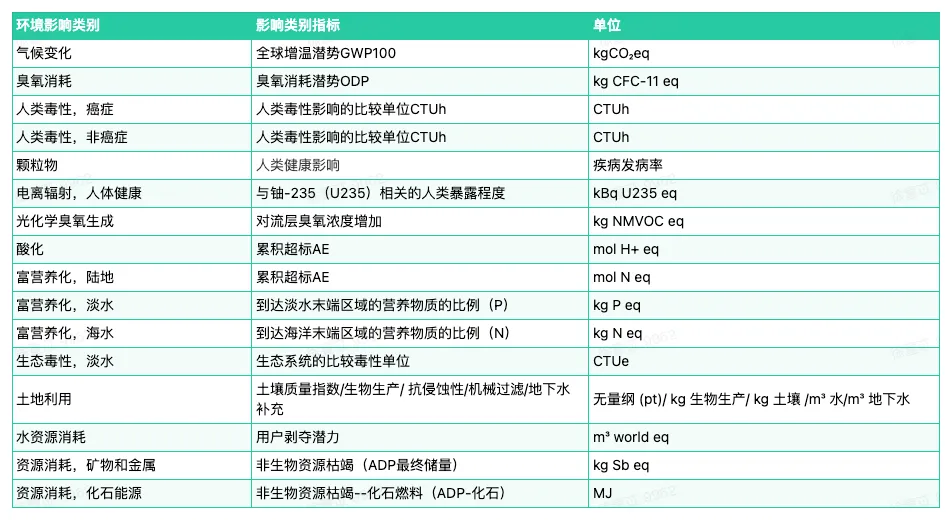
The EU PEF studies the environmental impacts of the full lifecycle of products, considering 16 environmental impact categories closely related to the environmental impacts of the product supply chain, including climate change and eutrophication. Additionally, the EU is considering incorporating biodiversity into the environmental impact categories of the PEF study (see Table 2). In the PEF study, the results of the environmental impact assessment are processed through characterization, normalization, and weighting to obtain a dimensionless single value representing the magnitude of the product's environmental impact, with smaller values indicating better environmental performance (see Figure 5). Characterization is a mandatory step, while normalization and weighting are optional.
The new EU Battery Regulation requires the disclosure of only the product carbon footprint among the environmental impact categories, and the assessment method for this impact aligns with the results of the IPCC Sixth Assessment Report (AR6), reported in units of gCO₂eq/kWh.
Database and Data Quality Requirements:
The EU has developed a mandatory LCA background dataset for free use by implementers of the EU PEF study, currently updated to version EF 3.1. When conducting a PEF study, if no matching official dataset is available, project implementers may prioritize alternative datasets compliant with the EU environmental impact method standards (EF-compliant proxies), followed by alternative datasets compliant with the International Life Cycle Data System ILCD entry-level standards (ILCD EL compliant proxies). If neither of these alternatives is available, the process should be excluded from the modeling.
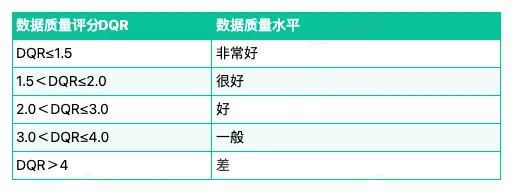
Data quality in the EU PEF study requires semi-quantitative assessment. On the basis of data completeness and appropriate and consistent methodology, data quality is evaluated from four dimensions: technical representativeness, geographical representativeness, temporal representativeness, and precision, resulting in a five-level data quality assessment (see Table 3).
04
/ Concept Clarification /
When conducting product carbon footprint studies, it is often easy to confuse concepts such as LCA, PEF, PEFCR, EPD, and PCR. Here, we attempt to clarify these concepts.
- Lifecycle Assessment (LCA): A method for investigating and evaluating environmental loads and assessing the overall environmental impact of a product (good or service) from "cradle to grave."
- Product Environmental Footprint (PEF): An EU-developed methodology based on the LCA concept for quantifying the full lifecycle environmental impact of a product.
- Product Environmental Footprint Category Rules (PEFCRs): Detailed rules for environmental footprint analysis of specific product categories under the PEF system.
- Environmental Product Declaration (EPD): A Type III environmental declaration based on ISO 14025, which comprehensively evaluates the environmental impact of a product throughout its lifecycle based on the LCA concept.
- Product Category Rules (PCR): A set of specific rules, requirements, and guidelines for developing Type III environmental product declarations and carbon footprint information for one or more product categories.
Overall, both PEF and EPD are methods for quantifying environmental impacts based on the LCA concept. An EPD is a disclosure document based on LCA that describes the environmental information of a product, while PEF is a methodology for implementing LCA studies. PEFCR is the detailed guideline for conducting PEF studies for specific products under the PEF system. The EPD system has stronger commercial attributes and a broader application range, while the PEF system is more commonly used in EU policy-making.
05
/ Industry Observations and Recommendations /
The EU's product environmental footprint initiative started relatively early, and after over a decade of development, the PEF has established a methodological guide and 19 PEFCRs for specific product categories, built a background dataset suitable for PEF studies, and established a data quality control method. In 2021, PEF became the recommended method for the EU to formulate public policies related to environmental footprints. Today, the new EU Battery Regulation requires batteries entering the EU market to disclose their product carbon footprint information, elevating the calculation of product carbon footprints from a recommended practice to a compliance requirement.
In the context of frequent global trade, the tightening of the EU's product carbon footprint policies also affects multiple industries in China, with the battery industry directly impacted by the new EU Battery Regulation. Other emerging industries in China that have gained a competitive edge globally, such as photovoltaics and electric vehicles, have also been affected. Related companies are actively building capabilities in corporate carbon inventories, product carbon footprint assessments, system construction, and information systems. During this process, there may be some overly advanced layouts, such as companies hoping to meet the requirements of different systems like PEF and EPD simultaneously, necessitating the evaluation of more than ten environmental impacts.
Carbonstop believes that climate change is a global hot topic, and Chinese companies strengthening carbon management and conducting product carbon footprint and corporate carbon inventory assessments not only meet specific market compliance requirements but also enhance product competitiveness. We recommend that battery-related companies stay updated on policy dynamics in export markets, strengthen corporate and product carbon management, organize and manage the data needed for product carbon footprint calculations, build capabilities, and avoid unnecessary panic, gradually adapting to the impact of the new EU Battery Regulation.


