


 2315
2315On July 30, the Ministry of Ecology and Environment released a letter soliciting public opinions on the Methodology for Voluntary Greenhouse Gas Emission Reduction Projects - Utilization of Low Concentration Methane and Ventilation Air Methane from Coal Mines and the Methodology for Voluntary Greenhouse Gas Emission Reduction Projects - Energy Saving of Highway Tunnel Lighting Systems. This indicates that the second batch of CCER methodologies is coming soon. Adding to the four methodologies already released in the first batch—grid-connected solar thermal power generation, grid-connected offshore wind power generation, afforestation carbon sink projects, and mangrove restoration—there are now six sectors where CCER projects can be developed. Let's take a look at how these two new types of projects can earn money from "carbon assets."
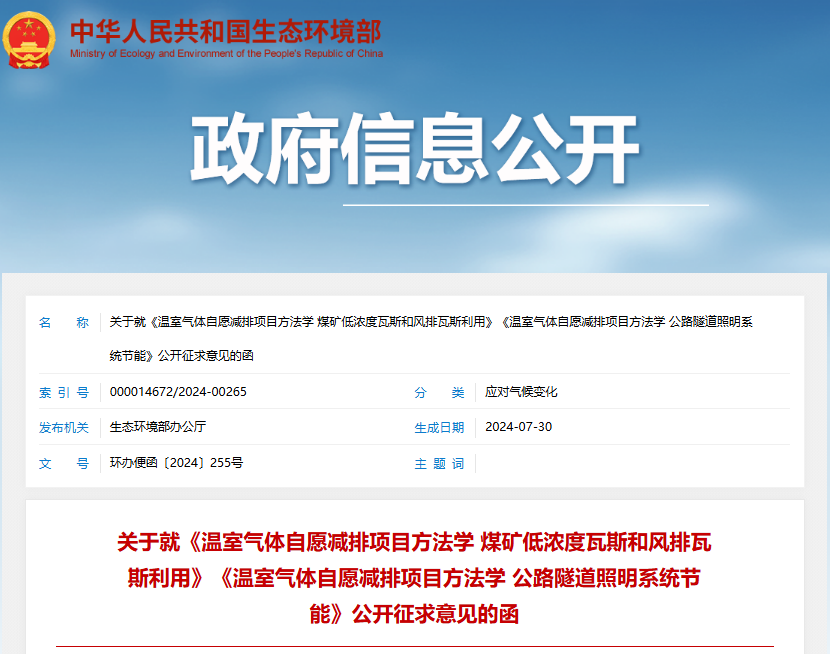
The two methodologies currently open for comments belong to two different industry sectors: Utilization of Low Concentration Methane and Ventilation Air Methane from Coal Mines falls under methane reduction and can be categorized as fugitive emissions from fuels (solid, oil, and natural gas); Energy Saving of Highway Tunnel Lighting Systems pertains to energy savings in the transportation sector, expanding the scope of industries covered by CCER projects.
Utilization of Low Concentration Methane and Ventilation Air Methane from Coal Mines
The direction of coal mine methane recovery and utilization has always been highly anticipated and is one of the most called-for sectors to be included in the second batch of CCERs.
Methane is the second-largest greenhouse gas after carbon dioxide, with a high warming potential and a short lifespan, contributing about half of the global temperature increase. Coal mine methane escape emissions are the main source of anthropogenic methane emissions in China, accounting for approximately 40% of the country's total methane emissions. The utilization of coal mine methane is the primary approach for reducing coal methane emissions. Currently, coal mine methane with a concentration higher than 30% can be directly used for residential and industrial gas, compressed natural gas (CNG), and power generation. Methane with a concentration between 8% and 30% can be used for internal combustion engine power generation, which is economically viable. Methane with a concentration lower than 8%, along with ventilation air methane, can be destroyed using flameless oxidation technology, with the heat generated used for power generation. However, this process is costly and economically unattractive, still in the demonstration project stage.
The recently announced methodology for the utilization of low concentration methane and ventilation air methane applies to coal mine methane with a methane volume concentration of no more than 8% and ventilation air methane. Flameless oxidation projects for coal mine methane are still in the early stages of industrial development, with high project investment costs and no scale effect. Currently, there are only about 20 operational flameless oxidation projects for coal mine methane in the country, all of which have yields below the industry benchmark yield of 13%, making them economically unviable. Therefore, this methodology adopts a waiver of additionality argumentation, which is very beneficial for applications of such projects.
Applicable Project Types:
The flameless oxidation of methane with a volume concentration of no more than 8% from coal mines and ventilation air methane mainly includes two technical routes, both of which can be developed:
a) Collecting ventilation air methane and destroying it through flameless oxidation, or using the heat generated from destruction for power generation;
b) Mixing methane with a volume concentration of no more than 8% from coal mine extraction pump stations with collected ventilation air methane and/or air, then destroying it through flameless oxidation, or using the heat generated from destruction for power generation.
Energy Saving of Highway Tunnel Lighting Systems
The announcement of the methodology for energy saving in highway tunnel lighting systems, which belongs to the transportation sector, was almost unexpected by everyone because the involved business groups are relatively small. However, for companies with relevant industry resources, this is definitely an opportunity to seize.
Tunnel lighting systems are key systems for ensuring vehicle safety and the safe operation of highway tunnels, and they are also the main energy-consuming components of highway infrastructure. According to public data estimates, China's highway tunnels consume approximately 10.67 billion kWh of electricity annually, with lighting systems accounting for 60% to 80% of this consumption. To promote the use of high-efficiency lighting lamps and intelligent lighting control systems in tunnel lighting systems, thereby improving energy efficiency and reducing greenhouse gas emissions, the adoption of high-efficiency tunnel lighting lamps and intelligent lighting control systems aligns with policy guidance and has significant emission reduction effects. Based on survey results, it is estimated that after the release of this methodology, the annual emission reduction from projects could be around 3 million tons of CO₂, increasing to 10 million tons of CO₂ by 2030.
Currently, in tunnel lighting system projects being upgraded or newly constructed, tunnels equipped with high-efficiency tunnel lighting lamps with an initial efficacy of over 150 lm/W account for less than 10% of the total, and the cost is more than 20% higher than the commonly used lamps with an initial efficacy of 120 lm/W. If an intelligent lighting control system is adopted, additional lighting control cabinets and front-end sensing units need to be installed, increasing the cost by 10% to 30% compared to tunnels without such systems, significantly higher than the current mainstream technology. Therefore, the additionality of projects meeting the requirements of this methodology is also exempt from argumentation.
Applicable Project Types:
This methodology applies to new construction or renovation projects of lighting systems in single or multiple highway tunnels.
The main requirement is the use of high-efficiency tunnel lighting lamps with an initial efficacy of no less than 150 lm/W and no less than the initial efficacy grade I specified in Highway LED Lighting Lamps Part 2: Highway Tunnel LED Lighting Lamps (JT/T 939.2).
Conclusion
According to data from the National Energy Administration, China currently has more than 4,200 coal mines, with low-concentration methane coal mines mainly distributed in Shanxi, Shaanxi, and Inner Mongolia. These regions are rich in coalbed methane resources, providing a solid foundation for coal mine methane utilization projects. Considering CCER revenue, such projects have the potential to recover costs within a year, so it is foreseeable that low-concentration methane utilization projects will soon become a hot investment area.
Tunnel lighting projects are somewhat mysterious, typically operated by highway tunnel maintenance companies. If you have friends familiar with such projects, feel free to call and discuss!
If you have projects related to the above and are unsure how to apply, please contact Carbonstop. Carbonstop is dedicated to serving you wholeheartedly!


