


 979
979Recently, Carbonstop, in collaboration with the Hangzhou E-Commerce Association, Beijing Entrepreneurs Environmental Foundation, Alashan SEE Jiangnan Project Center, Break Free From Plastic, Toxin-Free Pioneer, Natural Fields, Return to Wilderness, China Environmental Protection Federation, Business for Social Responsibility, and MioTech, jointly released the“Green E-Commerce Action Guide - Environmental Impact and Countermeasures of China's Retail E-Commerce” (hereinafter referred to as the "Guide")

"Green E-Commerce Action Guide - Environmental Impact and Countermeasures of China's Retail E-Commerce"
In the past 20 years, China's e-commerce industry has experienced rapid growth. Data shows that the number of online shopping users in China has reached 782 million, accounting for 79.1% of all internet users. By 2020, the online retail sales of physical goods in China accounted for about one-quarter of the total retail sales of consumer goods, making online shopping an important channel for resident consumption. However, along with this rapid development, the carbon emissions and environmental impacts of the e-commerce industry have become increasingly significant and cannot be ignored.
According to Carbonstop's estimates, the total carbon emissions from China's e-commerce companies in 2019 were 53.26 million tons, accounting for 2.5% of the total emissions from the tertiary sector. Moreover,the total carbon emissions from e-commerce are expected to grow rapidly over the next five years, reaching 116 million tons by 2025, a growth rate of 73%. As other industries intensify their efforts towards low-carbon transitions, if the e-commerce industry does not take effective measures, its incremental emissions during the 14th Five-Year Plan period could account for one-quarter of the national increment.
The "14th Five-Year Plan for the Development of E-Commerce" points out that e-commerce companies should proactively adapt to green and low-carbon development requirements, actively fulfill their social responsibility for environmental protection, and enhance their level of green innovation. The "Notice on Promoting Green Development of E-Commerce Enterprises" issued by the Ministry of Commerce in 2021 detailed the requirements for green development in e-commerce: fromenergy efficiency improvements, strengthening the construction of green data centers, promoting the greening of courier packaging, reducing and replacing single-use plastic products, expanding the sales of green products, and guiding green consumption, the notice requires e-commerce platforms to establish a sense of primary responsibility for environmental protection and to regard environmental protection and sustainable development as fundamental principles for business operations.
Based on policy requirements and investment trends, to better support retail e-commerce companies in taking targeted green actions, the "Green E-Commerce Action Guide - Environmental Impact and Countermeasures of China's Retail E-Commerce" was born.
The guide outlines the environmental impacts of retail e-commerce, including climate change, solid waste and circular economy, chemical management, biodiversity protection, and sustainable diets, and provides targeted action recommendations for each impact dimension based on domestic and international policy guidance and industry best practices. The aim is to help retail e-commerce companies comprehensively identify their environmental impacts and assist them in setting environmental performance goals and tracking implementation at the strategic level.
The report points out thatin terms of climate change, retail e-commerce companies should start from data centers, office buildings, logistics transportation, packaging, warehousing, and suppliers, setting comprehensive carbon reduction and carbon neutrality goals (Scope 1, 2, and 3) and clearly defining reduction pathways and timelines.
Furthermore, the guide indicates that compared to Scope 1 and 2,Scope 3 emissions (note: referring to carbon emissions throughout the e-commerce value chain) are the main source of emissions for e-commerce companies. In Scope 3 emissions, the procurement of products and services and the transportation and use of physical goods are the largest sources.
The guide reminds that whether addressing climate change or other environmental issues, retail e-commerce platforms, as the core of the platform ecosystem, should fulfill their environmental responsibilities within the ecosystem. They should leverage their influence and innovation capabilities to trigger reduction actions and positive changes throughout the value chain (Scope 3).
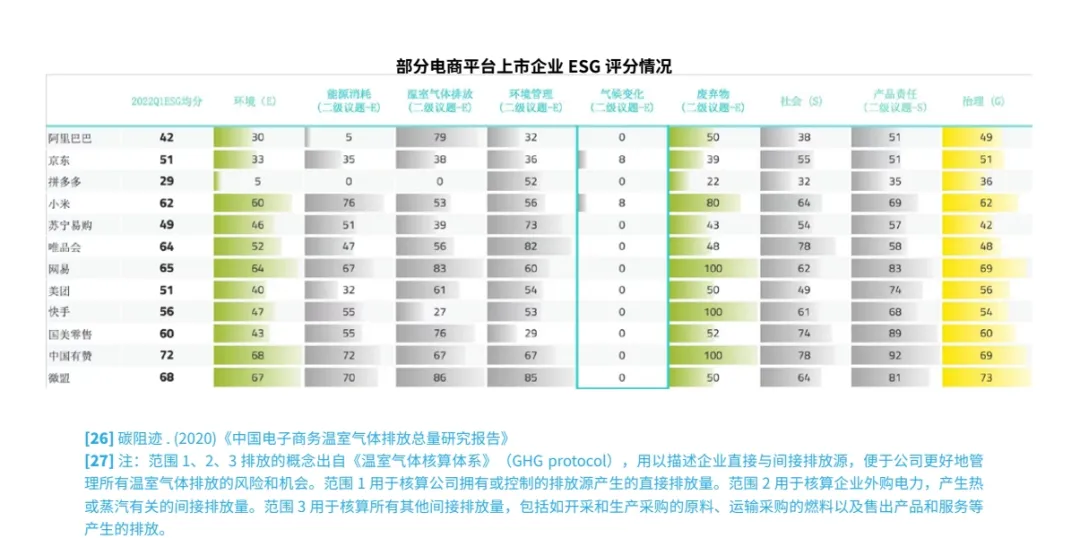
Currently, domestic e-commerce companies such as Alibaba and JD Logistics have set certain Scope 3 reduction targets to some extent. Meanwhile, mainstream foreign e-commerce companies, including Amazon, Target, Zalando, and ASOS, have disclosed their Scope 3 emissions and incorporated them into their corporate reduction targets to varying degrees.
Carbonstop has been deeply involved in the fields of corporate carbon management and carbon neutrality for many years, and these innovative initiatives are supported by a strong foundation. Prior to this,the Carbonstop team conducted in-depth research on e-commerce companies, evaluating the total carbon emissions of the industry and comparing the carbon emissions of online and offline shopping, and released the "Report on Total Greenhouse Gas Emissions of China's E-Commerce Companies" and the "Report on Comparison of Online and Offline Greenhouse Gas Emissions," providing scientific guidance for the green and low-carbon transition of the e-commerce industry.
To date, Carbonstop has served leading retail e-commerce clients such as Alibaba, Meituan, and JD with its advanced carbon neutrality methodology CREOS and technological innovations. Additionally, Carbonstop, in collaboration with the Hangzhou E-Commerce Association, Beijing Entrepreneurs Environmental Foundation, Alashan SEE Jiangnan Project Center, and 19 other public welfare organizations, industry associations, and enterprises, initiated the "Harnessing Platform Power to Achieve Dual-Carbon Goals - Initiative for Retail E-Commerce Platforms to Actively Practice Green Development," proposing nine initiatives, including setting comprehensive environmental and sustainability goals.
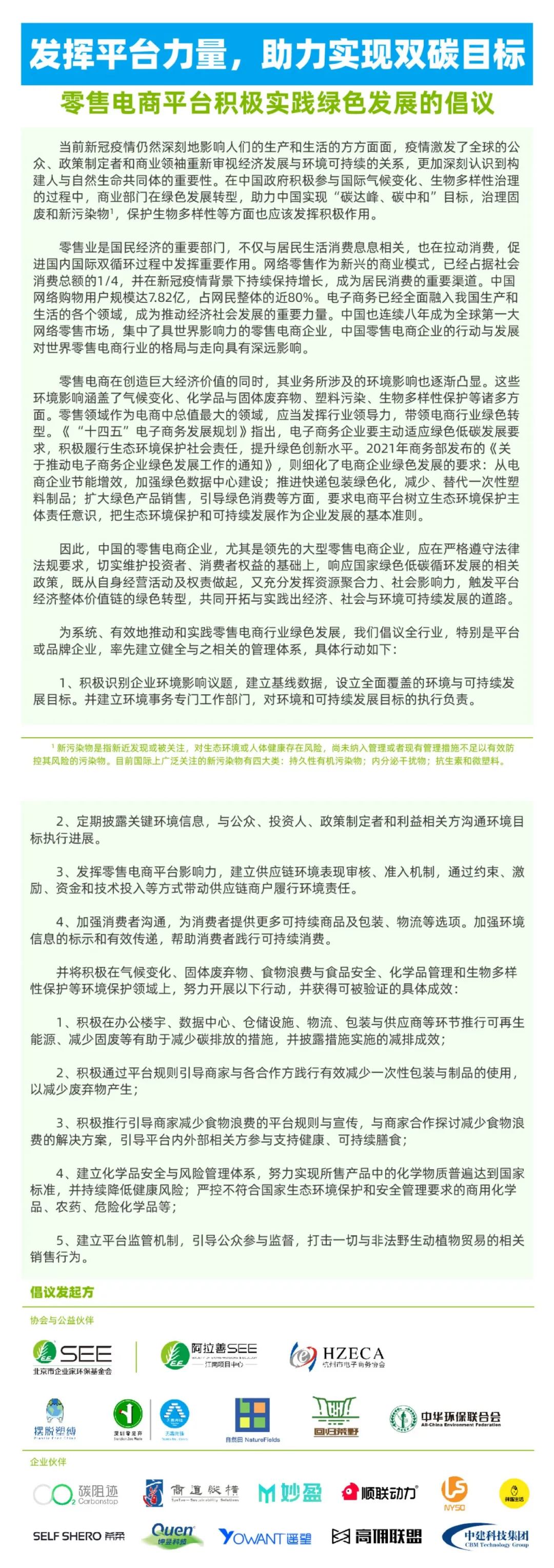
"Harnessing Platform Power to Achieve Dual-Carbon Goals - Initiative for Retail E-Commerce Platforms to Actively Practice Green Development"
The green and low-carbon transition of enterprises is a complex and long-term project that requires not only the cooperation of multiple technical forces but also continuous innovation. Carbonstop practices the concept of "making every product have a carbon footprint" and collaborates with more ecosystem partners to continuously deepen carbon management technology and solution innovation, promoting the low-carbon and sustainable development of more retail e-commerce companies.


