


 732
732Danone has a clear and resolute carbon reduction roadmap: In 2008, it initiated carbon footprint investigations globally; in 2019, it achieved carbon peak; and by 2050, it aims to achieve carbon neutrality across its entire value chain.
Time speaks volumes without words. From 2008 to 2022, Danone has steadily progressed toward its commitments.
On April 20, 2020, Evian, a mineral water brand under Danone, announced that it had obtained global carbon neutrality certification, implementing emission reduction measures at every stage of product creativity, production, and recycling use.

Image Source: Danone
This issue, Carbonstop's Consumer Brand Special Session invites Juncai Wu, General Manager of Danone Greater China, to share the secrets behind Danone's sustainable development practices.
01
Playing a 'Hub' Role to Drive Upstream and Downstream Emission Reductions
Carbonstop: As a fast-moving consumer goods (FMCG) company, why did Danone start its sustainable development journey as early as 2008? What was the initial motivation?
Juncai Wu: The carbon emissions of the FMCG industry are relatively low, but indirect emissions from our upstream supply chain are high. The FMCG industry acts as a hub; we can drive upstream suppliers to participate in carbon reduction while encouraging downstream consumers and employees to get involved. The impact of these actions cannot be overlooked.
All these efforts aim to make consumers feel the warmth of Danone. Simultaneously, for a company to sustain, it must build brand strength, which requires not only economic value but also the creation of social value.
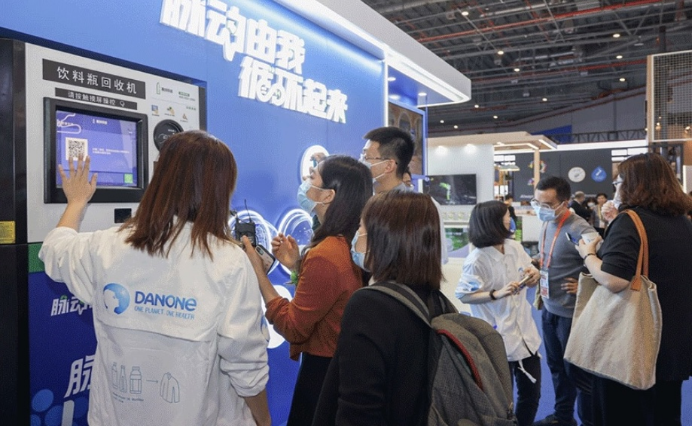
Image Source: Danone
Carbonstop: It is understood that Danone's energy-saving and emission reduction concepts influence both upstream and downstream. Does Danone have any strong requirements for its upstream suppliers?
Juncai Wu: Driving suppliers to reduce emissions is a long-term process. In Europe, we have a mature green supply chain model and framework, encouraging upstream suppliers to join environmental actions. In China, we encourage and support upstream suppliers to participate in environmental actions, such as providing relevant training, participating in environmental information disclosure, and gradually progressing together. During this process, we found many suppliers to be very excellent, actively participating in environmental and carbon reduction activities.
02
Balancing Internal and External Efforts to Tackle Carbon Neutrality Challenges
Carbonstop: What do you think are the biggest challenges Danone faces in creating carbon-neutral products and transitioning to green and low-carbon development? How does Danone address these challenges?
Juncai Wu: First, when we started carbon footprinting in 2008, carbon tracking and carbon footprinting were very mature in Europe, but it was a completely new field in China.
At that time, we had to use Excel spreadsheets for carbon footprinting, which required a lot of manpower and effort. Today, our carbon footprinting has become systematic, providing historical data support when companies seek carbon neutrality certification, and helping companies better reduce emissions.
Second, carbon neutrality is a long-term process, and we need to balance short-term investments with medium- to long-term benefits.
Initially, significant resources and efforts may not yield immediate results, leading to conflicts. We need to find a balance between enhancing brand benefits and consuming company resources, achieving a win-win situation at this balance point.
For example, the weight of the Volvic bottles has been reduced by 40% compared to before, reducing procurement costs and improving company efficiency. We found excellent designers to improve the bottle manufacturing process, ensuring aesthetics while maintaining consumer experience, thereby reducing emissions and boosting company performance.
Finally, and most importantly,companies need to have a long-term mission. Danone, with over 100 years of development background, has experience balancing short-term and medium-to-long-term goals, setting phased objectives, and moving forward step by step according to environmental developments.
Carbonstop: For traditional industries transitioning from 0 to 1 in low-carbon development, what should be the primary focus?
Juncai Wu: I believe this depends on the industry. For example, for consulting firms, whose emissions are relatively low, reductions can be achieved by changing employee travel methods from flights to high-speed trains and choosing office buildings certified for carbon emissions, which can also have a significant effect on carbon reduction.
In the early stages of carbon reduction, companies will encounter many opportunities, such as improving energy efficiency, optimizing boiler usage during lower production cycles, which can reduce emissions while lowering costs.


