


 1539
1539/ Carbon Insight/
Standing on the shoulders of giants allows us to see further.
/Carbon Insight/ is a series of "Best Practices in Carbon Management" by Carbonstop. We aim to help enterprise managers gain a comprehensive understanding of carbon management practices, concepts, and methods from leading domestic and international companies by dissecting advanced carbon neutrality case studies, helping them avoid unnecessary detours on their path to carbon neutrality.
In September 2021, Procter & Gamble (P&G) announced its "Net-Zero 2040 Goal"—to achieve net-zero greenhouse gas emissions across global operations and the supply chain (from raw materials to retail) by 2040. Additionally, P&G set science-based interim targets for 2030, aiming to make significant progress within a decade. By 2030, compared to the 2010 baseline, P&G plans to reduce Scope 1 and Scope 2 emissions by 50%, and decrease carbon emissions per unit of production in key categories of the supply chain by 40%. The company aims to achieve net-zero emissions by 2040.
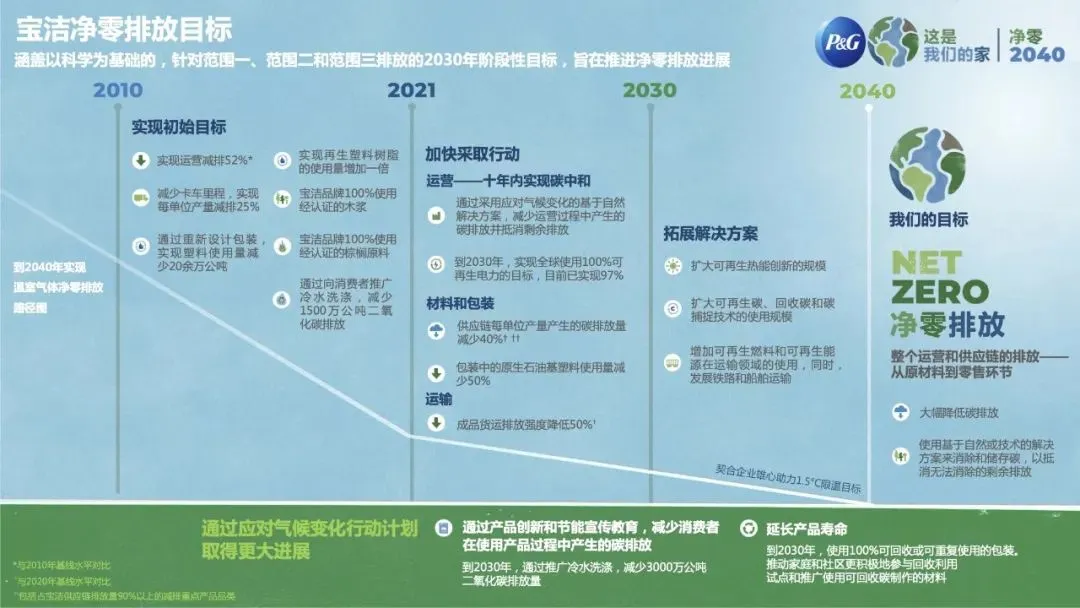
Source: Procter & Gamble's Climate Transition Action Plan
After analyzing numerous companies that have proposed carbon neutrality strategies, Carbonstop has distilled the CREOS pathway for enterprises to achieve carbon neutrality. This article analyzes and explores P&G’s carbon neutrality implementation path based on the CREOS methodology for corporate carbon neutrality.
01 Calculating(Calculation)
"Quantifying carbon emissions is always the top priority in carbon emission management."
P&G calculated its Scope 1 and Scope 2 greenhouse gas emissions for the fiscal year 2021. Scope 1 emissions (2.242 million metric tons) were more than 14 times higher than Scope 2 emissions (156,000 metric tons). Notably, the highest proportion of greenhouse gas emissions came from P&G’s Baby, Feminine, and Family Care business.
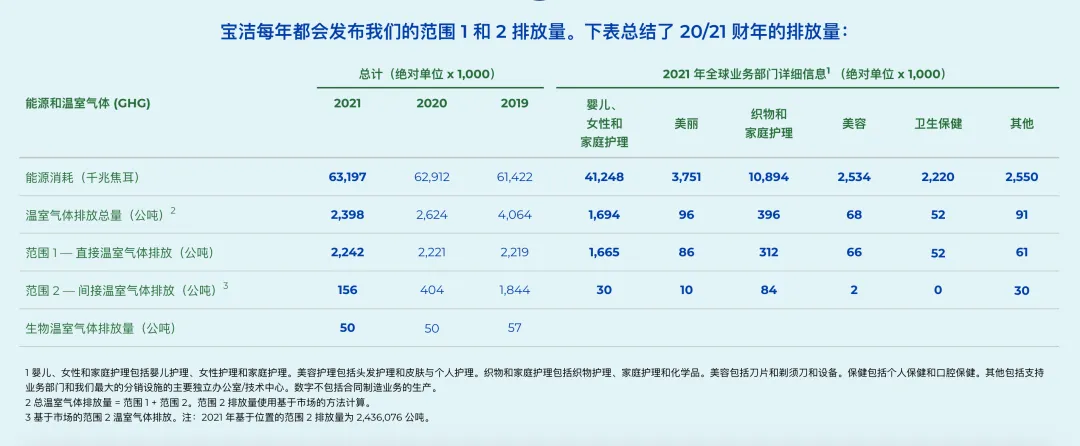
Source: Procter & Gamble's Official Website
02 Reducing(Reduction)
"After setting carbon neutrality goals and quantifying carbon emissions, the first step for enterprises should be to identify carbon 'hotspots' and reduce emissions as much as possible."
At the operational level, P&G primarily reduces emissions through technological innovation. Specific measures include:
Accelerating the use of renewable electricity:By 2030, P&G aims to achieve 100% renewable electricity usage globally, with 97% of this goal already met. In 2021, the U.S. Environmental Protection Agency ranked P&G fifth on the list of the top 100 green power users in the United States and second on the list of the top 30 national on-site renewable energy generators, leading the consumer goods industry.
Maximizing the use of renewable thermal energy:P&G uses geothermal, solar, and renewable steam in some of its production bases. Additionally, P&G is collaborating with the World Wildlife Fund, manufacturers, and local governments to develop a Renewable Thermal Collaborative (RTC), identifying and promoting cost-competitive renewable thermal energy solutions.

Image Source: Procter & Gamble China WeChat Official Account
Additionally, in the supply chain, P&G focuses on green logistics and supply chain decarbonization.
Building green logistics:P&G has built an efficient e-commerce logistics network using big data and AI, reducing the distance between products and consumers to just one delivery person. P&G also launched the "Beautifully Responsible, Reborn" project with JD Logistics, recycling and repurposing discarded plastic bottles into diverse eco-friendly products. For packaging, P&G uses direct-to-consumer packaging like "Little Green Treasure" and "Big Green Treasure," effectively reducing carbon emissions from packaging.
Supply chain decarbonization: To achieve a 50% increase in upstream finished goods freight emission efficiency by 2030, P&G will explore various feasible strategies, including increasing rail and ship transport, using alternative fuel trucks, and optimizing delivery routes. Over the past five years, greenhouse gas emissions from the production process of Pampers raw materials have been reduced by approximately 1 million metric tons.
Promoting low-carbon technology, materials, and packaging:P&G is advancing innovations in renewable materials, bio-based materials, and recyclable carbon materials for brands like Head & Shoulders, Pantene, Ariel, Tide, and Pampers. The company aims to ensure that all product packaging is 100% recyclable or reusable by 2030 and to reduce the use of petroleum-based plastics in packaging by 50% by 2030. Many of P&G's laundry brands have introduced refill systems to encourage the reuse of packaging bottles.
Exploring carbon capture technology:Tide is collaborating with Silicon Valley startup Twelve to explore carbon capture technology, incorporating components extracted from CO2 into the production process of Tide products.
03 Engaging(Engagement)
"For most companies, besides reducing their own emissions, engaging internal members and ecosystem partners to reduce emissions together is where the real value lies."
P&G works to engage employees, consumers, and the industry in practicing low-carbon behaviors, leading the industry toward low-carbon sustainable development.
Engaging consumers in carbon reduction:Tide and Ariel have improved detergent formulas to enhance cold water washing efficiency, successfully reducing the largest portion of their carbon footprint—carbon emissions from hot water used during product use—by about 15 million metric tons. They will continue to promote energy-saving education, encouraging people to wash clothes with cold water to help reduce carbon emissions by another 30 million metric tons by 2030.
Engaging employees in low-carbon practices:P&G provides sustainability education to employees at all levels, encouraging them to contribute to sustainability efforts and incorporating it into individual performance evaluations. This empowers every P&G employee to apply sustainable thinking and practices in both work and community activities.
Leading the industry in solving recycling challenges:P&G joined the Ellen MacArthur Foundation's New Plastics Economy Global Commitment and plays a leading role in addressing the low sorting efficiency at material recovery facilities—one of the biggest challenges in material recycling.
04 Offsetting(Offsetting)
"For unavoidable carbon emissions, companies can choose to offset them by planting trees or purchasing carbon credits, achieving 'zero emissions'."
To meet its 2030 operational carbon reduction targets, P&G is actively promoting nature-based solutions (NCS) to offset residual emissions that cannot be eliminated by 2030. This includes new projects aimed at protecting and restoring forests and other ecosystems crucial to humans and wildlife.
05 Spreading(Spreading)
"After setting carbon neutrality goals and pathways, companies should start spreading the message early to have a greater impact on the industry."
Leveraging its marketing advantages as a consumer brand giant, P&G actively promotes environmental living concepts through exhibitions, celebrity endorsements, and advertising campaigns.
The "Beautifully Responsible" Environmental Project:Launched in 2020, the "Beautifully Responsible" project is a long-term environmental initiative by P&G's Beauty & Grooming division. On World Environment Day this year, P&G introduced "Waste to Beauty," transforming recycled plastic into unique artworks, giving再生塑料充满艺术性和生命力的“重生”,用艺术和美的力量影响更多人关注环保。 Image Source: Internet
Promoting Cold Water Washing with the Coldest Celebrities:Choosing cold water washing can reduce energy consumption in the washing phase by up to 90%. To promote this, Tide invited two of the most "cold" celebrities in American pop culture, rapper Ice-T and wrestler Stone Cold, to endorse the "Cold Water Washing" concept.
Creative Short Film "This Is Our Home":On Earth Day this year, P&G released the creative short film "This Is Our Home," which uses a child's perspective to call on consumers to take small actions at home that can make a big difference for the planet.


