


 3508
3508The European Financial Reporting Advisory Group (EFRAG) has announced the release of its revised Exposure Draft of the European Sustainability Reporting Standards (ESRS), significantly simplifying and reducing the reporting requirements imposed on companies under the Corporate Sustainability Reporting Directive (CSRD) of the European Union.
Key changes from the initial ESRS version include the removal of all voluntary disclosure provisions and a 68% reduction in the number of data points required for reporting, surpassing EFRAG's recent estimate of a 66% reduction.
This update to the ESRS is part of the European Commission's "Omnibus I Proposal," aimed at substantially easing the burden on businesses in terms of sustainability reporting and regulatory compliance. Targeted regulations include the CSRD, the Corporate Sustainability Due Diligence Directive (CSDDD), the Taxonomy Regulation, and the Carbon Border Adjustment Mechanism (CBAM).

Omnibus Package
Relaxation of CSRD Reporting Obligations
Significant adjustments to the CSRD involve narrowing the scope, extending implementation timelines, and simplifying reporting requirements:
- Substantially narrowing the scope of companies subject to mandatory disclosure: The threshold for mandatory disclosure has been raised to "very large enterprises." The new proposal stipulates that only companies with more than 1,000 employees and annual revenues exceeding €50 million or total assets over €25 million will need to submit sustainability reports under the CSRD. This means approximately 80% of originally included companies are now exempt from disclosure obligations, primarily affecting small and medium-sized enterprises (SMEs). Previously, CSRD criteria mandated disclosure if any two out of three conditions were met (€250 million in assets, €50 million in revenue, 250 employees). The new rules focus on the largest enterprises through a "size filter," thereby alleviating the burden on most companies.
- Delaying the timeline for report disclosures: For those still within the scope, longer transition periods are allowed. Companies initially scheduled to start reporting in 2026 or 2027 will have their first reporting obligation postponed by two years to 2028, providing extra time to improve ESG data collection and internal management.
- Simplification of reporting requirements: Industry-specific disclosure standards are no longer mandatory, and companies do not need to adhere to sector-specific ESG standards. Additionally, an "importance threshold" focusing on the most significant sustainability metrics relevant to business operations has been introduced to avoid disclosing every detail. Furthermore, for mid-sized firms and companies with fewer than 1,000 employees, many EU Taxonomy indicators previously required under CSRD are now voluntary. According to estimates by the European Commission, this will streamline reporting content by around 70%, significantly reducing the workload involved in preparing sustainability reports.
- Reducing information requests from SMEs in the supply chain: The original CSRD required large companies to collect substantial amounts of ESG data from SMEs in their supply chains for compiling their own reports. The Omnibus proposal limits the amount of information large enterprises can request from small suppliers, setting caps or standardizing these requests. This protects SMEs from excessive data burdens while also making it easier for large enterprises to gather data.

Simplified Reporting Requirements Under the Revised ESRS
In June 2020, the European Commission mandated EFRAG to draft the initial version of the European Sustainability Reporting Standards (ESRS), which was adopted by the European Commission in 2023. Following the publication of the "Omnibus Package," the European Commission once again tasked EFRAG with providing technical advice to revise the ESRS in line with the proposed simplifications.
In announcing the new draft standards, EFRAG emphasized that their work focused on "reducing complexity and enhancing applicability," including extensive consultations with companies already reporting under the CSRD and those preparing to comply with the directive.
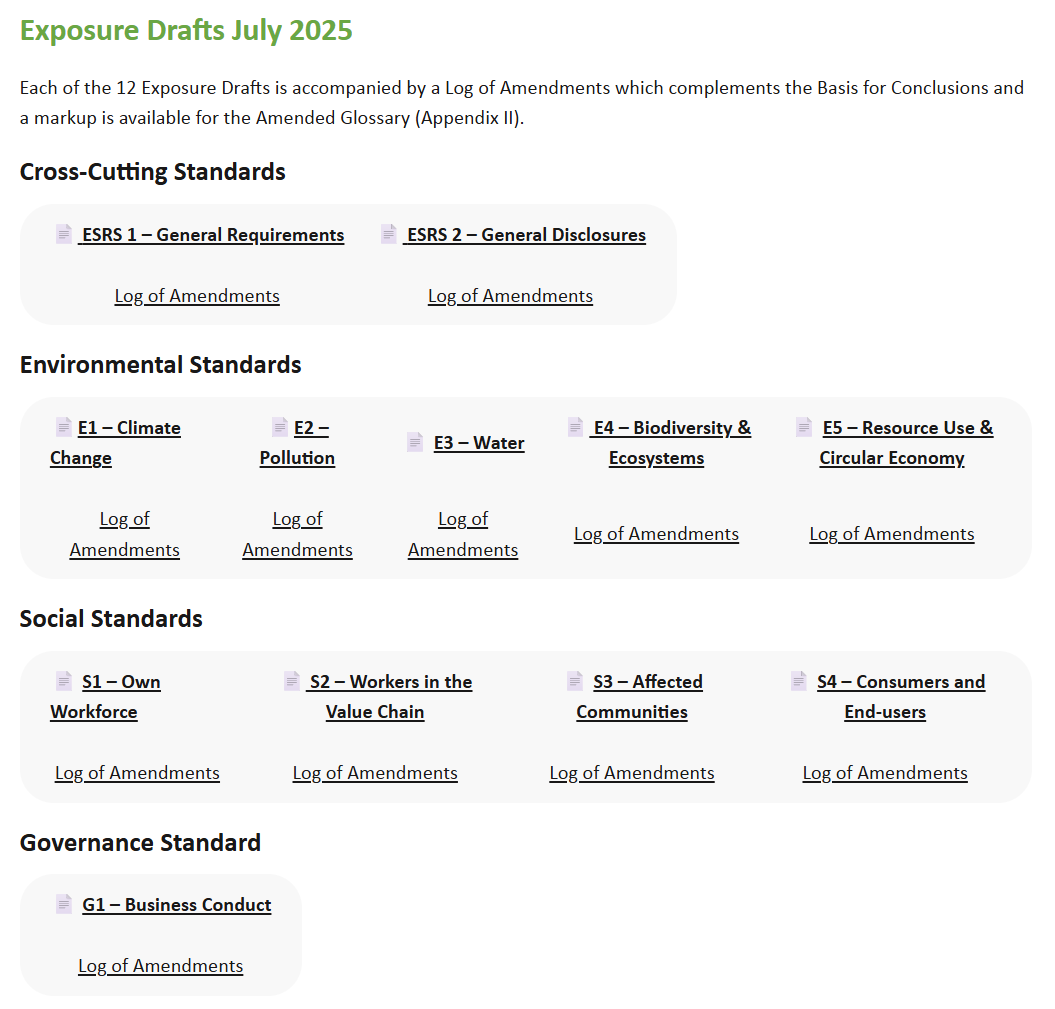
Source: July 2025 Revised ESRS https://www.efrag.org/en/amended-esrs-0
One of the key areas of simplification in the revised ESRS is the 'double materiality assessment', a core reporting requirement introduced by the CSRD. This assessment mandates companies to disclose both the risks and impacts of sustainability issues on their business and their impacts on the environment and society, including reporting on how significant impacts, risks, and opportunities (IROs) evolve over time.
During the consultation process for the revised standards, EFRAG noted feedback from companies stating that the process of identifying reportable topics was "particularly burdensome" and generally viewed the double materiality assessment as having "disproportionate input versus output." In response, EFRAG made several adjustments, including (1) introducing "pragmatic considerations" to focus the process on identifying the most significant topics; (2) refining the materiality assessment criteria and emphasizing that "the expected level of evidence supporting conclusions must be reasonable and proportionate."
Other simplification measures taken by EFRAG include:
- Enhancing the readability and simplicity of sustainability statements, improving their alignment with conventional corporate reports, and increasing the understandability, clarity, and accessibility of the ESRS;
- Improving interoperability between ESRS and the International Financial Reporting Standards (IFRS) Foundation's sustainability reporting standards, such as adopting identical wording where feasible;
- Emphasizing the "fair presentation" framework used in IFRS standards;
- Introducing similar exemption mechanisms found in IFRS standards, such as exemptions when reporting would lead to disproportionate costs or efforts.
According to EFRAG, the new standard text length is reduced by over 55% compared to the initial ESRS, with mandatory data points decreasing by 57%. Including removed voluntary disclosure provisions, the total reduction in data points is 68%.
Alongside releasing the exposure draft, EFRAG launched a 60-day public consultation to gather feedback on the revised ESRS proposals, which will run until September 29, 2025. The European Commission recently extended EFRAG's deadline for submitting technical advice on the ESRS, with the final standards now expected to be submitted by the end of November 2025.
Patrick de Cambourg, Chairman of the EFRAG Sustainability Reporting Board, stated: "EFRAG fully aligns with the strategic vision proposed by the European Commission. This revision aims to address Europe's current pressing needs—establishing a more focused, practical sustainability reporting system that maintains ambition without overburdening businesses. Leveraging effective practices, we aim to make the ESRS a more operational reality, ensuring sustainability reporting truly supports (rather than hinders) business resilience, investment activities, and long-term value creation."

Carbonstop CSRD Solutions
As a leading provider of sustainability and digitalization services, Carbonstop focuses on advanced ESG and carbon management, continuously tracking policy developments domestically and internationally. Regarding EU outbound compliance and CSRD information disclosure, we offer comprehensive solutions from double materiality assessments to CSRD-compliant disclosures and digital data management, helping companies efficiently meet ESRS requirements, mitigate risks, and enhance the strategic value of their ESG initiatives.
Conduct Double Materiality Assessments
- Status Diagnosis: Through questionnaires, interviews, and industry benchmarks, organize existing ESG management systems and data foundations of the company.
- Topic Screening: Based on ESRS (European Sustainability Reporting Standards) and industry characteristics, initially screen potential material topics (such as climate change, biodiversity, labor rights).
- Stakeholder Research: Assist companies in researching and collecting priority feedback from internal and external stakeholders (investors, employees, communities).
- Result Integration and Validation: Generate visual matrices (financial impact vs. environmental and social impact) to identify material topics requiring disclosure.
Develop CSRD Compliance Disclosure Strategies
- Gap Analysis: Compare existing ESG data with ESRS requirements to identify missing indicators (e.g., Scope 3 emissions, transition plans).
- Compliance Disclosure Model Development: Thoroughly review whether the current company and its EU subsidiaries or branches are subject to CSRD constraints based on CSRD compliance requirements, and develop the optimal compliance disclosure model considering future European development strategies.
- Report Framework Construction: Customize CSRD report templates, integrating ESRS chapters (such as ESRS 1 General Disclosures, ESRS E1 Climate Change).
- Internal Capacity Building and Work Plan Development: Conduct CSRD workshops for company teams, explaining ESRS standards and related tools usage, and support the formulation of future CSRD work plans.
Digital Empowerment for ESRS Data Management
The Carbonstop carbon management platform - Carbon Cloud has launched an ESG functional module, featuring functions such as information and data collection, ESG indicator management, and automatic generation of ESG reports. In the future, it will gradually improve and update the following functions according to the ESRS standards:
Indicator system construction and data management functions: Refining the indicator system and data management based on ESRS disclosure requirements and data points.
- Data System Integration: Integrating with existing ERP, HR systems of enterprises to automatically collect ESG data.
- Indicator Calculation and Verification: Built-in ESRS indicator formulas (such as carbon emission calculations, pay gap ratios) to automatically generate compliance data.
- Visualization Dashboard: Dynamically displaying ESG performance (such as carbon intensity trends, gender equality progress) to support management decision-making.


