


 704
704For most organisations, carbon accounting is an annual exercise that is traditionally backward-looking. It involves gathering data across sites and various systems, from procurement, travel, and finance, estimating emissions in Excel spreadsheets, publishing a report, and then repeating the exercise the following year.
This model is no longer sustainable. Regulators now demand assurance-ready disclosures, investors want transparent numbers, and customers expect companies to have a credible plan to reduce emissions. Companies themselves need to understand emissions across hundreds of suppliers spread across the globe.
As a result, carbon accounting has evolved into a strategic business function that goes beyond basic carbon footprinting. Accurate, timely, and auditable emissions data now shapes procurement decisions, operational planning, and risk management across the enterprise.
_1764052803734905.jpg)

What Carbon Accounting Actually Involves
The purpose of carbon accounting is to measure and manage all greenhouse gas emissions that arise from business operations and their supply chains. Results are expressed in carbon dioxide equivalent units (CO₂e), which converts gases like methane and nitrous oxide into a common unit based on their global warming potential.
The GHG Protocol groups emissions into three categories. Scope 1 covers direct emissions from assets a company owns, such as boilers or company vehicles. Scope 2 represents indirect emissions from purchased electricity or heat. Scope 3 is everything else: the emissions in a company’s supply chain, logistics, product use, and disposal.
For most organisations, Scope 3 represents well over 70 percent of total emissions. This area is where the majority of data challenges arise: collecting data from different systems, dealing with inconsistent data, engaging different teams across the business, engaging suppliers, finding relevant country or sector-specific emission factors.

Why Carbon Accounting Matters More Than Ever
There has been a significant increase in carbon reporting requirements over the past few years.
The EU Corporate Sustainability Reporting Directive (CSRD) has brought mandatory, assurance-ready emissions disclosures to thousands of companies.
The Carbon Border Adjustment Mechanism (CBAM) requires businesses to report the embodied emissions of goods entering the EU using facility-specific data where available. The ISSB standard requires companies to disclose emissions along with the methodologies, assumptions, and data quality assessments. CDP expects businesses to disclose their emissions data along with how credible and complete their reporting process is.
However, carbon accounting is more than regular compliance-led exercise. Organizations have learned that improved emissions reporting enables them to improve operational performance, and highlights cost and efficiency opportunities, identifies supply chain hotspots, and strengthens supplier engagement.
Increasingly, carbon management has become a proxy for organisational maturity and future-readiness.

Why Manual Methods No Longer Work
Despite this complexity, many sustainability teams still spend weeks pulling data from finance, operations, travel systems, and suppliers. Spreadsheets are passed around by email. Emission factors are obtained from a mix of publicly available sources, which can be outdated. And the carbon models developed in spreadsheets can have inbuilt errors that affect the quality of final results. There is typically no version control, limited audit trail, and no guarantee that the numbers used last year are still correct today.
This manual approach has three systemic issues.
Accuracy risk. Inconsistent emission factors, missing data, unverified estimates, errors in calculations, and late corrections are common.
Resource inefficiency. Sustainability managers often spend more time chasing utility bills and supplier spreadsheets than analysing results or planning reductions.
Compliance exposure. As regulations tighten, companies that cannot demonstrate how data was collected, validated, and verified face delays, reputational damage, and compliance failures.
This is why software has become essential and is no longer “nice to have”.
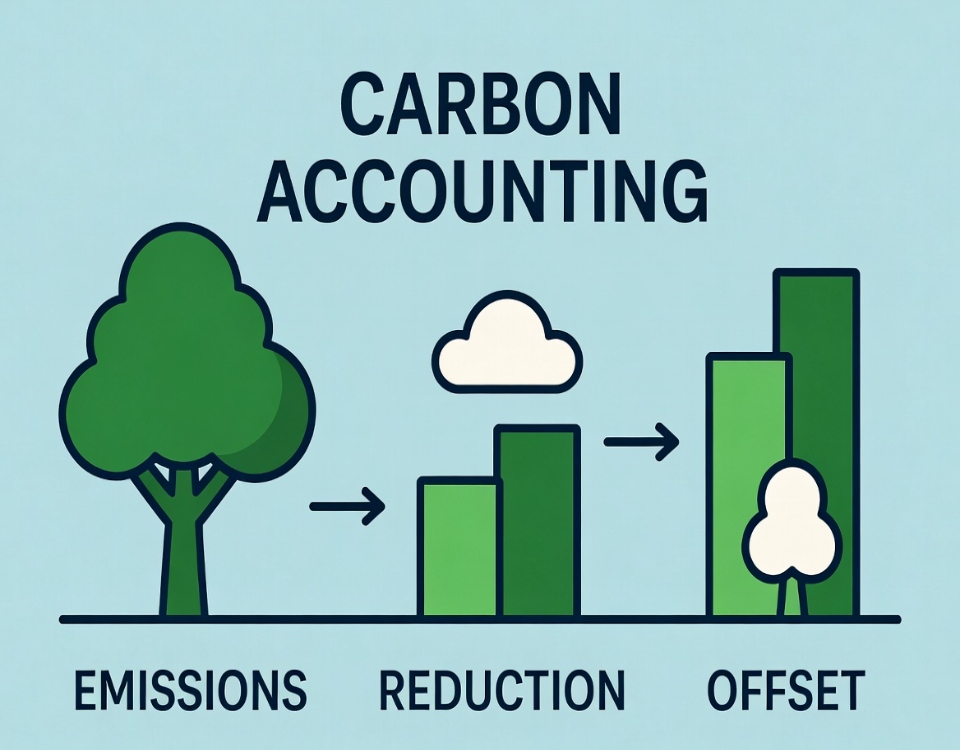

How Software Is Reshaping Carbon Accounting
Modern carbon management platforms do far more than automate calculations. They reshape the entire emissions reporting process from data collection to assurance in the following ways:
1. Automated Data Collection
Instead of relying on manual uploads, platforms connect directly to the systems companies already use: utility APIs, ERP systems, procurement systems, travel tools, and even IoT meters. Supplier data can be captured through structured portals rather than emails and informal spreadsheets.
2. High-Quality Emission Factors
Reporting and decision making is based on high-quality data and emission factors. Platforms maintain extensive global databases that are updated and reduce calculation errors. For companies with global supply chains, especially those sourcing from Asia, access to reliable, country-specific factors is vital for credible reporting and supplier engagement.
3. Data Validation
Rule-based data checks and AI-driven logic can detect anomalies, missing data, and inconsistencies in data. This reduces the time needed for internal reviews and ensures the final results are accurate and withstand external scrutiny.
4. Using data to support decision making
With software companies can model different decarbonisation scenarios track progress against targets, compare performance across sites, and even benchmark against peers. In other words, software gives organisations the ability to manage emissions proactively.

Where Ccloud Makes the Most Difference
Not all platforms handle complexity well. Many struggle when supply chains stretch across regions with varying data quality or when country-specific emissions factors matter. This is where Carbonstop’s Ccloudstands out.
China-Specific Emission Factors
Ccloud offers one of the most comprehensive emissions factor libraries in the world—including the largest and most accurate set of China-specific emission factors available. This matters because Chinese suppliers often account for a substantial share of corporate Scope 3 emissions. Using generic global averages can distort results and misinform decision-making.
AI-Powered Validation
CCloud’s AI validation engine automatically checks data quality, highlights anomalies, and flags missing information. This significantly shortens internal review cycles and creates a clear audit trail aligned with the GHG Protocol and CSRD. This enables companies to scale Scope 3 reporting without overwhelming their teams.
Practical Supplier Engagement
Instead of managing dozens of spreadsheets, companies can invite suppliers to a guided portal with structured questions and automated checks. This makes large-scale Scope 3 reporting finally manageable for corporate teams.
End-to-End Decarbonisation Support
CCloud also supports the entire decarbonisation lifecycle—from data collection to forecasting and scenario modelling.
How Companies Can Strengthen Their Carbon Accounting
Organisations early in their decarbonisation journey can significantly improve data quality, reduce effort, and improve accuracy of results by:
Clarify reporting boundaries based on the GHG Protocol and identify internal data owners. Defining clear organisational boundaries and accountability across teams helps identify data and smooths data collection effort.
Map internal data systems to understand where relevant data already exists. This makes data collection faster and avoids errors, including duplications and data gaps.
Prioritise high-impact categories. This typically includes categories such as purchased goods, logistics, and energy consumption. Targeting hotspots ensures effort is spent on the most important sources of emissions.
Engage suppliers early to obtain high-quality data. Agreed timelines, clear templates, and aligned expectations with suppliers improve the opportunity for companies to use primary data rather than proxies or financial data.
Implement software that meets the complexity of an organisation, especially for global supply chains, to calculate emissions. Carbon accounting platforms that streamline data collection, have in-built quality emission factors, and built-in validation significantly reduce compliance risk.
Report and disclose emissions in a clear and transparent manner. Good report strengthens credibility with regulators, investors, and customers.
Organisations that adopt these practices spend less time organising spreadsheets and more time developing reduction strategies. The right software is a crucial part of this process. It enables teams to build accurate GHG inventories faster, allowing sustainability teams to focus on interpreting data and developing decarbonisation strategies.

The Bottom Line
Carbon accounting is undergoing a fundamental shift. Now it has become a strategic business capability that supports procurement, operations, and strategy.
Software platforms built for global supply chains have become the only scalable and efficient way to produce high-quality, defensible carbon footprints. Companies are realising that carbon accounting does more than report the past. It is the basis for smarter decisions, stronger supplier relationships, and a more resilient business.


