


 3304
3304Faced with "green barriers" and the low-carbon procurement requirements of major international clients, how can cross-border trade enterprises navigate these challenges?
At the outset of the "15th Five-Year Plan" period, product carbon footprint management has become an unavoidable pivotal keyword within the hard tasks of climate change response. The Third Plenary Session of the 20th Central Committee explicitly called for establishing a "product carbon footprint management system," and the proposals for the "15th Five-Year Plan" further listed "policy systems such as product carbon footprint" as one of the core tools for emission reduction.
While the national "1+N" policy framework for product carbon footprint management is gradually taking shape, turning this system from paper-based rules into a practical, internationally recognized tool for enterprises requires first solidifying two "cornerstones." One is the national carbon footprint standard GB/T 24067-2024 Greenhouse gases — Carbon footprint of products — Quantification requirements and guidelines, which addresses the normative issue of "how to calculate." The other is the product carbon footprint factor database—the topic of our discussion today—which must answer the core question of "what data to use for calculation."
The newly issued Guidance on the Construction of Product Carbon Footprint Factor Databases (hereinafter referred to as the Guidance) precisely adds a "unified benchmark" and "international interface" to this data cornerstone. It clarifies construction standards for factor databases, providing enterprises with authoritative data for accounting. More importantly, it harbors the key to "international mutual recognition"—only when factor databases can interface with mainstream international data standards can our product carbon footprint reports truly become green passports for going global. So, how should enterprises prepare to both comply with national policy and enhance their own competitiveness?

Interpretation of Key Points in the Guidance
The core value of this Guidance lies in establishing a unified data calculation foundation for China's product carbon footprint management. Previously, different enterprises and institutions used varying accounting methods and data sources, leading to potentially vastly different carbon footprint results for the same product. The accuracy and consistency of these foundational data directly determine the credibility and comparability of carbon footprint accounting. The issuance of the Guidance aims to resolve the issue of inconsistent data "speaking different languages" at its source.
Clear Objectives, Defined Roadmap
The Guidance outlines a clear construction roadmap: initially build the product carbon footprint factor database by 2027, and essentially complete a database with wide coverage, high data quality, and strong international influence by 2030. These two timelines are not arbitrarily set. The 2027 target for "initial construction" provides Chinese enterprises with a valuable adaptation period just before the full implementation of the EU Carbon Border Adjustment Mechanism (CBAM). The 2030 target for "essential completion" aligns closely with China's overall strategy of peaking carbon emissions before 2030, ensuring the database construction progresses in step with the national carbon neutrality process.
Collaborative Co-construction of National and Sectoral Databases
The most crucial design of the Guidance is the establishment of a collaborative "National Database + Entity Databases" framework. The national database will focus on key areas like basic energy, bulk commodities, and raw materials, providing authoritative benchmark data. Simultaneously, it encourages various entities—sectoral authorities, local governments, industry associations, research institutions, and enterprises—to leverage their strengths in building specialized databases for subdivided fields. These databases, each with its own focus, will complement the national database, forming a complete data ecosystem. As the sectoral authority, especially in fields like automotive and electronics facing significant international carbon barrier pressure, the Ministry of Industry and Information Technology (MIIT) has already taken the lead in promoting data construction for key industries.
Four Pillars Constituting a Complete Construction System
The Guidance systematically deploys 11 key tasks across four aspects, forming a complete framework for database construction:
- Data Quality: The Guidance requires establishing a full-process management system covering data sources, development processes, quality evaluation, and security protection. This ensures every carbon footprint factor can withstand scientific scrutiny and international comparison, upholding the baseline for data quality.
- Technical Requirements: The document clarifies the database's architecture and unifies the naming, classification, and coding systems for factor data, establishing an "official language" for nationwide data circulation. Furthermore, the Guidance specifically encourages exploring scenario applications using cutting-edge technologies like AI to improve database construction efficiency while ensuring data quality.
- International Alignment: The Guidance particularly emphasizes strengthening international exchange and cooperation to promote interconnectivity between Chinese and foreign databases. This arrangement directly addresses the current practical challenges faced by Chinese product exports. This is a national-level strategy and a crucial step in promoting mutual recognition and alignment between domestic and international databases.
- Collaboration Mechanism: The document designs a multi-party participation and data-sharing working mechanism, ensuring the national database can aggregate high-quality data from all parties while feeding authoritative data back to users.

Carbonstop's CCDB Database
Explorations in Localization and Diversified Data Construction
The released Guidance strongly emphasizes building a carbon footprint factor database "aligned with China's national conditions" and establishing a collaboration mechanism of "government guidance, market participation." As industry practitioners, Carbonstop has also deeply recognized the necessity of this direction through over a decade of practical experience in database construction.
Origin: Addressing the Objective Need for Missing Local Data
The Guidance proposes to address the weak data foundation. Looking back to 2012 when Carbonstop initiated the construction of CCDB (China Carbon Database), the original intention was precisely to tackle the "data gap" commonly faced by the industry at that time. In early carbon inventory and Product Carbon Footprint (PCF) projects, practitioners often had to rely on overseas public databases like the UK's DEFRA. However, due to significant differences in energy structure, supply chain processes, and transportation distances, directly applying foreign factors could not accurately reflect the real carbon emission levels of Chinese products. For example, while assisting a stationery company in calculating the carbon footprint of recycled exercise books years ago, we found it difficult to obtain factors for locally produced recycled paper and eco-friendly inks in China. Such practical pain points from front-line projects prompted us to establish the focus of our database construction as "accumulating localized data that conforms to China's actual situation."
Current State: Building a Multi-Source Data Architecture
After years of accumulation and iteration, as of July 2025, CCDB contains over 510,000 entries of various carbon data, with China-specific and related data accounting for approximately 50-60%. It covers calculation needs across different dimensions such as organizations, products, and project emission reductions. Its data architecture mainly consists of the following three parts, which also align with the technical path for integrating multi-source data resources outlined in the Guidance:
- Aggregation of Authoritative Public Data: Systematically incorporates grid and electricity factors released by the National Development and Reform Commission (NDRC) and the Ministry of Ecology and Environment (MEE), as well as localized data published by various provinces and cities. It also integrates authoritative public data from the US, Europe, Japan, South Korea, etc., to ensure the compliance of foundational calculation bases.
- Introduction of International Standard Data: Through official cooperation and licensing with the ecoinvent database, internationally recognized background data and LCIA (Life Cycle Impact Assessment) results have been introduced, providing data support for enterprises to address carbon barriers in international trade.
- Supplementation with Real-Scenario Data: Based on experience serving over 1,500 enterprises, we have desensitized and standardized a large amount of primary data from actual supply chain surveys. This data, to some extent, fills gaps in general databases regarding specific subdivided industries and particular process technologies, improving data granularity and representativeness.
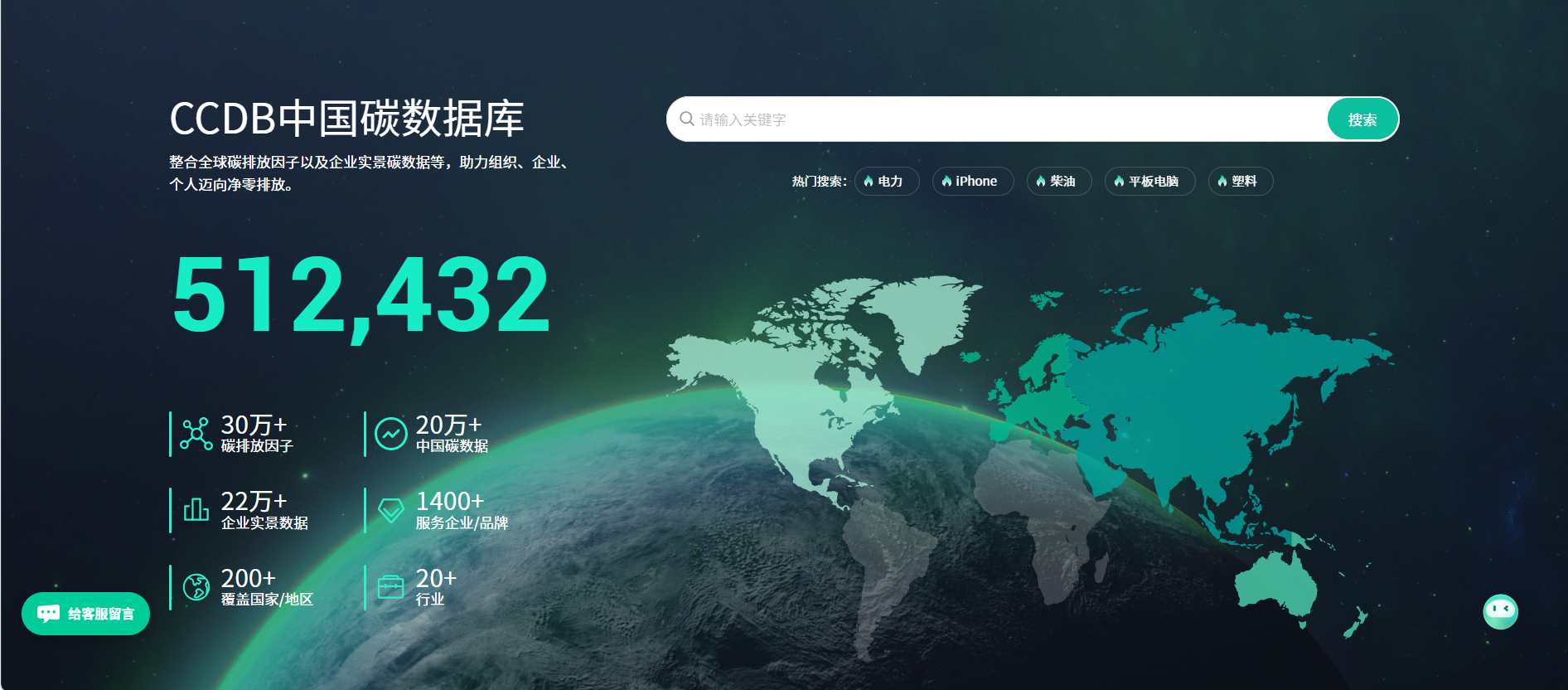
The construction journey of CCDB reflects the process of China's carbon footprint management moving from "reliance on references" to "independent construction." It also validates the feasibility proposed in the Guidance of enhancing data quality and coverage through multi-party collaboration.
AI Empowering Factor Database Construction
In the database construction process, we have deeply integrated AI technology, empowering aspects like factor matching, data governance, and intelligent accounting to ensure the accuracy and efficiency of both database construction and usage.

How Should Enterprises in Various Sectors Act?
New Energy Automotive Industry
Product carbon footprint is receiving increasing attention from new energy enterprises. On one hand, the industry has a long, complex supply chain covering multiple segments—from mining raw materials like lithium and cobalt, to battery production, vehicle assembly, and recycling. Tracing carbon emissions across the entire lifecycle is challenging, with supply chain emissions constituting a significant portion. Most small and medium-sized suppliers lack mature carbon accounting systems and tools, resulting in inefficient data collection and uneven quality. On the other hand, domestic and international policy constraints are tightening. Domestically, China is advancing the formulation of carbon footprint quantification standards for new energy vehicles and power batteries. Internationally, the EU Battery Regulation already requires carbon footprint declarations, and countries like France directly link carbon footprints to subsidies. Failure to meet carbon footprint standards for exported products will directly impact market access. Furthermore, the EU CBAM has proposed expanding its scope to include downstream products from January 1, 2028, encompassing some automotive components.
As key participants in this priority field, new energy vehicle enterprises can leverage their industrial advantages to develop carbon footprint factor data for subdivided products like complete vehicles and key components (e.g., power batteries), following national standards throughout the process. Enterprises can collect primary data from their own production, supply chain logistics, product use, etc., to build unit process datasets and lifecycle models, forming high-quality, traceable carbon footprint factor datasets and development reports. They can participate in the "multi-party reporting, national integration" sharing mechanism by submitting data to the National Product Carbon Footprint Factor Database. Simultaneously, they can actively utilize technologies like AI to enhance data quality and participate in international standard alignment to promote international mutual recognition of industry data.
Electronics Industry
Although electronic products are lightweight, their carbon footprint intensity across the lifecycle is significant. The industry experiences rapid technological iteration and has a globalized supply chain. Carbon footprint factor data for key segments like chip manufacturing, PCB etching, and electronic waste recycling is relatively scarce. Furthermore, electronic products are widely used downstream in numerous applications—consumer electronics, new energy vehicles, industrial control, medical devices—and their carbon footprint directly affects the low-carbon attributes and compliance qualifications of end products. It even influences whether downstream industries can meet carbon policy requirements. China's carbon footprint management system is also accelerating the advancement of standards for the electronics industry. Filling data gaps and standardizing carbon footprint accounting is not only a necessary choice for electronics enterprises facing compliance pressure but also empowers collaborative decarbonization across the entire industrial chain. It can become a key lever for enterprises to seize the green market and enhance ESG competitiveness.
Electronics industry participants in product carbon footprint database construction can prioritize key segments like semiconductor manufacturing and precision assembly, reporting measured data such as production energy consumption and raw material usage. Leading enterprises can establish global supply chain carbon data-sharing platforms, driving small and medium-sized component suppliers to collaboratively fill data gaps.
Textiles Industry
China is a major global producer and consumer of textiles and apparel. The industry's annual carbon emissions are approximately 230 million tons, accounting for about 2% of the national total. In March 2025, China officially released the national standard Greenhouse gases — Product carbon footprint quantification method and requirement — Chemical fibers (GB/T 45540-2025), providing a unified methodological basis for quantifying the carbon footprint of products like polyester, nylon, and viscose fibers. Concurrently, carbon footprint standards for products like wool textiles are also under development.
Currently, textile and apparel enterprises face dual pressure from regulatory policies and market demand. Internationally, the EU's Ecodesign for Sustainable Products Regulation (ESPR) has listed textiles as one of the five priority-controlled sectors, planning to gradually implement mandatory ecodesign requirements over the next five years, explicitly including obligations for product carbon footprint information disclosure. Domestically, textiles have also been included in the first batch of national pilot programs for product carbon footprint labeling and certification. On the consumer side, the concept of green and low-carbon is increasingly taking root, with growing demand for eco-friendly products among younger generations. To address these challenges, it is recommended that supply chain leaders establish mechanisms for collecting supply chain carbon data, encouraging or even requiring key suppliers to report data using unified standards. This involves systematically collecting primary activity data from all segments—raw material extraction, spinning, weaving, dyeing, finishing, to finished product processing—thereby enabling accurate product carbon footprint accounting while empowering suppliers and reducing future compliance costs.
In the process of serving over 1,500 enterprises, Carbonstop has accumulated deep professional expertise in industries including new energy vehicles, electronics, textiles, and food & beverage. We conduct full-chain tracing of products, systematically collect primary data from multi-tier suppliers, build standardized unit processes, and rely on our self-developed carbon cloud SaaS platform and the CCDB factor database to establish complete product lifecycle carbon footprint models for multiple industries. In the future, we will continue to assist core enterprises in industrial chains to collaborate with upstream and downstream partners, fully leveraging their professional and resource advantages to jointly advance the construction of product carbon footprint factor databases and promote low-carbon transformation across industries.


