


 3230
3230On November 20, 2024, the Ministry of Finance, together with nine departments including the Ministry of Foreign Affairs, the National Development and Reform Commission, the Ministry of Industry and Information Technology, the Ministry of Ecology and Environment, the Ministry of Commerce, the People's Bank of China, the State-owned Assets Supervision and Administration Commission of the State Council, and the National Financial Regulatory Administration, jointly issued the Corporate Sustainability Disclosure Standards – Basic Standard (For Trial Implementation) (hereinafter referred to as the Basic Standard). As the "top-level design" of China's sustainability disclosure standard system, it clarifies for the first time the basic concepts, principles, methods, and core framework for corporate sustainability information disclosure.
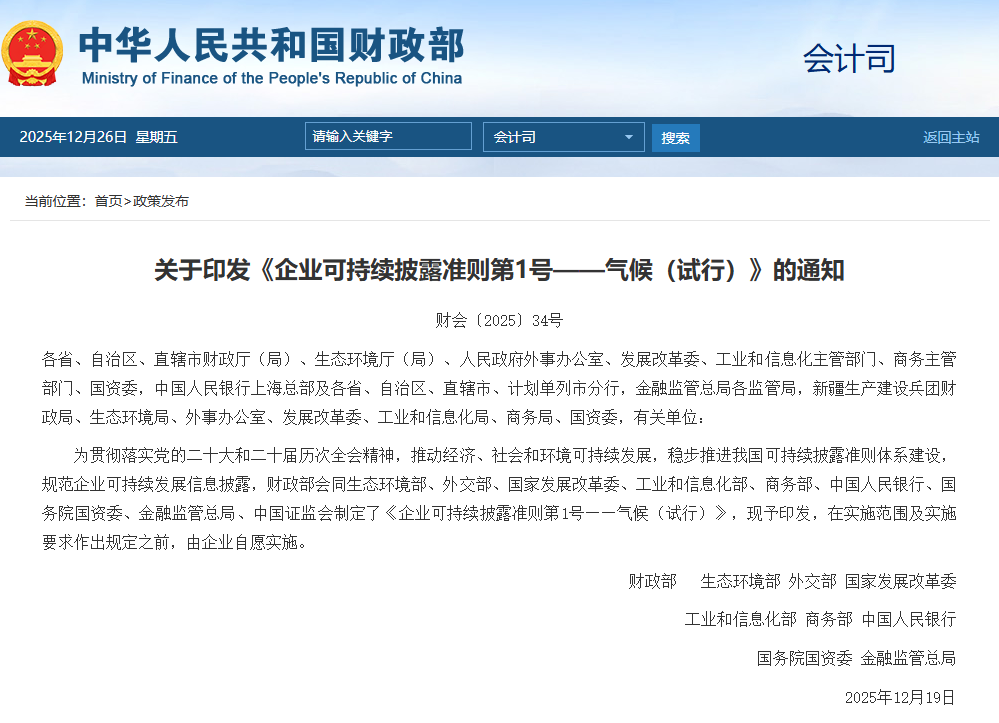
More than a year later, on December 25, 2025, the nine departments jointly released the Corporate Sustainability Disclosure Standard No. 1 – Climate (For Trial Implementation) (hereinafter referred to as the Climate Standard), becoming the first specialized standard focusing on a specific topic under the framework of the Basic Standard.
Timeline for the Corporate Sustainability Disclosure Standard No. 1 – Climate (For Trial Implementation)
From "general requirements" to "specialized guidance," China's corporate sustainability information disclosure is gradually moving away from a "fragmented" stage and entering a new phase of "systematic advancement," providing full-chain institutional support for companies to implement sustainable development concepts, align with international rules, and serve the "Dual Carbon" strategy.

Background of Standard Formulation:
From National Strategy to Global Governance, Climate Disclosure Becomes an Inevitable Choice
As the influence of climate information disclosure on financial stability, investment decisions, and international trade becomes increasingly prominent, major global economies and international organizations are accelerating the unified application of sustainability disclosure standards. Currently, corporate climate information disclosure in China faces issues such as inconsistent standards, fragmented content, and uneven data quality, making it difficult to meet the demand for high-quality information from market participants.
At the same time, the *International Financial Reporting Standards S2 – Climate-related Disclosures* (IFRS S2) issued by the International Sustainability Standards Board (ISSB) has become a mainstream global framework. Regulations such as the European Union's Carbon Border Adjustment Mechanism (CBAM) are being implemented successively, exposing multinational companies to compliance cost pressures from "parallel multiple standards."
Against this backdrop, the Climate Standard led by the Ministry of Finance not only aligns structurally with international standards to ensure international comparability of information and promote convergence between domestic and foreign disclosure languages—effectively reducing cross-border operational and financing costs for enterprises—but is also based on China's development stage and national realities. It fully integrates Chinese specifics in disclosure framework design and greenhouse gas accounting methods, ensuring the standard is both operable and applicable, thereby safeguarding national development interests.
 Structure and Main Content of the Climate Standard
As the first specific standard issued after the Basic Standard, the Climate Standard translates the "general requirements" of the Basic Standard into "specialized rules for the climate domain," achieving a seamless transition "from framework to implementation":
- Structural Logic: The Climate Standard strictly follows the four-core-element framework of "Governance – Strategy – Risk and Opportunity Management – Metrics and Targets" established by the Basic Standard, supplementing and refining content only for the specificities of the climate domain.
- Implementation Pace: The Climate Standard continues the Basic Standard's approach of "voluntary first, step-by-step advancement." The Basic Standard states that "before the scope and requirements for implementation are determined, enterprises may implement voluntarily." The Climate Standard adopts the same model. It will subsequently advance along the path of "from listed companies to non-listed companies, from large enterprises to small and medium-sized enterprises, from voluntary to mandatory," aligning with the implementation pace of the Basic Standard and providing an adaptation period for enterprises.
Main Content by Structure of the Climate Standard
- Chapter 1: General Provisions (4 Articles): Clarifies the purpose of the standard, the objectives of climate-related information disclosure, and information usage requirements. Stipulates that enterprises should prioritize disclosing information on significant climate-related risks and opportunities, concurrently disclose related impact information, and maintain consistency.
- Chapter 2: Governance (5 Articles): Focuses on the governance framework for climate-related risks and opportunities. Requires disclosure of relevant responsibilities of governance bodies and management, supervision methods, supports integrated disclosure, and encourages third-party assurance.
- Chapter 3: Strategy (11 Articles): Focuses on corporate disclosure of climate-related strategy. Clarifies the need to explain the impact of risks and opportunities on strategy and finances, and to conduct climate resilience assessments and scenario analysis.
- Chapter 4: Risk and Opportunity Management (5 Articles): Specifies that enterprises must disclose management processes such as the identification and assessment of climate-related risks and opportunities, and how these processes are integrated with the enterprise's overall risk management process.
- Chapter 5: Metrics and Targets (21 Articles): Requires enterprises to disclose seven types of general metrics, including greenhouse gas emissions, and industry-specific metrics. Clarifies the setting, progress toward achievement, and management of climate-related targets, detailing various disclosure rules.
- Chapter 6: Supplementary Provisions (1 Article): Identifies the entity responsible for interpreting the standard.
- Appendix: Definitions and explanations of some professional terms.
 Comparison Between the Climate Standard and IFRS S2
| Comparison Dimension | Climate Standard | IFRS S2 | Key Difference Analysis |
|---|---|---|---|
| Governance | Encourages enterprises to utilize internal audit, legal, or other supervisory departments to oversee climate-related risks and opportunities, and to engage independent third-party institutions for assurance of climate-related information. | Does not explicitly use the term "third-party assurance." | The Climate Standard guides toward third-party assurance through an "encouragement + emphasis on independence" approach, focusing on the overall credibility of climate information. |
| Strategy | Enterprises should disclose four types of information to help sustainability information users understand their climate risk and opportunity management strategy and results: climate risks and opportunities affecting prospects, impact on strategic decisions, financial impact, and business model resilience. | Entities should disclose five types of information to help general purpose financial report users understand their climate risk management strategy: climate risks and opportunities affecting prospects, impact on business model and value chain, impact on strategic decisions and transition plans, financial impact, and climate resilience of strategy and business model. | The Climate Standard does not separately treat "business model and value chain" as an independent disclosure item; the overall framework is more concise, focusing on the completeness of core logic. IFRS S2 explicitly requires resilience assessment to be directly linked to previously identified risks and opportunities, avoiding disconnection between resilience analysis and actual risks/opportunities; its requirements for relevance and specificity in assessment are stricter. |
| Risk & Opp. Management | Enterprises should disclose three types of information to help sustainability information users understand their management processes for climate-related risks and opportunities: management processes and policies for climate risks, management processes for climate opportunities (including scenario analysis application), and integration of climate management processes with overall risk management. | Entities should disclose four types of information to help general purpose financial report users understand climate-related risks and opportunities affecting their prospects: description of risks and opportunities, risk categorization, time horizon of effects, and linkage between short/medium/long-term definitions and strategic decision timeframes. | The Climate Standard is structured around "management processes," forming a complete logic of "risk process + opportunity process + process integration." Disclosure content revolves around "how to manage," offering strong practicality. IFRS S2 focuses on "defining basic information about risks and opportunities," requiring disclosure only of description, risk type, time horizon of effects, time period definitions, and linkage to strategic decisions; disclosure content revolves around "what are the risks/opportunities." |
| Metrics & Targets: GHG Accounting Basis | Priority is given to "corporate carbon emission accounting standards formulated by relevant national departments"; the Greenhouse Gas Protocol is referenced only in the absence of national standards. Explicitly requires disclosure of changes in accounting methods and reasons. | Primarily based on the Greenhouse Gas Protocol; does not establish a priority order for national-level accounting standards. Requirements for disclosing method changes are relatively lenient. | The Climate Standard clearly establishes the "national standards first" principle, prioritizing the use of officially released domestic accounting standards. IFRS S2 uses the internationally common Greenhouse Gas Protocol as its core basis, without setting a priority application order for national-level standards. |
| Metrics & Targets: Scope 2 Measurement | Enterprises shall disclose their location-based total Scope 2 GHG emissions and provide contract or settlement information that helps sustainability information users understand their total Scope 2 GHG emissions. Enterprises may also disclose their market-based total Scope 2 GHG emissions. | Scope 2 GHG emissions shall be disclosed using the location-based method. Necessary information about contractual instruments shall be provided to help users understand the entity's Scope 2 GHG emissions. | Both standards require disclosure of location-based Scope 2 GHG emissions. The Climate Standard encourages disclosure of market-based Scope 2 GHG emissions. |
| Metrics & Targets: Scope 3 Measurement | Allows limiting Scope 3 "investments" category emissions to "financed emissions," reducing the accounting burden for financial institutions. Priority is given to direct measurement data; if unavailable, management approaches must be disclosed. | Requires comprehensive measurement of Scope 3 "investments" category emissions, without setting a "financed emissions" limitation, imposing broader accounting scope requirements on financial institutions. | The Climate Standard sets special rules for financial institutions, limiting the Scope 3 "investments" category to "financed emissions," significantly simplifying accounting difficulty. IFRS S2 requires comprehensive measurement of Scope 3 investment-related emissions without any scope reduction clauses, imposing stricter accounting requirements. |
| Metrics & Targets: Industry-Specific Metrics | Has not yet introduced the SASB indicator system. Requires formulation based on domestic industry characteristics, to be detailed subsequently through "Industry Application Guidelines" (e.g., for 9 industries like power, steel). | Provides "illustrative guidance" on industry-specific metrics based on SASB standards, with plans to transition to mandatory requirements in the future, focusing on globally applicable industry metrics. | The Climate Standard is based on China's industrial structure and policy direction, setting specific metrics relevant to Chinese industries, to be detailed later through industry application guidelines. IFRS S2 relies on the international SASB standard system for industry metrics, focusing on global applicability, which may differ from domestic industry adaptation. |
| Metrics & Targets: Financed Emissions Disclosure | Requires only enterprises in "asset management, commercial banking, insurance business" to disclose financed emissions. Removes excessive requirements from the draft for "specific emission data of financial products," leaving room for future industry guidelines. | Requires all enterprises involved in financing activities to disclose financed emissions, with higher granularity requirements (e.g., asset class, industry segmentation), without distinguishing industry differences. | The Climate Standard limits disclosure of financed emissions to specific industries (asset management, commercial banking, insurance) and simplifies granularity requirements. IFRS S2 requires all enterprises involved in financing activities to disclose financed emissions, with more detailed disclosure requirements. |
| Metrics & Targets: Purchased Emission Reductions / Carbon Credits | When enterprises plan to use purchased emission reductions to offset emissions to achieve net emission targets, they need to disclose more detailed information, such as the extent and manner of use, name of the certifying independent third party and certification system, project name and country, and other necessary factors. | When entities use carbon credits to offset GHG emissions to achieve net emissions targets, they need to disclose information such as: the extent and manner of use, the certifying independent third-party system, the type of carbon credits, and other necessary factors. | The Climate Standard uniformly uses the localized term "purchased emission reductions," consistent with the core concept of China's CCER trading market, precisely corresponding to the certified emission reduction credits purchased by enterprises. IFRS S2 uses the internationally common term "carbon credits" without adjusting the terminology for specific regional markets. |
 Impact of the Standard on Enterprises and Response Recommendations
The standard is currently in the voluntary implementation stage. Implementation scope and mandatory requirements will be gradually clarified based on market practices. Enterprises can advance compliance in stages according to their own circumstances.
(1) Profound Impact of Standard Implementation
For enterprises, the implementation of the standard presents both challenges and opportunities. In the short term, enterprises need to invest resources in establishing a climate information system. However, the standard introduces the principle of proportionality: small, medium, and micro enterprises can start with qualitative disclosures based on their resources, effectively reducing compliance costs. In the long term, the standard will drive enterprises to more systematically identify climate-related risks and opportunities, compelling them to optimize business structures and enhance climate resilience. Simultaneously, high-quality information disclosure can enhance investor confidence and secure advantages in green financing, injecting long-term momentum for sustainable corporate development.
For the market, the implementation of the standard will improve the transparency and comparability of climate-related information, helping stakeholders such as investors and creditors assess corporate ESG performance more accurately. This will guide capital towards low-carbon enterprises, fostering a virtuous cycle of "disclosure – assessment – incentive – transformation," and supporting the achievement of China's "Dual Carbon" goals.
(2) Recommendations for Enterprise Response
1.Strengthen Organizational Support and Improve Governance Framework:
Enterprises should promptly clarify the supervisory bodies and management responsibilities for climate-related risks and opportunities, establish cross-departmental coordination mechanisms, and incorporate climate performance into compensation assessments. If a specialized governance framework has not yet been established, integration can be achieved by leveraging the existing sustainable development governance system to ensure governance requirements are met.
2.Comprehensively Review Climate Factors and Optimize Strategic Planning:
Based on industry characteristics and business layout, systematically identify climate-related physical and transition risks, assess their current and anticipated impacts on business models and value chains, incorporate climate resilience into strategic planning, formulate scientific and reasonable climate transition plans and targets, and clarify resource allocation plans.
3.Establish a Standardized Information Management System and Improve Data Quality:
Following the standard's requirements, establish a greenhouse gas emission accounting system covering Scopes 1 to 3, standardize data sources, accounting methods, and assumptions to ensure the accuracy of emission data. For complex metrics such as Scope 3 emissions and financed emissions, leverage the professional capabilities of third-party institutions to enhance the scientific rigor and credibility of information accounting.
4.Enhance Communication and Learning to Proactively Adapt to Disclosure Requirements:
Enterprises should closely monitor the finalization of the standard and supporting interpretations, strengthen communication with peers to learn from advanced disclosure practices, and actively conduct internal training to improve the professional capabilities of relevant personnel in areas such as climate information accounting, scenario analysis, and target setting, ensuring disclosed information meets the standard's requirements.
The release of the Climate Standard is a significant milestone in the construction of China's sustainability information disclosure system, marking a key transition from "voluntary exploration" to "normative implementation" in climate information disclosure. As the standard is formally implemented, Carbonstop, leveraging its three core capabilities—digital platform, localized database, and professional consulting team—tailors one-stop service solutions encompassing data accounting, compliance disclosure, and target achievement for enterprises. We are committed to fully assisting enterprises in accurately aligning with the standard's requirements and seizing developmental opportunities in the green and low-carbon transition.


