


 442
442
Carbon accounting is no longer optional—it’s operational
A few years ago, many companies treated carbon accounting as a sustainability task. It seemed important, yet often stayed on the edges.
Today, it stands at the heart of business choices.
With stricter rules from the Corporate Sustainability Reporting Directive (CSRD), plus growing demands for Scope 3, and product-specific reporting under laws like CBAM and the EU Battery Regulation, carbon data now feels auditable, comparable, and commercially consequential.
In simple words, this points to one key fact: You can no longer rely on rough estimates or a standalone carbon emissions calculator to understand your footprint.
The gap between “calculation” and real carbon management
Many organizations start with common tools.
They use a carbon footprint calculator for broad estimates. Or they pick a CO2 emissions calculator to measure energy use. Spreadsheets help track Scope 1 and Scope 2.
These items work well, but just up to a certain level.
As companies grow larger, three main issues arise.
First, Scope 3 complexity. Most emissions hide in the supply chain. There, the data is scattered and hard to get.
Second, data quality. Basic emission factors and spending-based guesses soon fall short under close checks.
Third, reporting pressure. Standards like CSRD and CDP now demand traceable, verifiable, and consistent data.
The outcome? Many companies can calculate carbon emissions. However, they find it tough to trust, defend, or act on the results.
What “good” looks like today
Top companies are steadily changing how they view calculating a carbon footprint.
They avoid simple questions like:
“How do we calculate carbon emissions?”
Instead, they focus on:
“How do we build a system that continuously measures, validates, and improves carbon performance?”
This change, from single calculations to continuous carbon management, shows where platforms like Carbonstop fit in more and more.
From fragmented data to a unified carbon system
At its base, calculating a corporate carbon footprint keeps a basic pattern.
Activity data × emission factors = emissions
Yet in real use, strong enterprise carbon accounting proves much tougher.
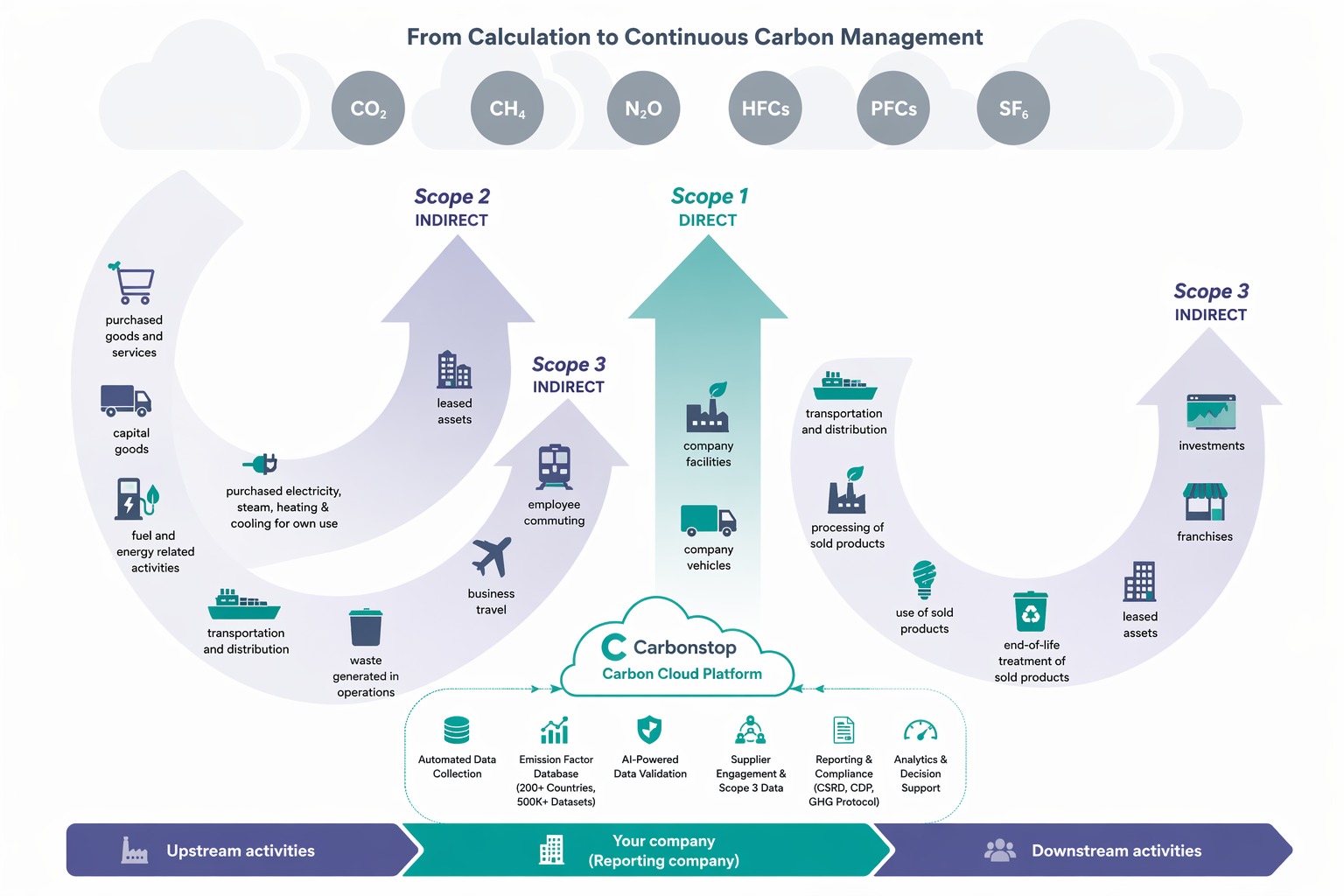
It needs several steps. For instance, integrating data across operations, procurement, and supply chains. It also calls for high-quality, localized emission factors. Plus, it involves continuously updating and validating data inputs. Finally, outputs must align with GHG Protocol, CSRD, and ISSB expectations.

How Carbonstop changes the way companies calculate carbon
Carbonstop does not see carbon accounting as just a math issue. Instead, it treats it as a data and system challenge.
For over ten years, the firm has created one of the biggest carbon databases worldwide. It spans more than 200 countries and includes over 500,000 emission factor datasets.
This matters significantly because:
- Emission factors determine accuracy
- Accuracy determines compliance and credibility
For firms with tricky supply chains, particularly those tied to China-based manufacturing, this range of local data boosts result reliability a great deal.
Moving beyond calculators: from tools to infrastructure
A usual carbon emissions calculator or carbon footprint calculator gives a fixed response.
Carbonstop’s Ccloud platform aims to do more. It turns carbon accounting into a continuous, enterprise-wide capability.
What does that look like in action? It includes automatically collecting and structuring activity data across business units. It means embedding emission factor logic right into workflows. It allows real-time calculation rather than yearly reports. And it supports both organizational and product-level footprints.
This move, from separate tools to linked systems, grows more vital as firms gear up for audit-ready ESG disclosures.
Solving the hardest problem: Scope 3 and supplier data
If Scopes 1 and 2 form the base, Scope 3 poses the true challenge.
Laws and market needs point in one clear way: primary supplier data will increasingly replace estimates.
Still, most companies miss key pieces. They lack direct visibility into supplier emissions. They do not have standardized data collection processes. And they want better ways to engage suppliers at scale.
Carbonstop tackles this with clear supplier engagement workflows. These let companies collect emissions data straight from suppliers. They help improve data quality over time. And they create a more precise and solid Scope 3 footprint.
This holds special weight with rules that call for traceable upstream data, above all for product-level carbon disclosures.
From calculation to decision-making
The biggest change might come after emissions are calculated.
In many places, carbon data sits unused. It gets reported, but is not put to work.
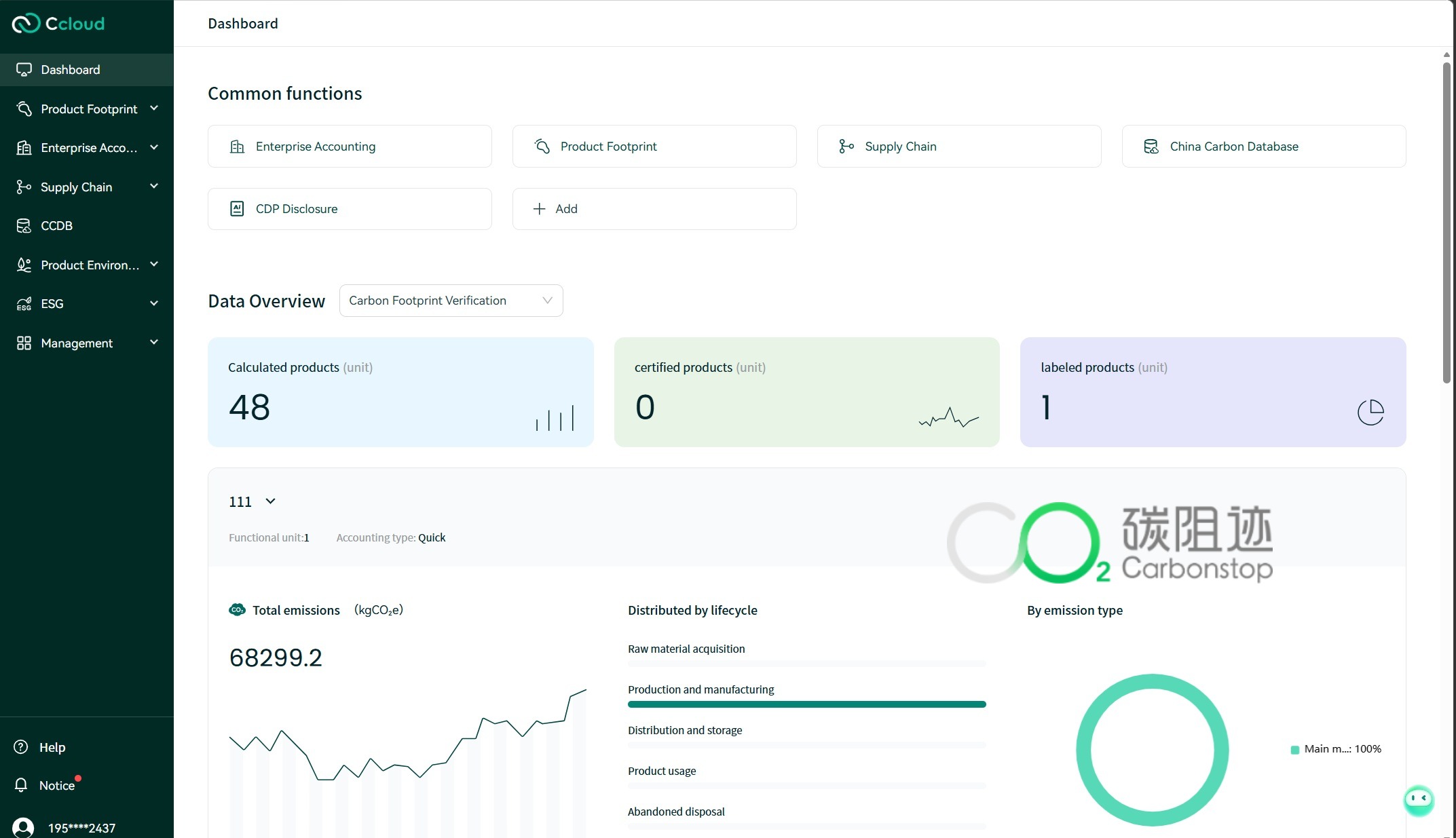
Carbonstop’s platform goes further than calculation. It covers scenario modelling, like the effects of supplier shifts or energy changes. It offers benchmarking against industry peers. And it spots emission hotspots across value chains.
This helps firms shift from asking:
“What are our emissions?”
To wondering:
“Where should we act—and what will it change?”

Why data quality is becoming the differentiator
As carbon reporting advances, a fresh truth appears:
Not all carbon footprints are created equal.
Two companies might share similar emissions figures. But one uses generic factors and guesses. The other draws on checked, traceable, detailed data.
In systems like CSRD and CDP, this split shows up more. And it matters a lot.
Carbonstop’s AI-driven data validation and quality checks fill this space by detecting anomalies in data inputs. They standardize calculation methodologies. And they ensure consistency across reporting cycles.
For groups readying for outside checks, this kind of care turns essential fast.
A more practical way to think about carbon calculation
Rather than seeing carbon accounting as a straight path, top companies now view it as a cycle.
- Collect and structure data
- Calculate emissions
- Validate and verify
- Analyze and identify hotspots
- Implement reduction actions
- Repeat with better data
This matches Carbonstop’s CREOS methodology—Calculate, Reduce, Engage, Offset, Spread. It shows how carbon management grows in real life.
Conclusion: calculation is just the beginning
Calculating a carbon footprint no longer serves as the main aim. It acts as the starting point.
The true task lies in creating a system that stays:
- Accurate enough for compliance
- Scalable enough for global operations
- Actionable enough for business decisions
For many groups, the path begins with a carbon calculator.
But the firms set to lead in a world short on carbon resources are those that push past calculators. They aim for integrated, data-driven carbon management systems.
A final perspective
If your organization still uses a standalone CO2 emissions calculator or manual setups, it might help to pause and reflect.
Are we calculating emissions—or are we building the capability to manage them?
The reply will affect not only your reports. It will also shape your edge in the coming years.


