碳阻迹 CarbonStop Logo
Please be aware that this article is translated by AI, and like humans, they can make mistakes too.
Carbonstop Calculates Carbon Emission Reductions for Fei Mayi‘s Recycling Scenarios

Carbonstop Calculates Carbon Emission Reductions for Fei Mayi‘s Recycling Scenarios

CARBON REDUCTIONCARBON FOOTPRINTEMISSION FACTOR
viewCount713

Feimayi X Carbonstop, no more confusion about emission reductions


Recently, Carbonstop calculated the carbon emission reductions for Feimayi's primary scenarios. The conclusions are as follows, after going through the Feimayi platform:

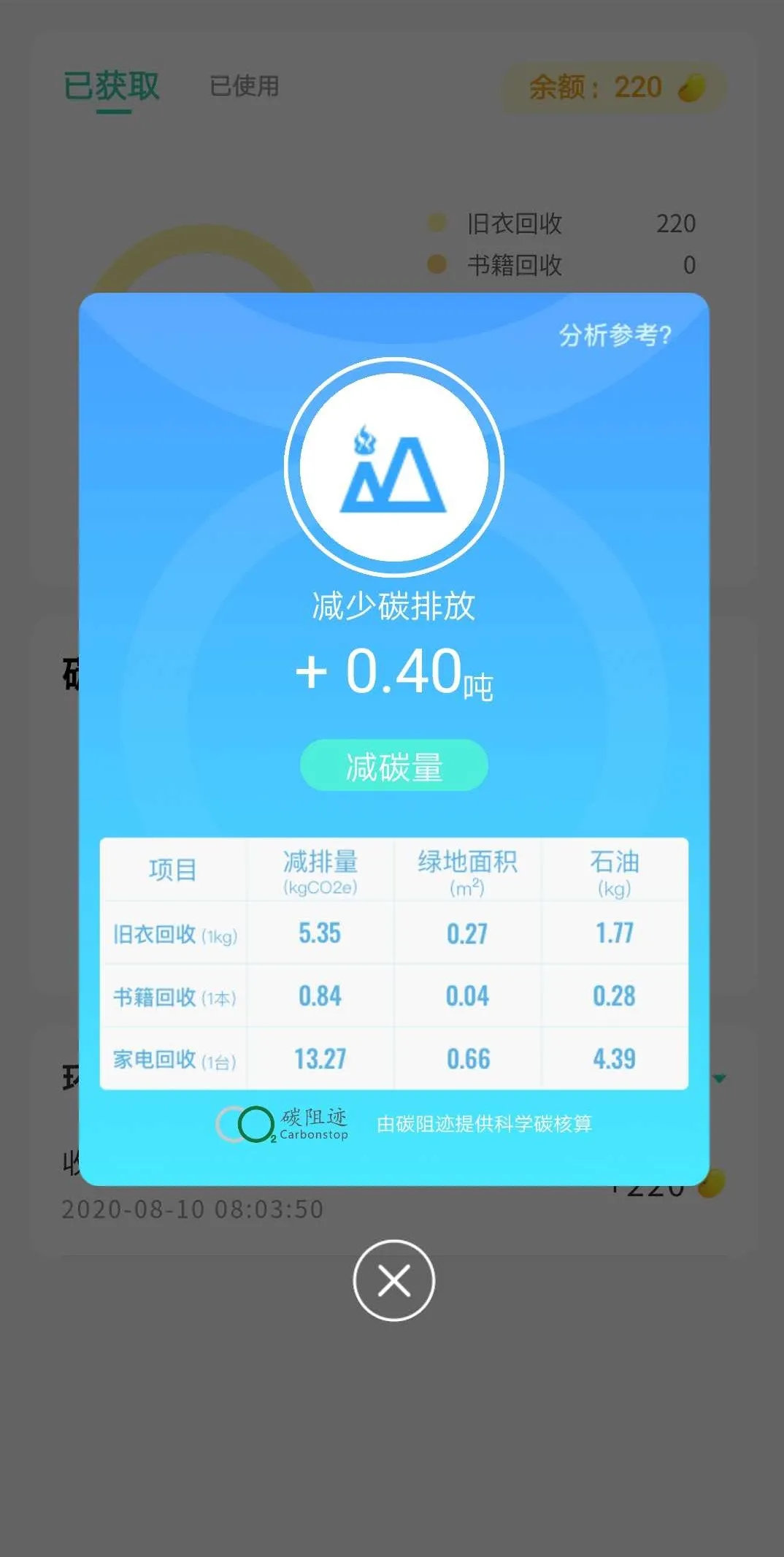
Old clothing recycling brings about an emission reduction of 5.38kgCO2e/kg

Old book recycling brings about an emission reduction of 0.8358kgCO2e/book

Appliance recycling brings an average emission reduction of 13.27kgCO2e/unit

01_1727679907420398.webp02_1727679907626966.webp


Have you ever found your own hidden 10 RMB in old books?

Did you ever secretly wear your dad or mom's clothes when you were young?

Do you want to find a home for your retired old appliances?

Recently, Carbonstop and Feimayi have reached a cooperation agreement to calculate the carbon emission reductions for old clothing recycling, old book recycling, and appliance recycling. Feimayi is a platform advocating zero discarding of idle items and environmentally friendly handling of old clothes. The platform operates under the concept of "environmental protection for the world, public welfare for you." Residents can obtain Eco-Beans through the Feimayi platform for recycling, which can be used to donate to public welfare projects or exchange for eco-friendly benefits, encouraging the whole society to participate in the action of idle-zero-discarding.


03_1727679927819783.gif

Feimayi provides us with an "effective" channel for dealing with old books, clothes, and appliances. You just need to place an order on your phone, and someone will come to collect the items you want to get rid of but might still be useful to others.

Turning waste into treasure is usually low-carbon, but specific carbon emissions and reductions need to be calculated based on actual processes, energy input and consumption, and the scenarios being compared. Therefore, if you want to know whether Feimayi is reducing emissions and how much, you need to dive into the ocean of knowledge!

Old Clothing Recycling

The fashion industry produces approximately 10% of the world's carbon emissions, and it is estimated that textile production alone emits about 120 million tons of greenhouse gases annually. The emergence of fast fashion means that more and more clothes are produced, chosen, forgotten, and sometimes discarded.

The old clothes collected by Feimayi have several main processing routes:

  1. Eco-regeneration: processed into other materials, such as agricultural insulation materials, building industrial sound insulation materials, regenerated fabrics, etc.
  2. Charitable donation: clothes meeting donation standards are given to charitable organizations or foundations for cleaning and disinfection before being donated to poor mountain areas or charitable organizations and individuals.
  3. Export of old clothes: some summer clothes are cleaned and disinfected and then exported to Africa, Southeast Asia, and other impoverished countries through relevant export companies.
  4. Eco-recreation: some recycled clothes are regenerated into fibers and fabrics designed as eco-bags, storage boxes, gloves, cushions, etc.


The emissions from clothing are closely related to their materials, processing processes, and final types. Clothes of the same style, color, and size may produce different carbon footprints due to different materials. Considering the rapid changes in fashion styles, estimating the emission proportions of different types of clothing based on the proportion of clothing materials is more scientific and can find effective data.

In this calculation, I used data from the National Bureau of Statistics and relevant industry associations to find the output or consumption volumes of major common fabric materials such as cotton, wool, silk, linen, viscose fiber, polyester fiber, acrylic, nylon, and polypropylene. Considering the different emissions for reuse (donation and export), open-loop recycling (recycling into different products), and closed-loop recycling (recycling into similar products), and the actual recycling destinations of Feimayi, I calculated the final emission reduction of old clothing recycling to be 5.38 kgCO2e/kg.


Old Book Recycling

With the rapid development of electronic devices and e-books, our demand for physical books may have declined somewhat. However, handling books remains a challenge; throwing them away is wasteful, and selling them as scrap paper seems a pity. The Feimayi platform can properly handle books, with donation, circulation, and shared libraries being the first tier of book handling, while the remaining ineffective books follow the usual book disposal methods.

Considering the emission reductions from donating, circulating, and sharing libraries for old books, and the emissions from raw materials and processing of new books, factors such as paper, ink, water, additives, PS plates, glue, plastic, preparation, collection, writing, design, image editing, proofreading, binding, and plastic films are included. Also considering the combustion and landfilling of paper, the average carbon emission reduction per book is approximately 0.8358 kgCO2e.


Appliance Recycling

Data availability for appliance recycling is relatively poor. Although there are some standards and requirements, such as General Technical Specifications for the Recycling and Utilization of Waste Electrical and Electronic Equipment, Guidelines for Pollution Control during the Recycling and Processing of Waste Electrical and Electronic Equipment, Output Rates of Resources from Disposal of Waste Appliances, Evaluative Values for Regeneration of Electronic Products, Evaluation Technical Specifications for Comprehensive Utilization of Waste TV Sets, etc., these provide guidance and evaluation methods for dismantling steps and products. However, effective data is limited, and due to significant differences between various types of appliances, the actual dismantling processes and output quantities of dismantled products vary.

In this calculation, the focus was mainly on four major categories of appliances: air conditioners, washing machines, refrigerators, and televisions. Using data from the Resources and Environment Database for Electrical and Electronic Equipment for the theoretical and actual scrapped quantities and weights in 2019, combined with a study based on Japan's WEEE recycling phase, the emissions during the logistics, dismantling, and smelting stages of waste metals were considered. By comparing the emissions from smelting the main metallic materials (iron, copper, aluminum) used in appliance production using primary materials, the emission reductions per unit weight of appliances due to recycling were derived. Based on the average weight of different appliances, the estimated average emission reduction for each category of appliance was obtained.

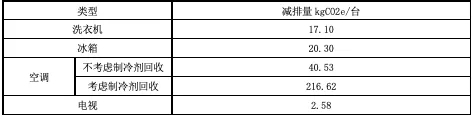
Compared to other appliances, air conditioners have certain particularities because their refrigerants can be recovered and reduce corresponding greenhouse effects. According to the White Paper on China's Waste Electrical and Electronic Equipment Recovery, Processing, and Comprehensive Utilization Industry 2019, the average refrigerant recovery volume for all recycled air conditioners was recorded, leading to the final result shown in the following table.

05_1727680022475896.webp

Based on the recycling ratios of different appliances, the weighted average emission reduction brought about by effectively recycling the main recyclable parts (metals) of an appliance is 13.27kgCO2e/unit (this figure does not include refrigerant recovery).


Welcome to experience and harvest your carbon emission reductions! You can also support your idol!

Schedule a Call with Our Carbon Management Expert

Provide your information and needs, and our carbon management experts will contact you within 24 hours.

碳阻迹 CarbonStop Logo
400-80-14067
mail@carbonstop.com
10th Floor, Building B, Vanke Office Building, Jiu Gong, Daxing District, Beijing
WeChat Official Account二维码
WeChat Official Account
WeChat Service Account二维码
WeChat Service Account
Carbonstop Assistant二维码
Carbonstop Assistant
EarthShop二维码
EarthShop
Authoritative Certification:
京公网安备 11011502037717号
京ICP备11035662号-15
Copyright 2011-2025 All Rights Reserved: Carbonstop (Beijing) Technology Co., Ltd.