
With increasingly stringent external scrutiny, carbon neutrality statements from major companies are constantly questioned, and international condemnation of "greenwashing" is growing louder. However, some experts argue that China is still at the initial stage of forming a consensus on carbon reduction, and it is premature to hastily label companies as engaging in greenwashing. The path to carbon neutrality is destined to be fraught with challenges. Today, Carbonstop would like to discuss with everyone what "greenwashing" is and how Chinese companies can avoid "greenwashing."

01
【What】
/ What is "Greenwashing"? /
"Greenwashing," in English, refers to the practice where companies exaggerate their environmental efforts and mislead consumers into believing them. The term first appeared in 1986 when American environmental activist Jay Westerveld sharply pointed out that hotels suggesting guests "reuse towels" was driven by economic interests rather than environmental concerns. In the Cambridge Dictionary, greenwashing is defined as "companies exaggerating their environmental actions and misleading consumers into believing them."
In 2007, the American Terra Choice Environmental Marketing company conducted a survey on so-called "green products" sold in North America, and subsequently released the "Seven Sins of Greenwashing" in its report, including superficiality, lack of proof, vagueness, irrelevant claims, lesser of two evils, fibbing, and false labeling.
It can be seen that "greenwashing" is essentially false green marketing where companies and their products or businesses claim to have contributed to environmental protection but act inconsistently with their words.
Due to frequent environmental crises around the world, nearly 200 parties agreed to the Paris Agreement at the 2015 Paris Climate Conference, making arrangements for global climate action post-2020. Relevant national laws and regulations were introduced, and public environmental awareness has steadily increased, turning environmental concepts and green living into a fashion.
Driven by green issues such as "carbon neutrality," companies strive to showcase their environmental image and promote their green attributes to gain consumer favor, aiming to enhance their reputation and gain a competitive edge in the market. Additionally, the lack of a standardized regulatory mechanism has made "greenwashing" practices increasingly common in recent years.

02
【Why】
/ Is "Greenwashing" Good or Bad? /
1. The "Lie" of "Carbon Neutrality"
Critics argue that many companies' carbon neutrality actions do not focus on reducing emissions but instead achieve their goals through the simple and crude purchase of carbon offsets, yet many carbon offset projects do not contribute to reducing carbon emissions, yet they bring good reputations to companies for their positive responses.
- The Carbon Offset Bubble
Many high-energy-consuming companies find it difficult to achieve zero emissions no matter how hard they try, thus partially relying on carbon credits to meet their decarbonization goals. While carbon credits create new opportunities in the market, they also pose significant integrity risks, exposing companies to accusations of greenwashing and subsequent reputational damage.
Some believe that the actual effectiveness of many carbon offset projects is often exaggerated and inaccurate. Because today's carbon emissions can only be offset through nature-based solutions, which require time to fully realize their carbon sequestration potential.

For example, reforestation does not immediately reduce carbon emissions; it takes at least twenty years for trees to grow and absorb carbon dioxide from the atmosphere. Moreover, many forest carbon sink projects face the risk of wildfires, which could release stored carbon back into the atmosphere.
- Erosion of Consumer Trust
As "green and sustainable" becomes an increasing demand for consumers, companies are eager to incorporate "green" elements into their marketing to create a perception of being "sufficiently green." This means that consumers will have higher expectations for companies' environmental practices.
The higher the expectation, the greater the disappointment. Once a company's greenwashing behavior is exposed, it significantly reduces consumer willingness to buy and undermines trust in the company's claimed environmental practices. If greenwashing spreads, it may lead the public to doubt all companies' sustainability declarations, putting genuinely sustainable companies at risk as well.
A more pressing issue is the asymmetry of sustainable information and the lack of accessible channels for obtaining information about corporate responsibility, which are critical factors affecting consumer purchases of sustainable products. Sellers know the quality and greenness of so-called green products, but consumers do not. In this context, the provision of information by companies is crucial. However, once there is too much greenwashing, companies lose the space and effectiveness of self-defense.
As Pascal Canfin, Chair of the European Parliament's Environment Committee, said, consumers want to adopt a more sustainable lifestyle, but they don't know what is truly sustainable. And the more companies and organizations abuse terms like sustainability and social responsibility, the more they undermine trust in achieving the 17 Sustainable Development Goals.
"This is the true cost of greenwashing: a society without trust. This society will continue to accelerate the depletion of our natural resources, making it uninhabitable for future generations. We cannot afford this cost."

To combat greenwashing, some national legislative bodies have begun discussing regulations to oversee companies' "greenwashing" behaviors.On April 13, 2022, France enacted specific regulations requiring mandatory disclosure of information related to product "carbon neutrality" advertising and promotion.
The regulations stipulate that if a company wishes to use such promotional language, it must publish a summary report on its website or mobile application, detailing the carbon footprint of the advertised product or service, and the methods prioritized to avoid, reduce, and offset these greenhouse gas emissions. The report includes three annexes, covering the product's carbon footprint, reduction plans, and carbon offset situations.
• Carbon Footprint (Annex 1): Annual greenhouse gas emissions throughout the entire lifecycle of the advertised product or service, following the requirements of ISO 14067 or equivalent standards;
• Reduction Plan (Annex 2): Quantitative annual reduction targets over a 10-year period. Every five years, updated plans covering the next 10 years must be published;
• Carbon Offsetting (Annex 3): Details of the company's arrangements to offset residual greenhouse gas emissions to achieve "carbon neutrality," including the nature, description, and cost of purchased carbon offset projects.
If violations of the regulations are suspected, the company is required to respond within a specified timeframe; otherwise, the environmental department will impose administrative fines on the company.
2. Exploration of "Carbon Neutrality"
However, some experts argue that compared to consumers in developed countries, China's journey toward carbon neutrality is still in its early stages, in the exploratory phase of promoting energy-saving and carbon reduction awareness. Not all companies can achieve carbon neutrality on their own, and purchasing carbon offset projects is a way to support carbon reduction using economic means, an awareness that should be encouraged.
Furthermore, the government has not yet defined greenwashing behavior, nor has it issued corresponding green guidelines for companies and consumers, or established standards for green advertising; the sustainability awareness of Chinese consumers is also not fully awakened.
Therefore, blindly copying foreign perceptions and views on greenwashing may not be wise, as it could harm companies' enthusiasm to participate in carbon neutrality.
Since China proposed the dual carbon targets in 2020, more and more companies have started paying attention to low-carbon environmental protection and are willing to invest real money in the global effort against climate change, which is very encouraging. Currently, most Chinese companies are still in the early stages of observing and learning about carbon neutrality. If we exaggerate the negative impact of greenwashing and create a tense atmosphere, companies will hesitate and refrain from taking proactive actions, which would be counterproductive and missing the point.
If Chinese companies withdraw from participation, the global effort against climate change will lose its greatest momentum!
Wang Jun, author of The Era of Carbon Neutrality, also believes that prematurely labeling companies as engaging in greenwashing is hasty. Even if a company spends one dollar on carbon offsetting, it provides additional economic support to these carbon reduction projects, which is better than doing nothing at all. Such enthusiasm should not be discouraged.
Creating an environment that suits the national conditions and the current stage is what we need to do. On the path to carbon neutrality, allowing companies to engage in healthy competition within legal and compliant frameworks might not be a bad thing!
Taking a simple carbon-neutral conference as an example, the organizer usually considers some carbon reduction scenarios, but the main method to achieve a carbon-neutral conference is still through tree planting or purchasing carbon credits to remove or offset carbon emissions, thereby achieving relative zero emissions. Generally, a conference with 100 participants emits about 10 tons of carbon, and the cost of carbon offsetting, even with the most expensive CCER, would normally be around 1000 yuan. This cost of carbon offsetting poses little barrier to the organizer.
However, the core significance of organizing a carbon-neutral conference lies in raising awareness among the 100 participants and involving them in the process. These individuals will have opportunities to promote carbon neutrality in their respective workplaces, which holds great significance. Therefore, from the perspective of advancing carbon neutrality across society, carbon-neutral conferences are also commendable.
In 2020, the World Economic Forum launched the "1 Trillion Trees Initiative" to plant 1 trillion trees globally by 2030, and China pledged in 2022 to protect, restore, and plant 7 billion trees by 2030. Subsequently, leading Chinese companies such as Yili, Ant Group (pledged 340 million trees), Mengniu, and KE Holdings also committed to their own "tree planting goals" by 2030.
Such proactive actions should certainly be encouraged and supported, praising their bold first steps and the leading role they play in society, showing us a beautiful future and determination to address climate change. Only then do we stand a chance of overcoming humanity's greatest challenge. Of course, we also need to pay attention to the implementation and fulfillment of these commitments.
All these examples indicate that making carbon neutrality commitments is easy, but implementing them is indeed challenging. To avoid the suspicion of greenwashing on the challenging path to carbon neutrality, having a scientific methodology as guidance is key, rather than overly strict one-size-fits-all measures that could prevent companies from taking any action and consumers from making any purchases.
03
【How】
/ How Can Companies Avoid "Greenwashing"? /
China's national carbon neutrality strategy has been proposed for nearly three years. Although awareness of carbon neutrality has significantly improved across various levels of society, companies still feel helpless when faced with the topic of greenwashing, which involves both potential risks and professional thresholds.
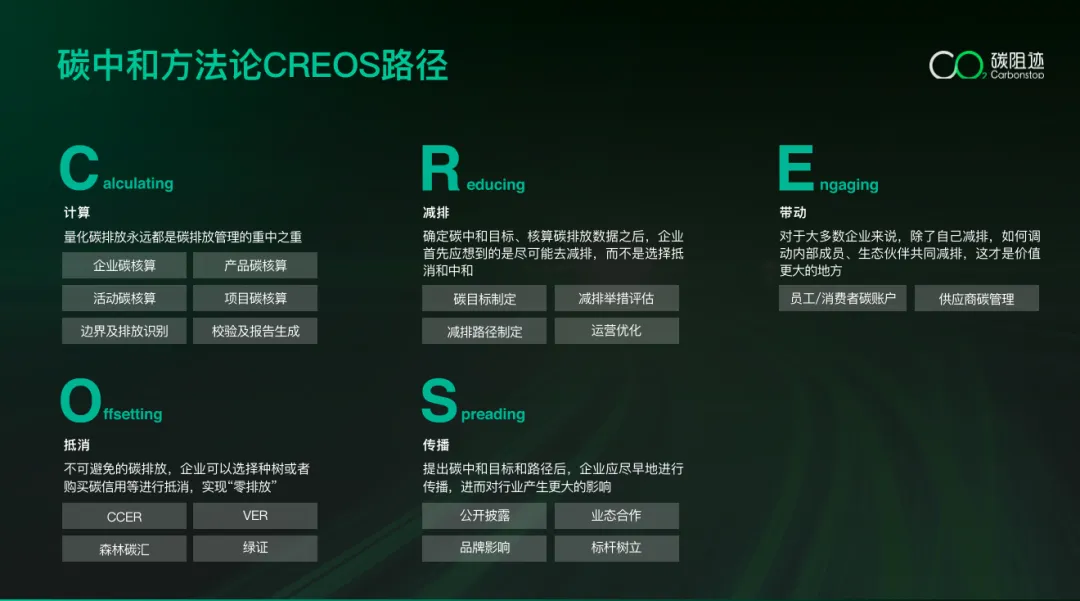
The Carbonstop team, with 12 years of experience in the carbon field, has developed the CREOS methodology through numerous benchmark carbon neutrality projects, providing a clear path for companies to avoid greenwashing.

- C: Calculating(计算)
The first step for companies to avoid greenwashing is to have a complete, accurate, and standard-compliant inventory of their carbon emissions.
"No measurement, no management."
Regardless of the industry, the first step for any company to set its carbon neutrality goals is always to quantify its carbon emissions and understand its carbon footprint. Knowing one's current carbon emission status and position within the industry is essential for taking targeted reduction measures and laying a solid foundation for specific energy-saving and carbon reduction plans.
- R: Reducing(减排)
Reduction before offsetting is one of the key principles to avoid greenwashing.
We have consistently emphasized that in the path to achieving carbon neutrality, internal reduction should always take precedence over offsetting. Companies should consider using offsetting methods to neutralize unavoidable emissions only after they have made every effort to reduce their own carbon emissions.
Current carbon offset projects still come with many uncertainties. Holding the initiative for carbon reduction in one's own hands is akin to controlling one's own destiny.
However, it is important to emphasize that reductions must be feasible within the company's technical capabilities, economically viable, and sustainable. We oppose both excessive reliance on offsetting and irrational or movement-style reductions that disregard technological maturity and economic rationality.
- E: Engaging(带动)
For leading companies, another crucial aspect of avoiding greenwashing is engaging the supply chain. "When poor, improve oneself; when successful, help others," expressing hope for leading companies in the field of carbon neutrality. If a leading company claims carbon neutrality simply by reducing and offsetting its Scope 1 and 2 emissions at minimal cost, it risks falling into the trap of greenwashing.
For most companies, a carbon neutrality path that lacks engagement with ecosystem partners is incomplete. Engaging stakeholders in concrete actions helps avoid the suspicion of "all talk and no action." Engaging in carbon reduction can be reflected in three main areas within a company: supply chain carbon management, employee carbon accounts, and user carbon accounts.
Supply Chain Carbon Management: Some companies require suppliers to provide carbon emission data to disclose their Scope 3 upstream emissions. Thus, they choose suppliers who disclose their carbon emissions, becoming a significant driving force for carbon management across society.
Employee Carbon Accounts: Innovative practices for promoting employee carbon reduction through "carbon accounts" are becoming more common. Companies like China Telecom, Singapore Port Authority, BAIC Group, and Airbus have used employee carbon accounts to involve tens of thousands or even hundreds of thousands of employees in carbon reduction actions. Two things are easiest for companies to manage well: conducting their own carbon inventory and setting carbon neutrality goals and paths, and promoting employee carbon reduction actions. Managing internal affairs is less constrained by external factors and is more controllable.
User Carbon Accounts: Many brand companies are beginning to pay attention to downstream emissions from their products and services. User carbon accounts can engage users in carbon reduction actions, incentivizing everyone to work towards carbon neutrality goals. Initiatives like Ant Forest, Alibaba's 88 Carbon Account, UnionPay Carbon Account, and CITIC Carbon Account are actively promoting the application of user-side carbon accounts.
- O: Offsetting(抵消)
Carbon offsetting is a major area where greenwashing occurs, and media and NGOs focus on the phenomenon of companies not taking action on emission reductions but merely buying carbon credits to achieve carbon neutrality, as well as the authenticity, non-duplication, and longevity of carbon offset projects.Therefore, when companies aim to achieve the final leg of carbon neutrality through carbon offsetting, they can refer to the following principles and strategies:
From the Project Perspective: We encourage carbon removal projects; long-term carbon storage projects; projects with multiple ecological values; and projects with inclusive benefits.
From the Project Provider Perspective: We encourage companies to purchase or invest in promising carbon reduction-related startups, buy their carbon reduction credits, or invest in them so that these startups can obtain much-needed funds to grow and develop when they are not yet mature. When they become strong enough and their technologies are more advanced, they can offer more innovative reduction projects to society and apply their reduction technologies to broader fields.
From the Corporate Perspective: We encourage companies to periodically review their progress and timely adjust their carbon offset strategies to avoid greenwashing risks.
- S: Spreading(传播)
- In terms of communication, overstating or exaggerating is also a key issue of greenwashing that receives social attention.
Internationally, there are increasingly more standards and platforms encouraging carbon disclosure, including CDP, SBTi, and even ESG reports, which mandate or encourage companies to disclose detailed carbon emission data and progress toward carbon neutrality. In terms of disclosure, companies should provide objective and comprehensive information. Overstated or vague carbon neutrality commitments are not commendable.
Firstly, when disclosing their carbon reduction efforts, companies should focus on their own reduction contributions before discussing the outcomes of carbon offset projects. They should provide detailed descriptions of different types of reduction projects, scopes, timelines, etc., enhancing transparency through reports and disclosing specific environmental performance and indicators, such as data on energy use, waste management, and emission reductions.
Secondly, when promoting products, companies should make more accurate and truthful statements. On one hand, they should not exaggerate environmental benefits and only make meaningful claims. They should not hide important information or make broad and uncertain assertions. On the other hand, they should provide consumers with more scientific, intuitive, and understandable low-carbon information.
Over 12 years, Carbonstop has experienced the ups and downs of the industry, investing significant effort in collecting and organizing global carbon emission factor data and developing local databases, as well as creating China's first carbon emission measurement and management platform CAMP and China's leading carbon management SaaS platform Carbon Cloud.As a provider of carbon neutrality management and consulting solutions with a 12-year history, Carbonstop will leverage its practical experience serving 1,200 corporate clients to help companies actively engage in carbon neutrality and avoid greenwashing pitfalls.
04
【Tips】
1. Strengthen Compliance Management and Conduct Self-Inspections Based on Relevant Laws and Regulations: As laws and regulations continue to improve, related regulatory provisions will become stricter. Companies should strengthen their focus on compliance and management. The compliance department should conduct comprehensive self-inspections based on relevant laws and regulations, ensuring that content related to brand communication, marketing language, and product descriptions does not involve compliance risks. They should continuously standardize the company's sustainable promotion behaviors and avoid risks associated with them.
2. Utilize Appropriate Channels and Innovate Methods to Enhance Communication and Feedback: There often exists an information asymmetry between consumers and companies, as consumers typically lack a comprehensive understanding of sustainable practices in the business sectors of companies, and their understanding of sustainability may differ from that of industry insiders. To truly help consumers choose sustainable products and services, companies with sustainable practices should take on the responsibility of active communication and education, while optimizing communication channels with all stakeholders, such as strengthening ties with media and actively engaging in feedback communications.
3. Avoid “Hollow Grandiosity,” Replace Perfectionism with Practicality: Many companies aspire to be leaders and set benchmarks in the low-carbon sector, which can lead to setting overly ambitious carbon neutrality goals that risk being labeled as greenwashing if unmet. Given this, companies should adopt a sincere and open attitude in their environmental practices, timely acknowledge shortcomings, and truthfully disclose their efforts in green practices, drop by drop. They should not strive for flawless records but focus on delivering tangible green benefits.
On the journey to implementing carbon neutrality, challenges are inevitable, but perhaps a scientific approach and methodology can turn this thorny path into one full of opportunities!
References:
1. The Oxford Principles for Net Zero Aligned Carbon Offsetting
https://www.smithschool.ox.ac.uk/sites/default/files/2022-01/Oxford-Offsetting-Principles-2020.pdf
2. Southern Weekly. Southern Weekly Releases the '2022 China Greenwashing List'
https://mp.weixin.qq.com/s/Ha7lUIab99Zg-fkYvmpwDw
3. Song Bingchen, Wang Tao (eds.). Saying Goodbye to Greenwashing Is Not Difficult: Analysis of the 2022 'China Greenwashing List'
https://mp.weixin.qq.com/s/klEA-7wGC99UIB3KECK_gg
4. Lu Yaning, Su Jianxun (eds.). Nestle and Gucci, Planning to Abandon Carbon Neutrality Commitments? | 36 Carbon Focus
https://mp.weixin.qq.com/s/GCDiRqffQnP9VWnDZ9Jm9w
5. Ayman Guirguis, Zero Carbon Jun (translator). Eight Commandments to Avoid 'Greenwashing' and Non-compliance in Environmental and Sustainability Claims
https://mp.weixin.qq.com/s/KELdO2U2o8KXdcp1uMt2LA