碳阻迹 CarbonStop Logo
Please be aware that this article is translated by AI, and like humans, they can make mistakes too.
World Health Day | Health Also Goes "Carbon Neutral," How Can China’s Healthcare Industry Scientifically Reduce Emissions?

World Health Day | Health Also Goes "Carbon Neutral," How Can China’s Healthcare Industry Scientifically Reduce Emissions?

NET-0CARBON MANAGEMENTCARBON REDUCTION
viewCount211

Spring arrives, and all things renew themselves, the sky clears and the earth brightens. Today marks the 74th World Health Day and also the 75th birthday of the World Health Organization. After the first spring following three years of pandemic, the theme of World Health Day, “Health for All,” carries particularly profound significance.

“Health for All” — everyone can enjoy health, living fulfilling lives in a peaceful, prosperous, and sustainable world.

The World Health Organization (World Health Organization, abbreviated as WHO) considers climate change one of the most pressing public health issues globally, as it impacts human health in multiple ways.

Therefore, the WHO has repeatedly expressed its emphasis on the relationship between climate change and health in various contexts, calling on countries to take proactive actions to address climate change and safeguard global health and sustainable development.

In 2008, the WHO clarified its organizational action direction through its work plan, supporting member states in strengthening health systems and community climate resilience.

In 2015, the WHO released the 2014-2019 Climate Change and Health Work Plan, making climate action a priority.

In 2018, the WHO, in collaboration with the United Nations Environment Programme (UN Environment) and the United Nations Framework Convention on Climate Change (UNFCCC), among others, published the report “Driving Climate Action in the UN 2030 Agenda for Sustainable Development,” aiming to promote synergistic actions between climate change and sustainable development.

In 2021, at the Glasgow United Nations Climate Change Conference, 50 countries committed to taking concrete measures to build climate-resilient health systems. Among them, 45 countries also pledged to transform their health systems into more sustainable, low-carbon systems, with 14 countries setting target dates to achieve net-zero emissions by 2050 or earlier.


01

Carbon Emissions from Healthcare Industry

Global Healthcare Sector Carbon Emissions

Many people are unaware that the healthcare sector accounts for 10% of the global GDP and is a significant source of greenhouse gas emissions. The scale of healthcare sectors varies widely across countries, but they all emit greenhouse gases while providing services and need to procure products and technologies from carbon-intensive supply chains. For example, the healthcare sector generates carbon emissions during energy consumption, transportation, and the manufacturing, use, and disposal of products.

According to a September 2019 report by ARUP and Health Care Without Harm (HCWH), the global healthcare sector's carbon emissions account for 4.4% of total emissions (approximately 2 billion tons of CO2 equivalent). Therefore, reducing carbon emissions in the healthcare system is crucial for achieving greenhouse gas reduction targets.

However, to date, only a few countries worldwide have conducted comprehensive healthcare carbon footprint measurements.

The healthcare industry in the United States already accounts for 9.8% of the country's total emissions. If the U.S. healthcare industry were considered a separate country, its greenhouse gas emissions would rank 13th globally, ahead of the UK.

In 2015, the UK healthcare industry's carbon footprint was approximately 26.6 million tons of CO2 equivalent, accounting for 39% of public sector emissions.

China's rapidly growing healthcare industry emits about 361 million tons, comparable to France's total emissions.

If global health expenditure grows at an annual rate of 3.8%, starting from $9.2 trillion in 2014, it would reach approximately $24.2 trillion by 2040. Such growth, if not coupled with carbon reduction strategies, could double or even triple the healthcare sector's carbon footprint by 2050, directly conflicting with global climate goals.

Carbon Emissions from Chinese Healthcare Institutions

China's healthcare system primarily consists of hospitals, primary healthcare institutions, and specialized public health institutions. According to the report "Healthcare’s Climate Footprint," China's healthcare institutions rank second globally in terms of carbon emissions. With the continuous development of China's healthcare industry and the aging population, China's healthcare system's carbon emissions will continue to rise.

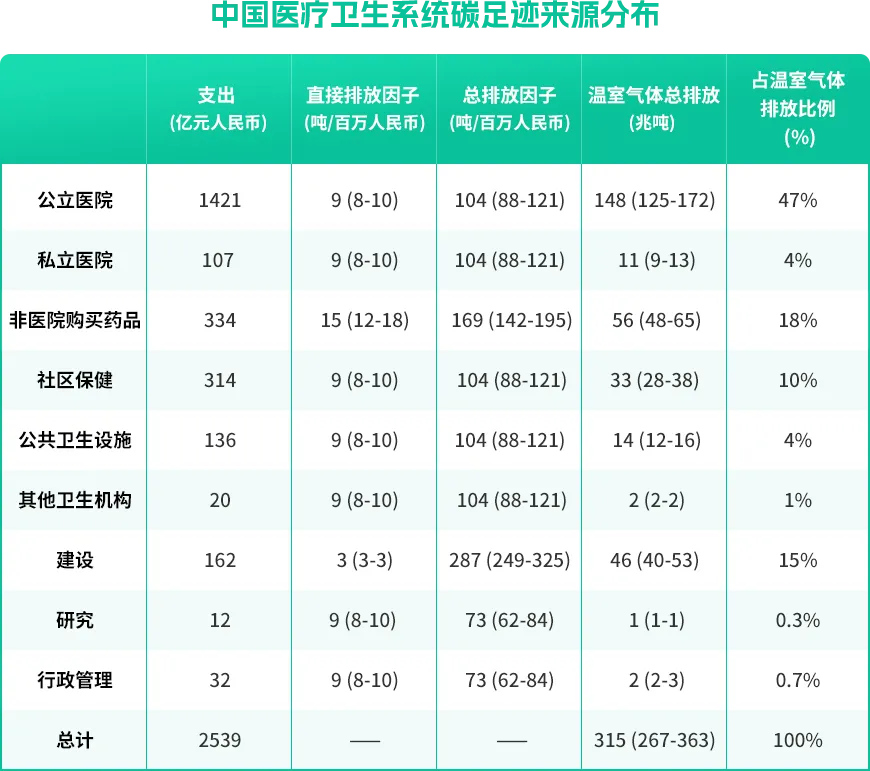
In China's healthcare system carbon emissions, the top three sectors with the highest emissions are the operation of public healthcare institutions, hospital construction, and non-hospital drug purchases, with public healthcare institutions accounting for about 47% of the total emissions.

It is evident that to promote carbon neutrality in the healthcare system, carbon reduction in healthcare institutions should be given sufficient attention.

640-25_1731406944026372.webp

02

Case Studies of Carbon Reduction in Foreign Healthcare Institutions

Most countries in the world have a certain foundation in the construction of green hospitals and carbon reduction in healthcare institutions. Some developed countries have advantages in the foundation and technology of carbon reduction and have set clear quantitative targets.

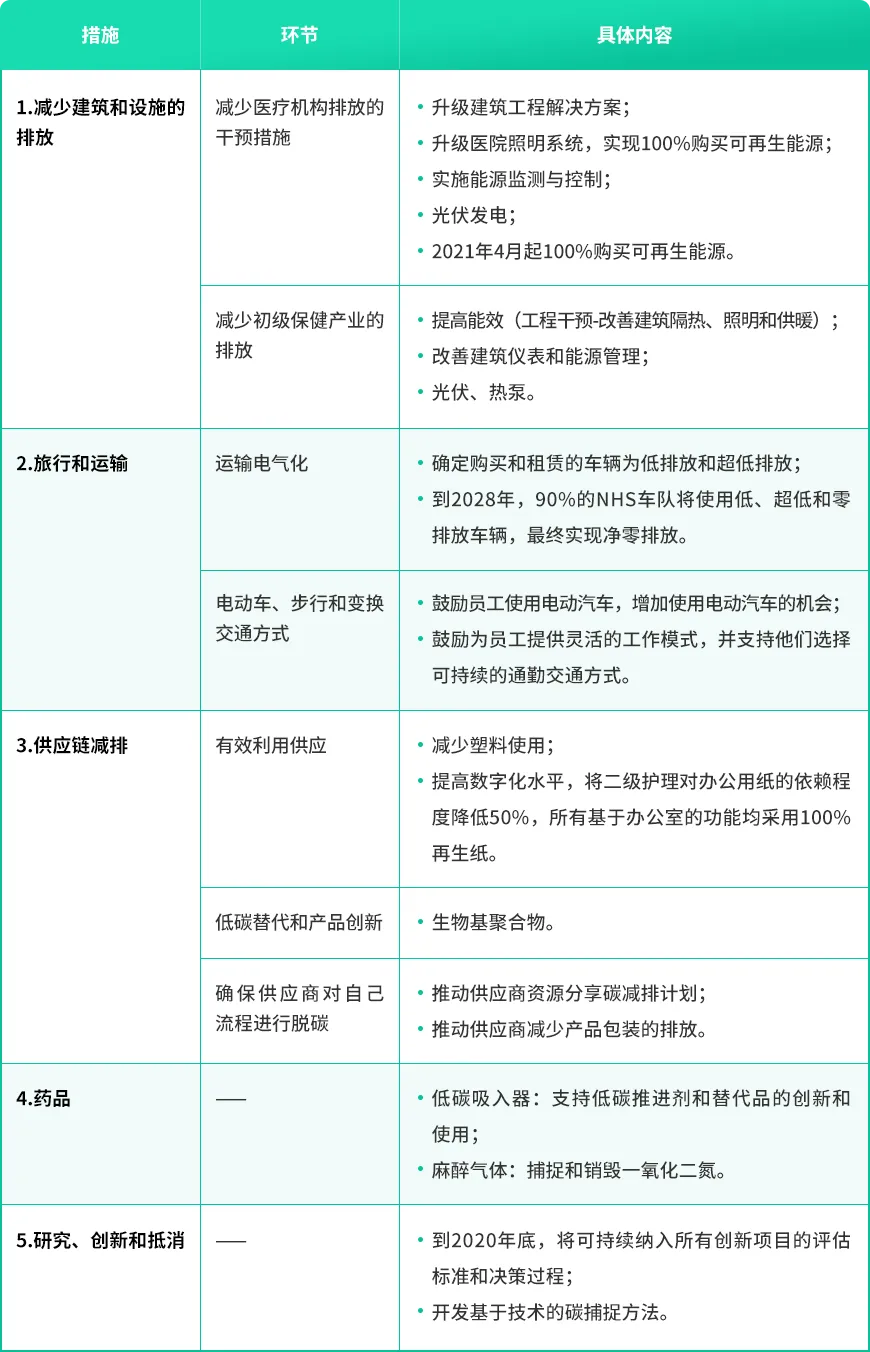
The National Health Service (NHS) in the UK has set a goal to achieve net-zero emissions by 2040 and ambitiously aims to reduce emissions by 80% between 2028 and 2032.

In specific measures, the NHS intervenes directly to achieve net-zero goals by reducing emissions from buildings and facilities, travel and transport, supply chain reductions, pharmaceuticals, research innovation, and offsets. In addition to direct interventions, the NHS provides net-zero health services through new care models combined with long-term plans, financial mechanisms, staff and leadership training, and other methods.

640-26_1731406997052770.webp

03

Case Studies of Carbon Reduction in Chinese Healthcare Institutions

China still has a large unmet medical demand, and improving access to and quality of medical services remains a priority for the current healthcare sector. Promoting carbon peak and carbon neutrality in healthcare institutions is a social responsibility of these institutions, although China's healthcare institutions are still in the early stages of exploring carbon neutrality.

Domestically, Schneider Electric has combined carbon reduction with the construction of smart hospitals, assisting Huashan Hospital North Campus of Fudan University in building a "smart hospital of tomorrow."

640-27_1731407299364801.webpFrom domestic case studies, it can be seen that current carbon reduction efforts in China's healthcare institutions are mostly pilot projects or single hospitals, lacking overall planning and coordination, and have not yet addressed supply chain reductions.

04

How Can China's Healthcare Industry Achieve Scientific Carbon Reduction?

Three pathways for the healthcare industry to achieve comprehensive and scientific decarbonization:

Decarbonization of Infrastructure and Service Operations

Hospital buildings are more energy-intensive than general commercial buildings due to high plug loads and relatively high lighting, heating, ventilation, and air conditioning demands. Healthcare institution buildings should quickly achieve full greenification; new healthcare institutions should meet corresponding green evaluation standards, and existing buildings should be promptly upgraded to green standards.

Decarbonization of Healthcare Supply Chains

In 2012, about 84% of the carbon footprint in China's healthcare system was embedded in the goods and services procured by healthcare institutions, making the choice of supply chains critical for reducing the carbon footprint.

Environmental Handling of Waste

Healthcare institutions generate a large amount of medical waste. Proper classification, collection, disposal, and recycling of medical waste can reduce waste generation and environmental pollution. Pharmaceutical companies can also promote the recycling and reuse of drug packaging to reduce waste generation.

Under the global climate crisis, the “3060” targets are a significant commitment made by China. Achieving carbon neutrality in healthcare institutions is an essential part of realizing China's dual carbon targets.

Carbon neutrality in the healthcare industry will transform the entire industrial chain, driving China's healthcare institutions toward a low-carbon and sustainable development path.

Schedule a Call with Our Carbon Management Expert

Provide your information and needs, and our carbon management experts will contact you within 24 hours.

碳阻迹 CarbonStop Logo
400-80-14067
mail@carbonstop.com
10th Floor, Building B, Vanke Office Building, Jiu Gong, Daxing District, Beijing
WeChat Official Account二维码
WeChat Official Account
WeChat Service Account二维码
WeChat Service Account
Carbonstop Assistant二维码
Carbonstop Assistant
EarthShop二维码
EarthShop
Authoritative Certification:
京公网安备 11011502037717号
京ICP备11035662号-15
Copyright 2011-2025 All Rights Reserved: Carbonstop (Beijing) Technology Co., Ltd.