In the grand narrative of addressing climate change, the financial system plays a pivotal role as the "core hub" for carbon flows. Every loan and investment decision profoundly influences the trajectory of global greenhouse gas emissions. Therefore, accurately measuring the greenhouse gas emissions associated with an institution's own operations and its financing and investment activities (referred to as "financed emissions") has become the cornerstone for promoting green transformation of the global economy, managing climate-related financial risks, and practicing responsible investments.
On the other hand, facing increasingly stringent sustainability disclosure requirements globally, financial institutions are under unprecedented pressure to quantify and disclose their "financed emissions". In previous articles in this series [Carbonstop Original], we have already outlined the core frameworks and key standards for carbon accounting within financial institutions under the ISSB guidelines. Among these, the Partnership for Carbon Accounting Financials (PCAF) standard stands out due to its systematic approach and practicality, being recommended by the Task Force on Climate-related Financial Disclosures (TCFD) and the International Sustainability Standards Board (ISSB) as the preferred reference standard for calculating financed emissions.
This sharing will delve into the core accounting logic and methodological points of the PCAF standard, breaking down key issues step by step:
Asset class alignment: How to precisely select applicable accounting methods based on asset classes (such as corporate loans, listed equities, project finance, etc.)?
Boundary definition of responsibility: How is the concept of attribution factor applied? How do financial institutions scientifically determine their "responsibility proportion" towards the carbon emissions of borrowers/investees?
Addressing data gaps: In light of challenges related to data availability (especially for non-listed companies), what practical and audit-compliant estimation methods does PCAF recommend (such as using industry average data, economic data estimates)?
Detailed operational steps: How are critical accounting processes (such as defining accounting boundaries, collecting activity data, selecting emission factors, calculating attributed emissions) specifically executed and ensured compliance?
Introduction to PCAF Methodology
PCAF (Partnership for Carbon Accounting Financials) is an industry partnership initiated by global financial institutions, established in 2015 and initially launched by several Dutch banks. Its mission is: "To provide consistent, transparent, and comparable greenhouse gas (GHG) emission accounting methodologies for the financial sector", helping banks, asset managers, insurers, and other institutions fully disclose the carbon footprint generated by their loans and investment portfolios.
PCAF has developed three main accounting guidelines tailored to the specific needs of the financial sector:
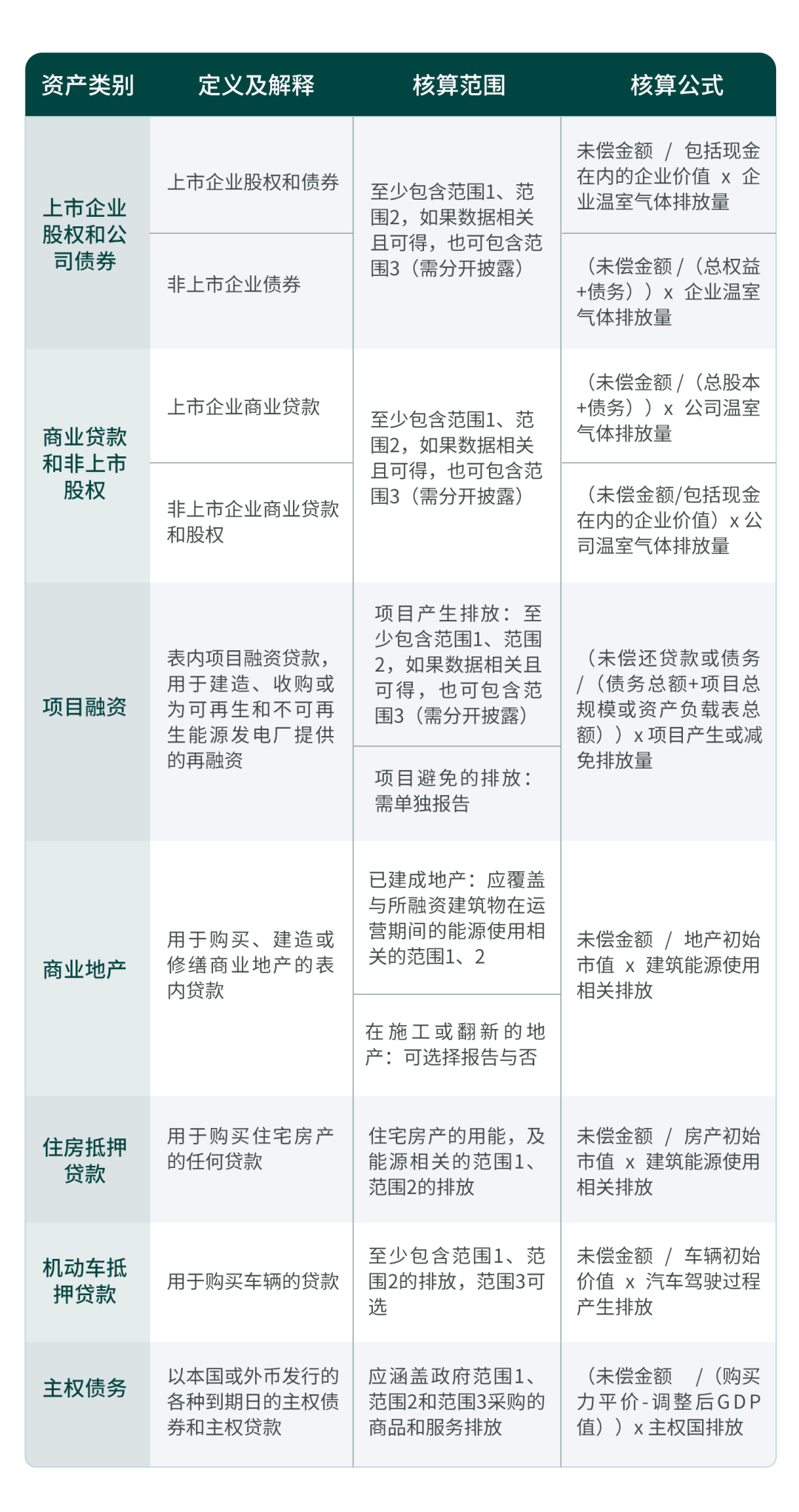
Part A - Financed Emissions, guiding banks and asset managers on how to incorporate seven asset categories including loans, equities, bonds, project finance, real estate loans, auto loans, and sovereign debt into emission accounting;
Part B - Facilitated Emissions, accounting for the emission impacts arising from transaction facilitation services such as underwriting, M&A, and capital market advisory provided by financial institutions;
Part C - Insurance-associated Emissions, focusing on how insurance companies identify and quantify emission liabilities from high-carbon-risk assets within their underwriting scope.
These three parts together form a GHG accounting system covering financing, underwriting, and insurance-related aspects across the financial sector. This standard system is based on the GHG Protocol and supported by multiple international initiatives including TCFD, SBTi, and GFANZ. The first version of PCAF has passed review by the GHG Protocol, aligning with Scope 3 Category 15 "Investment Activities"; the second version adds sovereign debt accounting methods and emission removal guidelines, currently under review by the GHG Protocol. Thus, greenhouse gas emissions calculated according to PCAF methods for financing activities are equivalent to Scope 3-15 emissions under the GHG Protocol framework, enabling seamless integration with corporate Scope 3 reporting.
PCAF is currently updating to its third version, expected to be released in the second half of 2025. This update addresses several key areas on top of the second version, including use-of-proceeds accounting, scope-shifting issues, and more refined and detailed asset category emission quantification methods, providing higher precision and granularity in disclosed data.
Principles and Requirements of PCAF Accounting Framework
The PCAF standard explicitly requires that financial institutions' accounting for financed emissions adhere to the five principles (completeness, relevance, consistency, accuracy, transparency) of the GHG Protocol accounting system. Additionally, it proposes extra requirements specific to the financial sector, key points include:
Classification of asset categories, including listed equities and corporate bonds, commercial loans and unlisted equities, project finance, commercial real estate finance, residential mortgage loans, auto loans, and sovereign debt.
Proposing the principle of "funds flow", guiding financial institutions to match different funds activities to corresponding asset categories according to the path of funds flow from "financing type and source - use of proceeds - activity sector".
Specifying specific accounting requirements for different asset categories, proposing accounting requirements around absolute GHG emissions, avoided emissions, and emission removals, and requiring supplementary disclosures of relevant information within the applicable asset scope.
Accounting recommendations employ four types of indicators: absolute emissions, economic emission intensity (based on monetary units), physical emission intensity (based on output units), and weighted average carbon intensity.
Proposing scope 3 accounting requirements for invested industries, the standard requires financial institutions to account for Scope 1 and Scope 2 emissions of financiers, while setting phased requirements for Scope 3 emissions accounting across different industries.
Data quality assessment standards, proposing corresponding standards for different asset categories, with scores ranging from 1 to 5, indicating decreasing data quality.
Core Methodology Principles and Asset Class Accounting Essentials
The core formula of the PCAF standard is: Financing activity emissions = Attribution factor × Carbon emissions
Where,
"Attribution factor" refers to the ratio of the financial institution's outstanding balance to the total financing amount of the target entity (company or project), representing the institution's share of emission responsibility;
"Carbon emissions" depend on the annual emission totals (or project emissions) of the invested entity, varying according to asset category.
For instance, for listed equities and corporate bonds, the attribution factor can be the holding ratio (or bond book value) divided by the company's total value, multiplied by the company's annual emissions; for project finance, it uses the financing amount's ratio to the project's total investment, multiplied by the project's annual emissions.
PCAF standards cover seven asset categories, each with specific accounting methods (the core idea being "investment share × carbon emissions of the target").

GHG Accounting Process - Listed Equities and Corporate Bonds Example
Asset Category Scope
This accounting method applies to the following asset categories:
① All types of corporate bonds for general purposes;
② Ordinary shares;
③ Preferred shares.
Core Formula
Emissions from listed equities and corporate bonds = Attribution factor × Company carbon emissions of financier
Emission Attribution
A portion of the financier's emissions should be attributed to the financial institution, determined by the attribution ratio, which is:
The ratio between the outstanding amount of financier (numerator) and the company value of financier (denominator)
Company Value of Financier: For listed companies, company value equals EVIC (Enterprise Value Including Cash); for unlisted companies issuing corporate bonds, company value equals the sum of equity and liabilities on the balance sheet.
EVIC: Defined as the year-end market value of ordinary shares, year-end market value of preferred shares, and the book values of liabilities and minority interests.
Outstanding Factor: The actual outstanding amount of listed equities or corporate bonds should be defined according to the denominator. For listed equities, it is the market value of stocks (i.e., stock price × number of held shares); for corporate bonds, it is the book value of debt owed by the borrower.
Therefore, when the investee is a listed company:
Attribution factor= (Market value of held shares / Book value of outstanding corporate bonds) ÷ EVIC
When the investee is an unlisted company issuing corporate bonds:
Attribution factor= Book value of outstanding corporate bonds ÷ Sum of equity and liabilities
Corporate Emission Data
「Emission Scope」
Default should use the target company's annual Scope 1+2 emissions data as emission input; for included industries, consider gradually incorporating Scope 3 emissions. For example, PCAF suggests including energy and mining sectors from 2021, transportation, construction, materials, and industrial sectors from 2024, with remaining sectors to follow.
「Data Timepoint」
Emission data timepoints should align with the financial institution's fiscal accounting periods (e.g., using end-of-year data of the same year), and specify the year used in reports.
「Emission Data Selection」
① Reported emissions: Directly obtained from the financier enterprise (such as corporate sustainability reports) or indirectly collected through validated third-party data providers (such as CDP);
② Entity-based emissions: Calculated using primary activity data (such as electricity, natural gas usage) collected from the financier enterprise, published or certified by credible independent entities;
③ Economy-based emissions: Estimated using industry-specific or regional average emission factors (EEIO) based on economic activity data collected from the financier enterprise.
「Data Quality Score」
PCAF requires financial institutions to adopt a graded quality evaluation for emission data, typically using a 1–5 scale (with 1 being the highest data quality). Specific scoring criteria are shown below:


「Avoided Emissions and Carbon Removals」
As mentioned earlier, the PACF standard requires additional disclosure of information on avoided emissions and carbon removals for applicable asset categories, which is specifically illustrated in the following image.

Reporting avoided emissions and emission removals is a way to quantify and demonstrate financial institutions' positive contributions to curbing climate change. Avoided emissions refer to investments in renewable energy projects or energy-efficient products that reduce emissions in other areas of the economy. Emission removals involve investments in carbon removal projects such as afforestation, direct air carbon capture, and storage, which directly help sequester or remove CO2.
When calculating avoided emissions, it is crucial to choose an appropriate baseline (i.e., average product or technology in the market) and adopt a conservative approach to avoid overstating avoided emissions. The baseline represents the emissions that would have been produced without implementing the project. The difference between baseline emissions and project emissions is the avoided emissions.

The calculation of carbon removals follows a similar logic to the quantification of carbon emissions, multiplying the allocation factor of an individual asset by its carbon removals, thereby obtaining the amount of carbon removals resulting from financing provided to a single asset. Then, the carbon removals are aggregated:
Funding Party's Carbon Removal = Unpaid Amount of Enterprise ÷ Sum of Enterprise Equity and Liabilities × Enterprise Carbon Removal
Conclusion

Accurately measuring the carbon footprint of investment and financing is no longer optional but a necessary course for the survival and development of financial institutions towards the future. With its authority, practicality, and continuous evolution capability, the PCAF standard has become the universal key for global finance to unlock the "carbon code." Mastering it not only effectively addresses regulation and risk but also proactively captures significant opportunities within the green finance wave, leading responsible investment futures.
Carbonstop, leveraging its core advantage of a self-developed database with 160,000 detailed industry factors, along with a professional consulting team and rich experience in serving financial institutions, can provide full-chain services from standard interpretation, method implementation, data solutions to report disclosure, assisting financial institutions in precisely quantifying the carbon footprint of their asset portfolios and seizing market opportunities in the green finance sector!
References:
1.PCAF Financed Emissions The Global GHG Accounting & Reporting Standard Part A
2.The PCAF Global GHG Accounting Standard for Financed Emissions: Key Considerations for Alternative Asset Managers: https://hl.com/insights/the-pcaf-global-ghg-accounting-standard-for-financed-emissions-key-considerations-for-alternative-asset-managers/
3.PCAF《金融业指南》核心内容解: https://www.ideacarbon.org/news_free/58348/?pc=pc
4.NSD PKU Macro & Green Finance Lab: https://mgflab.nsd.pku.edu.cn/en/Research/Articles/753cc132f02b4f0885a1bf67b39c6fad.htm
5.Banking Management and Operation: Practical Experience and Challenges of PCAF Carbon Accounting Methods in Commercial Banks, Du Han Xiao Yingqi: https://www.chinaifs.org.cn/upload/1/editor/1740151521834.pdf