碳阻迹 CarbonStop Logo
Please be aware that this article is translated by AI, and like humans, they can make mistakes too.
From the report, we can see the new dual carbon situation: reshaping the green industry competition pattern through the product carbon footprint system

From the report, we can see the new dual carbon situation: reshaping the green industry competition pattern through the product carbon footprint system

CARBON FOOTPRINTCARBON INVENTORYSUSTAINABILITY
viewCount365


On June 25th, the Ministry of Ecology and Environment released the "Report on the Construction Progress of the Product Carbon Footprint Management System (2025)". This report not only systematically summarizes the progress made in the construction of China's product carbon footprint management system since 2024 but also provides a clear guide for future green and low-carbon development paths. This article interprets the related work conducted from four aspects: establishing and improving the management system, constructing a working pattern, promoting mutual trust in international rules, and strengthening capacity building.


A product carbon footprint refers to the total amount of carbon emissions generated throughout all stages of a product's lifecycle, including raw material acquisition, production, transportation distribution, consumption, and final disposal. It is an important metric for measuring the green and low-carbon levels of production enterprises and products. In recent years, international trade policies and market access rules based on product carbon footprints have emerged frequently, with more and more multinational companies incorporating product carbon footprints into their sustainable supply chain management requirements.


Looking back at the process of establishing the product carbon footprint management system, the release of policies has played a crucial role. From the proposal of concepts to the initial construction of the system, and up to its current deepened development, China has been accelerating its progress in this area.

Establishing and Improving the Carbon Footprint Management System


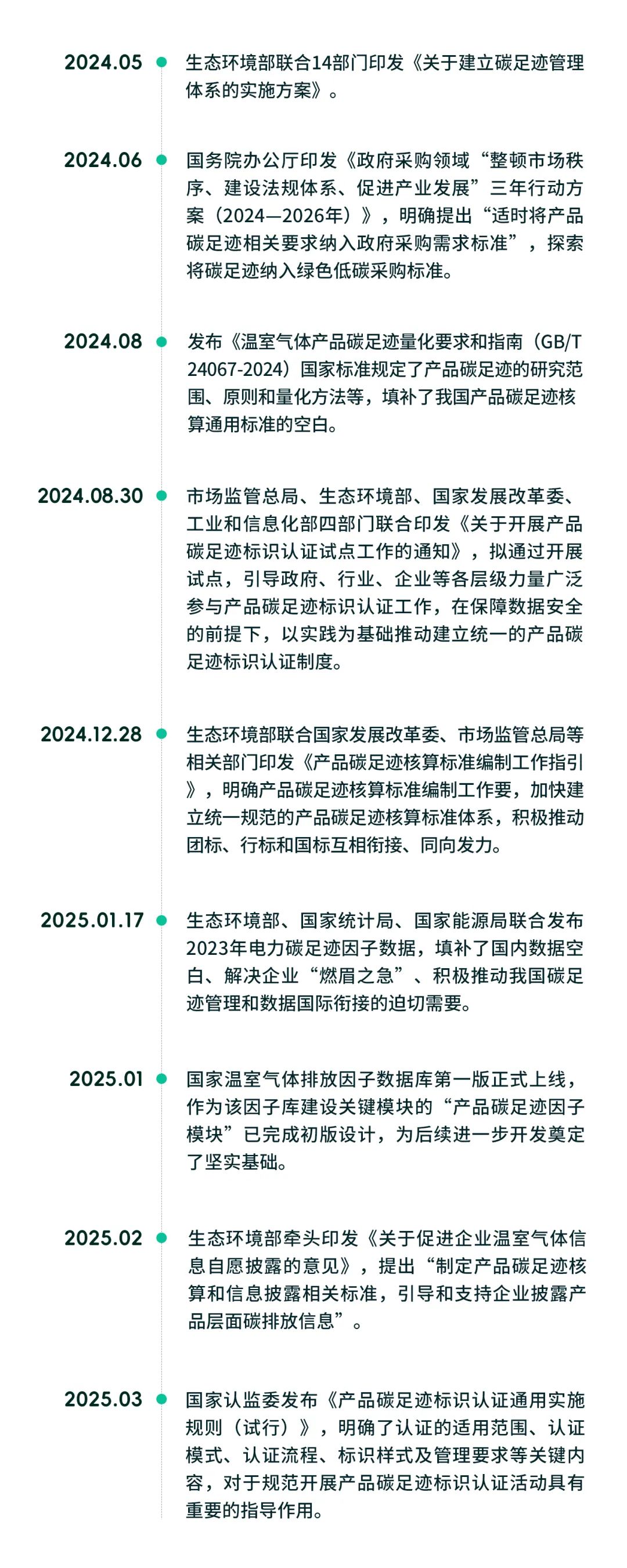
In May 2024, the Ministry of Ecology and Environment, along with 14 other departments, issued the Implementation Plan for Establishing a Carbon Footprint Management System, which clearly identified two major cornerstones—rules and standards, and factor data—and encouraged local pilot projects and policy innovations, as well as leading enterprises in key industries to take the lead in trials. It guided the establishment of three systems: product carbon footprint labeling certification, tiered management, and information disclosure.


Rules and Standards: Refers to the national standard GB/T 24067-2024 "Requirements and Guidelines for Quantifying Greenhouse Gas Product Carbon Footprints," which stipulates the scope of research, principles, and quantification methods for product carbon footprints, filling the gap in China's general standards for calculating product carbon footprints. The standard was adjusted structurally based on the international standard ISO 14067:2018. Experts from Carbonstop also participated in drafting and revising this standard, providing guidance and direction for the construction of the product carbon footprint standard system.


Factor Data: In January 2025, the first version of the National Greenhouse Gas Emission Factor Database was officially launched online. As a critical module of this database, the "Product Carbon Footprint Factor Module" has completed its initial design, laying a solid foundation for further development.


On January 17, 2025, the Ministry of Ecology and Environment, the National Bureau of Statistics, and the National Energy Administration jointly released the 2023 power carbon footprint factor data. This includes the average carbon footprint factor for national electricity, as well as the main types of power generation such as coal, gas, hydropower, nuclear energy, wind, photovoltaic, concentrated solar power, biomass, and transmission and distribution carbon footprint factors. As part of the expert group, Carbonstop was honored to participate in the calculation of national carbon footprint factors, laying a solid foundation for the basic factor data of China's product carbon footprint database.


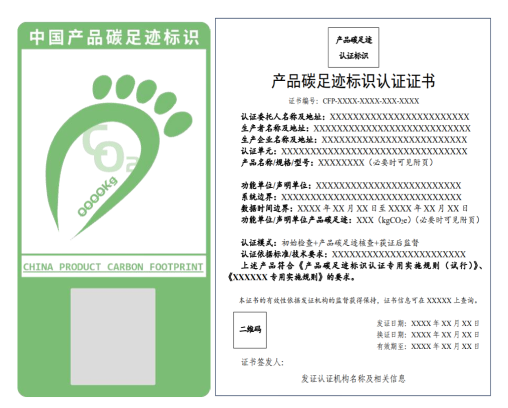
On August 30, 2024, the State Administration for Market Regulation, the Ministry of Ecology and Environment, the National Development and Reform Commission, and the Ministry of Industry and Information Technology jointly issued a notice on conducting pilot work for product carbon footprint labeling certification. In March 2025, the Certification and Accreditation Administration released the General Implementation Rules (Trial) for Product Carbon Footprint Labeling Certification, clarifying key contents such as the applicable scope, certification model, certification process, label style, and management requirements, which provide important guidance for standardizing product carbon footprint labeling certification activities.


Product Carbon Label / Product Carbon Footprint Labeling Certification Certificate


In February 2025, the Ministry of Ecology and Environment led the issuance of the Opinion on Promoting Voluntary Disclosure of Enterprise Greenhouse Gas Information, proposing to "formulate relevant standards for calculating and disclosing product carbon footprints and guide and support enterprises in disclosing product-level carbon emission information." By the end of 2024, over 1,000 listed companies had disclosed greenhouse gas emission data, and more than 150 listed companies had disclosed Scope 3 greenhouse gas emission data. For many enterprises, quantifying and managing Scope 3 remains a significant challenge due to its broad involvement across the value chain.

Preliminary Formation of a Multi-party Participation Work Pattern


In the process of implementing the product carbon footprint management system, China is building a diversified pattern of "policy synergy support, diverse application scenarios, and pioneering management" aimed at integrating the concept of carbon footprints into various aspects of economic and social life.


Strengthening Policy Synergy: The country is actively integrating product carbon footprint requirements into trade and industrial policies and promoting innovative applications in the financial sector. Priorities include establishing carbon footprint standards for export-oriented products, guiding central enterprises to incorporate carbon footprints into green supply chain evaluations, and supporting the construction of the national greenhouse gas emission factor database. Encouraging financial institutions to develop green finance products based on carbon footprints, linking loan interest rates to carbon footprints, and guiding credit rating agencies to include ESG factors. As of November 2024, the "Industrial Green Development" zone had included 4,025 enterprises, assisting 2,136 enterprises in financing RMB 111.912 billion and guiding financial institutions to continuously provide customized, targeted financial services.


Enriching Application Scenarios: Focuses on transforming the concept of carbon footprints into practical actions and visible results. For example, Alibaba launched the "88 Carbon Account," presenting low-carbon-friendly brands, low-carbon benchmark products, low-carbon packaging representative products, etc., while recording users' carbon footprint maps and emission reduction achievements, covering eating, wearing, using, and other life scenarios, making low-carbon behaviors perceptible. JD Retail initiated the "Green Youth Plan," opening personal carbon accounts for consumers, recording user lifestyle footprints while providing carbon energy as consumer points incentives. In terms of low-carbon scenario applications, Carbonstop has also customized platforms for multiple international renowned brand clients, allowing corporate employees and brand users to make low-carbon behaviors perceptible.


Promoting Pioneering Trials: Multiple provinces (regions, municipalities) have combined their own situations to study and compile provincial carbon footprint management work plans and implementation details, establishing coordination mechanisms. For instance, Zhejiang Province has actively carried out advantageous product carbon footprint work. Focusing on the textile industry with full industry chain advantages, it released local standards for evaluating carbon footprints of specific products like chemical fibers, silk, and cotton, built a localized carbon footprint database for textiles and clothing products covering upstream and downstream data across the chemical industry, chemical fiber, textile, printing and dyeing, clothing, and other industry chains, and developed and stored over 400 factors. It took the lead in conducting product carbon footprint evaluation pilots in more than 20 leading enterprises in key industries such as textiles and lithium batteries.

Steady Improvement in International Mutual Trust of Carbon Footprint Rules


In the process of moving towards internationalization in the construction of the product carbon footprint management system, China is adopting the three strategies of "judgment and guidance, standard connection, and platform support" to actively participate in global carbon governance and strive for dominance and discourse power in international rules.


China is conducting in-depth research on key issues such as the EU's Carbon Border Adjustment Mechanism (CBAM) and battery regulations, analyzing their potential impacts on products such as pesticides, synthetic materials, and power batteries, and organizing in-depth analysis of key technical issues. On international platforms such as the World Trade Organization (WTO), China actively proposes multilateral discussion suggestions on trade and climate measures, hosting special seminars. Additionally, through platforms such as BRICS countries, G20, APEC, etc., China advocates for green technology exchanges and standard cooperation, publicizing its green supply chain practices.


Domestic enterprises are aligning with international institutions such as Sphera MLC to discuss the rules of the EU battery carbon footprint database and explore mutual recognition of factor data. China is actively encouraging enterprises and experts to participate in international standardization activities, having already proposed 27 international standard proposals in areas such as ocean negative emissions, photovoltaic batteries, and automobile lifecycle assessments, laying the groundwork for alignment between domestic and international standards.


Strengthening exchanges and cooperation with countries and regions along the Belt and Road, discussing the establishment of carbon footprint service platforms, providing technical support, and promoting rule standard alignment and mutual recognition. Additionally, China is actively participating in WTO reports and discussions related to carbon pricing, laying a solid foundation for achieving international standard mutual recognition and alignment.

Continuous Strengthening of Product Carbon Footprint Capacity Building


On the path of constructing the product carbon footprint management system, the country is focusing on building a solid foundation of "talent priority, precise measurement, reliable data."


In talent cultivation, the core focus is on "having talents available." The country is vigorously strengthening the setup of majors and talent cultivation layouts related to the "dual carbon" field, delivering professional talents to the carbon footprint-related industry through selecting 46 national-level quality online courses, constructing 206 teaching resource libraries and 828 online courses, and deepening school-enterprise cooperation collaborative education projects totaling 796 items.


In improving the measurement system, the core lies in ensuring "accurate measurement." To achieve this, the country has issued a series of policy documents such as the Notice on Further Strengthening the Action Plan for Standardization and Metrology System Construction for Carbon Peak and Carbon Neutrality (2024-2025), aiming to enhance the precision of carbon emission quantification from foundational capability building, clarify key measurement parameters and technical specifications, and guide research and evaluation in related industries.


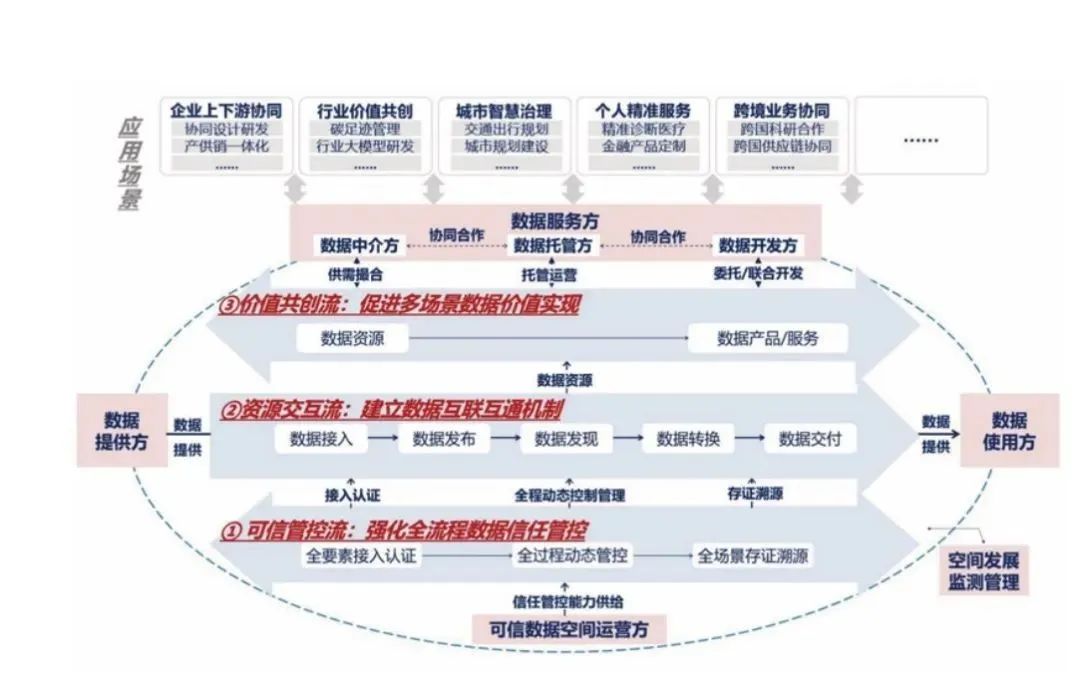
In enhancing quality levels, the goal is to ensure that carbon footprint data is "safe and reliable." Through formulating and releasing group standards, norms for the accuracy, reliability, and transparency of data calculations are provided. At the same time, the Action Plan for the Development of Trusted Data Spaces (2024-2028) was issued, focusing on promoting the construction and application of trusted data spaces, clearly emphasizing the vigorous cultivation of trusted data spaces in the carbon footprint management industry, empowering the integrated development of the primary, secondary, and tertiary industries.


Trusted Data Space Capability View


The release of the "Report on the Construction Progress of the Product Carbon Footprint Management System (2025)" highlights the significant progress made in China's product carbon footprint management system construction, clearly indicating the unprecedented importance and strong promotion given by the state to this work. From coordinated domestic policy efforts to active judgment and alignment with international rules, China is strategically deploying forward-looking frameworks that can support the green transformation of domestic industries while coordinating with the global climate governance system.


As China's "dual carbon" goals are further promoted, the national level will certainly continue to strengthen policy top-level design and supply, providing a more solid institutional guarantee and more flexible innovation space for the construction of product carbon footprint management systems. In the future, we will see more research support focusing on key industry carbon emission accounting methodologies, more detailed product carbon footprint information disclosure standards, as well as the implementation of more guiding green finance and market-oriented incentive mechanisms.


With over 14 years of deep involvement in the dual carbon industry, Carbonstop has served more than 1,400 clients and formed best practice cases, possessing rich professional capabilities in carbon management. Its one-stop carbon management solutions can provide enterprises with full lifecycle carbon footprint assessments of products and comprehensive greenhouse gas emissions quantification services covering Scope 1, 2, and 3, assisting companies in effectively managing their carbon emissions, enhancing supply chain transparency, shaping responsible brand images, and ultimately achieving their sustainable development goals.

Schedule a Call with Our Carbon Management Expert

Provide your information and needs, and our carbon management experts will contact you within 24 hours.

碳阻迹 CarbonStop Logo
400-80-14067
mail@carbonstop.com
10th Floor, Building B, Vanke Office Building, Jiu Gong, Daxing District, Beijing
WeChat Official Account二维码
WeChat Official Account
WeChat Service Account二维码
WeChat Service Account
Carbonstop Assistant二维码
Carbonstop Assistant
EarthShop二维码
EarthShop
Authoritative Certification:
京公网安备 11011502037717号
京ICP备11035662号-15
Copyright 2011-2025 All Rights Reserved: Carbonstop (Beijing) Technology Co., Ltd.