


 823
823Carbon management is no longer a sustainability reporting exercise; it is a core business requirement. For global organisations operating across complex supply chains, carbon data plays an important role that can impact reputation, regulatory compliance, procurement, and market access.
The goal for businesses today is no longer to produce an annual footprint report. The objective is to build a robust management system underpinned by accurate, auditable emissions data that enable real-time decision-making.

From Disclosure to Liability
The regulatory landscape is undergoing a fundamental shift. For example, the Corporate Sustainability Reporting Directive (CSRD) and the Carbon Border Adjustment Mechanism (CBAM) show why carbon data is important.
Carbon reporting is no longer the responsibility of the marketing department; it is increasingly in the domain of the legal and finance departments. Hence, inaccurate or unverifiable data is no longer merely a PR risk; it has become a financial liability. Under CBAM, relying on "default" emission factors instead of primary data can lead to significantly higher carbon levies. Similarly, CSRD mandates limited assurance while moving toward reasonable assurance, meaning carbon accounting must be as rigorous as financial accounting. Enterprises must be able to defend their numbers, not just publish them.
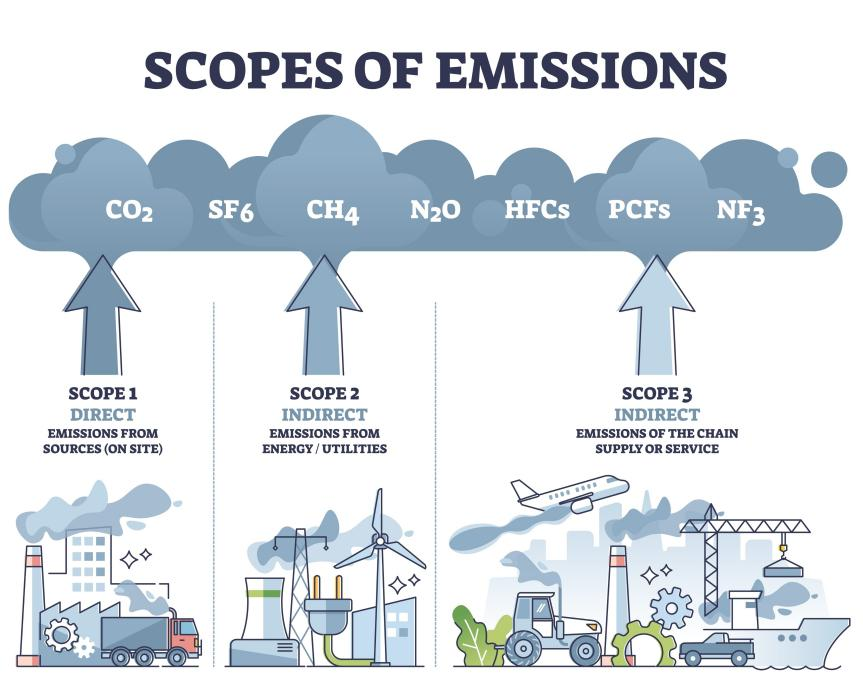

Solving the Scope 3 "Black Box"
For most manufacturing enterprises, Scope 3 emissions account for 70–90% of their total footprint. The majority of this impact resides within supplier networks, often in regions where data transparency is historically low and emission factors are generic.
Effective Scope 3 management requires moving beyond estimates and secondary data toward using primary data. This is particularly challenging in Asian supply chains, where local energy mixes and industrial processes vary significantly and data is hard to obtain. To manage this at scale, organisations require:
- Direct Supplier Engagement: Moving away from spend-based modelling toward actual activity data.
- Access to Accurate Regional Data: Employing China- and Asia-specific emission factors to replace inaccurate and non-representative global averages.
- AI-Powered Validation: Algorithms proactively detect gaps, inaccuracies, and outliers in organisational and supplier data. This automated layer ensures carbon inventories are audit-ready while providing the granular accuracy required for decarbonisation.

Carbon Data Can Improve Operational Performance
When carbon data is accurate and granular, it ceases to be a reporting burden and becomes a strategic asset. Leading organisations are integrating carbon data into four key areas:
- Sustainable Procurement: Traditional procurement is evolving from price-only sourcing to carbon-adjusted pricing. By integrating specific emissions data into the procurement process, teams can identify "carbon-efficient" suppliers. This enables organisations to build a supply chain that is resilient to future carbon pricing.
- Product Design: Up to 80% of a product’s environmental impact is determined during the design phase. By leveraging automated Life Cycle Assessments (LCA) and Carbonstop’s regional emission factors, R&D teams can model different materials and manufacturing processes in real-time. This ensures that sustainability credentials and compliance with "Green Public Procurement" standards are engineered into the product.
- Capital Allocation: Strategic capital allocation now requires Climate Scenario Analysis aligned with TCFD and ISSB recommendations. Carbon intelligence allows CFOs to perform "what-if" modelling on high-carbon assets and prospective investments. By quantifying the potential impact of carbon taxes or shifting energy costs, leadership can direct investment toward low-carbon technologies and "transition-ready" assets, preventing future stranded asset risk.
- Margin Protection: As mechanisms like CBAM transition from reporting to financial levies, reliance on "default" emission factors becomes a direct threat to margins. Proactively collecting verified primary data from suppliers allows enterprises to prove their actual carbon performance is better than regional averages. This precise accounting serves as a financial shield, ensuring the company does not overpay for carbon at the border and maintains its competitive pricing power.


Beyond Spreadsheets: The Digital Systems for Decarbonisation
Complex global operations and stricter requirements under CSRD, CBAM, ISSB, and CDP, are making spreadsheets obsolete. To mitigate regulatory risk, enterprises require scalable digital platforms that offer more than just calculations; they must provide the version control, data transparency, and automated validation essential for a modern, audit-ready carbon management system.
An enterprise-grade platform provides a "single source of truth." It automates data capture across disparate business units, applies consistent calculation methodologies across geographies, and provides the evidence-based trails required by third-party auditors.


The Carbonstop Advantage: Accuracy at Scale
Carbonstop is an AI-powered enterprise carbon management platform purpose-built for organisations with complex, global supply chains. We bridge the gap between high-level reporting and granular operational action, with a specialised focus on the world’s most critical manufacturing hubs.
- Regional Precision: Generic global emission factors often overstate or dangerously underestimate the carbon intensity of Asian manufacturing. Carbonstop provides direct access to a comprehensive, audited database of China-specific and Asia-specific emission factors. By moving beyond high-level proxies to regionally accurate data, enterprises can eliminate the "accuracy gap" that leads to inflated CBAM liabilities and distorted Scope 3 profiles.
- Supplier Engagement: True decarbonisation requires moving beyond spend-based modelling. Our specialised workflows facilitate the direct collection and validation of primary data from multi-tier suppliers. By streamlining the engagement process, Carbonstop replaces statistical guesswork with verifiable facts, allowing procurement teams to identify high-performing suppliers and foster a transparent, low-carbon value chain.
- Audit-Ready Compliance: As carbon data moves into the realm of mandatory financial disclosure, "good enough" reporting is no longer an option. From CSRD reporting to complex CBAM-specific documentation, Carbonstop ensures every data point is transparent and traceable. We provide a rigorous digital audit trail that simplifies the external assurance process and protects the organisation against charges of greenwashing.
- AI-Powered System: Manual data cleansing is the primary bottleneck of enterprise carbon management. Carbonstop utilises AI to automatically flag anomalies, identify data gaps, and pinpoint emissions hotspots across thousands of data points. This automated layer of governance ensures the highest level of data integrity, freeing your sustainability team to focus on high-impact reduction strategies rather than spreadsheet troubleshooting.

Conclusion: Carbon Accuracy as Competitive Advantage
In an era of tightening regulation and intensifying stakeholder scrutiny, the quality of your carbon data dictates the quality of your strategy. By establishing a "single source of truth" for emissions, organisations do more than mitigate transition risk; they build more resilient operations and secure a definitive competitive advantage in a decarbonisingglobal market.
Future-proof your enterprise with Carbonstop. Reach out to our team to see how accurate, credible and audit-ready data can streamline your compliance and accelerate your path to net zero.


