


 489
489 The Paradigm Shift in Industrial Decarbonization
For years, manufacturing leaders viewed environmental rules as a fixed expense. They tracked it with yearly spreadsheets to meet standards set by the Corporate Sustainability Reporting Directive (CSRD), the International Sustainability Standards Board (ISSB), and the EU Carbon Border Adjustment Mechanism (CBAM). Carbon intensity now shapes import fees, bid wins, and credit ratings. The old approach no longer fits daily operations.
Leading firms see digital tools for cutting emissions as more than a compliance fix. An enterprise carbon management platform, built on real activity data and detailed emission factors, turns reporting work into gains in efficiency, margins, and supply chain strength. Current carbon footprint management technologies help companies move from basic reports to steps that add real value. As a pioneer and market leader in enterprise carbon management, Carbonstop helps industrial enterprises navigate this transformation by turning regulatory requirements into sustainable growth drivers.
 From Mandatory Compliance to Bottom-Line Operational ROI
Legacy sustainability workflows treat operational carbon data as a static, backward-looking accounting balance sheet. In contrast, a modern decarbonization platform integrates directly into enterprise resource planning (ERP) and manufacturing execution systems (MES) to translate greenhouse gas (GHG) metrics into real-time financial and operational intelligence. Implementing an integrated sustainability management software ecosystem enables organizations to optimize resources effectively.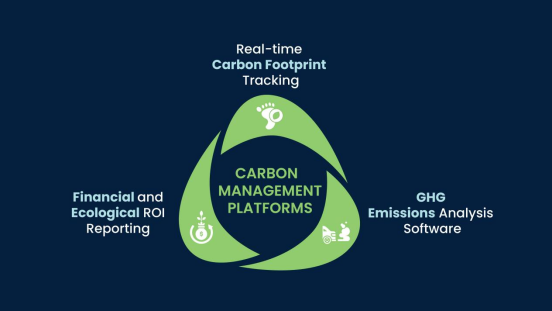
- Eliminating Supply Chain Opacity & Carbon Hotspots
For heavy manufacturing, up to 80% of total climate impact resides in Scope 3 Category 1 (Purchased Goods and Services). Traditional spend-based averages fail to capture true supplier performance, often penalizing efficient procurement teams. By transitioning to activity-based carbon accounting software, manufacturers gain itemized visibility across Bill of Materials (BOM) components. Advanced carbon footprint management pinpoints energy-intensive supplier bottlenecks, isolates scrap rate inefficiencies, and identifies optimal logistics routes before raw materials enter production lines.
2. Securing Commercial Tenders & Protecting Export Margins
Global original equipment manufacturers (OEMs) and tier-1 buyers increasingly mandate verified Product Carbon Footprint (PCF) disclosures under ISO 14067 standards as a core vendor selection criterion. Furthermore, CBAM regulations penalize importers using generic default emission factors. A robust carbon accounting solution enables manufacturers to validate actual embedded emissions per metric ton of product, allowing export-oriented firms to avoid punitive border tariffs and win high-margin procurement tenders over less transparent competitors.
3. Reducing Assurance & Regulatory Audit Overhead
Manual, spreadsheet-driven GHG inventories expose industrial enterprises to substantial compliance risk and exorbitant third-party audit fees during limited and reasonable assurance engagements. Deploying enterprise-grade sustainability reporting software establishes a continuous, immutable audit trail—from utility meter telemetry down to specific emission factor references—reducing audit preparation timelines from months to days while mitigating non-compliance penalties under CSRD.
 Strategic Architecture of the Carbonstop Platform
Moving beyond static footprint reporting requires a dedicated carbon management software architecture specifically built for the complexities of global industrial operations and regional supply chains.
The APAC Supply Chain Blindspot
Western enterprise carbon platforms frequently rely on global average factor sets that severely miscalculate Asia-Pacific manufacturing emissions. Carbonstop bridges this gap by offering localized, primary activity factor matching directly at the tier-N supplier level through an advanced enterprise carbon management platform.
Deep Regional Precision: The China Carbon Database (CCDB)
Precise carbon accounting requires hyper-localized data. Carbonstop’s proprietary China Carbon Database (CCDB) provides access to over 510,000 global and regional emission factor datasets. For enterprises manufacturing in or sourcing from APAC, this localized granularity within our carbon management software eliminates the heavy carbon penalties inherent in broad industry defaults, providing mathematically defensible calculation models required by international verifiers.
AI-Driven Data Ingestion & Factor Matching
Industrial operations generate massive volumes of unstructured data across utility invoices, ERP material receipts, and supplier disclosures. Carbon Agent automates complex data ingestion, automated factor matching, and real-time anomaly detection. Acting as an intelligent carbon management platform, the system automatically catches data drift or erroneous energy reads at the facility level, maintaining continuous audit readiness without overburdening plant engineering teams.
Flexible Enterprise Integration & Decarbonization Modeling
Engineered for complex IT environments, Carbonstop’s decarbonization platform supports SaaS, hybrid, and on-premises deployments that integrate seamlessly with existing SAP, Oracle, and MES architectures. Beyond reporting, this carbon management software features a predictive scenario engine—allowing decision-makers to simulate the financial payback and carbon reduction impact of capital expenditures (such as waste heat recovery retrofits, equipment electrification, or power purchase agreements) before committing capital, driving continuous brand equity and attracting ESG-focused investment.
 A Phased Framework for Industrial Deployment
Unlocking measurable financial returns from your sustainability management software requires a structured implementation model tailored to manufacturing workflows:
- Phase 1: Establishing Automated Data Baselines. Connect plant energy meters, procurement databases, and logistics systems to establish real-time activity baselines across Scope 1, Scope 2, and Scope 3 categories using a unified carbon accounting solution.
- Phase 2: Target Prioritization & Scenario Optimization. Utilize predictive scenario modeling within the decarbonization platform to rank capital investment projects by cost per metric ton of CO(2)e reduced, prioritizing high-ROI efficiency upgrades.
- Phase 3: Supplier Engagement & Export Compliance. Cascade primary data collection workflows to tier-1 and tier-2 suppliers using carbon footprint management tools while generating verified PCF reports via sustainability reporting software for CBAM and CSRD regulatory filings.
FAQ
How does an enterprise carbon management platform generate direct ROI for industrial plants?
Direct ROI is realized through three operational channels: identifying facility-level energy waste to reduce utility expenses, calculating precise primary product carbon footprints via a carbon accounting solution to avoid CBAM default tariff markups, and streamlining third-party audit preparation costs through automated data traceability within a comprehensive carbon management platform.
Why are generic global carbon accounting tools insufficient for APAC supply chains?
Generic tools rely on high-level spend data and western-centric default factors, which overstate emissions for Asian suppliers. Carbonstop’s CCDB database, integrated into its carbon management software, provides over 510,000 localized emission factors, allowing accurate calculation of actual embedded carbon across regional supply chains.
How does Carbonstop handle data assurance for international standards like CSRD and CBAM?
Carbonstop’s sustainability reporting software maintains full lineage tracking from raw source data to final emission outputs. Every calculation model within the carbon accounting software adheres to GHG Protocol Corporate and Value Chain standards and ISO 14067 methodologies, providing third-party auditors with fully transparent, line-item verification trails.
Accelerate Your Industrial Decarbonization Strategy
Turn regulatory compliance into a durable competitive advantage. Evaluate your manufacturing facility’s baseline carbon intensity and supply chain readiness with Carbonstop’s industrial ESG specialists.
[Schedule a Manufacturing ESG & Carbonstop Infrastructure Consultation Today]


