


 373
373 A shipment can leave Jiangsu with flawless commercial paperwork yet arrive in Europe carrying a carbon file built from generic global averages and assumptions nobody can reconstruct. That gap is rapidly becoming an operational and financial liability. As carbon performance shifts into customs audits, procurement scorecards, and margin calculations, procurement executives need traceable, verifiable primary data—not educated guesses. Carbonstop has launched Carbon Agent as a specialized carbon management platform that transforms fragmented China-linked activity data into audit-ready Product Carbon Footprints (PCFs) and supports more reliable supply chain carbon management.

The China Data Gap: Why Generic Emission Factors Create Enterprise and CBAM Risk
For European procurement teams, the challenge is rarely a total absence of supplier data. Rather, it is the inability to make local Chinese supplier data comparable, representative, and defensible before internal auditors and customs authorities.
A single operational dataset must now satisfy multiple, distinct regulatory frameworks:
- GHG Protocol Standards: The Product Standard measures individual product life-cycle emissions to inform sourcing choices, while the Scope 3 Standard (Category 1) addresses aggregate corporate carbon accounting and value-chain totals.
- CSRD and ESRS Disclosures: Mandatory European reporting demands governed calculation methodologies backed by supportable evidence across tier-1 and deep-tier suppliers.
- IFRS S2 Standards: Connects climate-related physical and transition risks directly to corporate governance, strategy, and capital allocation.
- CBAM Definitive Regime (Effective 1 January 2026): Covered importers must report actual embedded emissions from production installations and surrender corresponding financial certificates.
Relying on static spreadsheets and generic global averages across these overlapping mandates introduces severe compliance exposure. Effective enterprise carbon management requires a controlled carbon data management platform that preserves clear technical distinctions between high-level screening, product carbon footprinting, supplier-level evidence, and CBAM verification.

Carbon Agent: Transforming Unstructured Supplier Data Into Traceable Product Footprints
Carbonstop’s approach pairs domain-specific AI with deeply localized data and human-in-the-loop expert review. The goal is not merely faster prose or automated reporting; it is establishing a short, auditable path from raw supplier evidence to a defensible calculation.
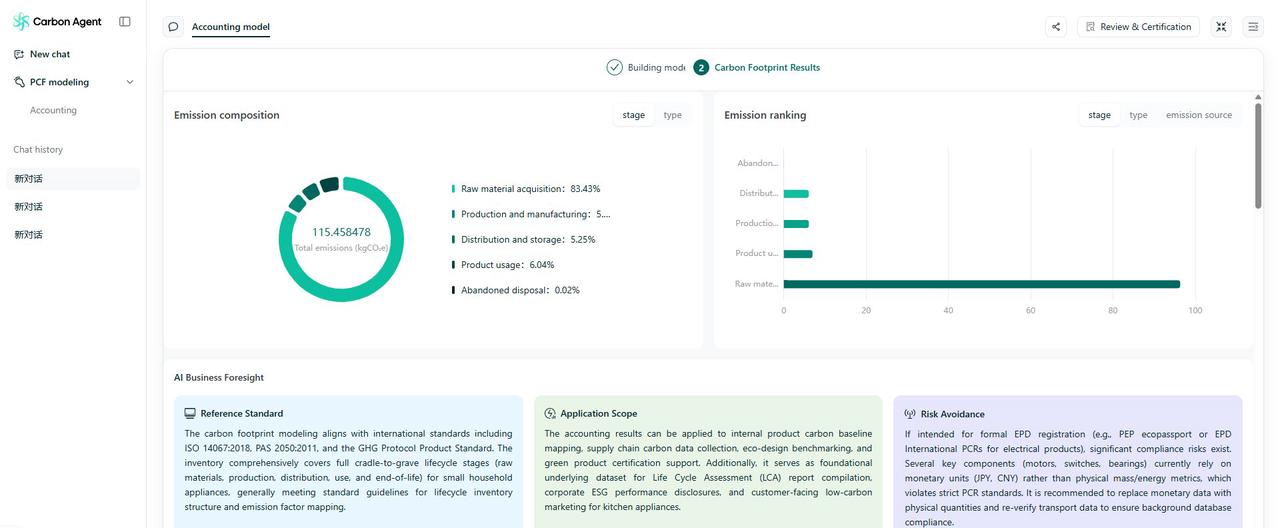
Instead of subjecting suppliers to tedious annual questionnaires, Carbon Agent supports supplier carbon management by streamlining data ingestion, validation, and carbon emissions tracking across the accounting chain:
- Automated Document Ingestion: The carbon accounting software interprets unstructured supplier files—including utility receipts, spec sheets, and material declarations—normalizing units and identifying missing data inputs without unnecessary vendor survey friction.
- Intelligent Factor Matching: Carbon Agent recommends relevant emission factors while keeping underlying sources, system boundaries, allocation rules, and calculation logic visible for audit review, strengthening carbon footprint management and factor governance.
- AI-Enabled Anomaly Detection: Automated logic checks flag unit conversion errors, out-of-range values, and baseline inconsistencies before erroneous inputs propagate into corporate carbon accounting or supplier evaluations.
- Scenario Modeling for Category Teams: Procurement managers can dynamically evaluate alternative raw materials, process changes, or regional energy mixes before executing commercial contracts, turning the platform into a practical carbon reduction solution for sourcing decisions.
Central to this capability is Carbonstop's China Carbon Database (CCDB). Containing more than 300,000 emission factors spanning localized Chinese industrial processes across 20+ sectors and 200 countries and regions, CCDB provides contextual depth—including technology descriptions and uncertainty analyses—that generic databases often lack. Combined with Carbon Agent, it creates a localized carbon data management platform for more defensible supply chain carbon management.

Why Modular Architecture Beats Bloated ESG Software in Procurement
Enterprise buyers often struggle with monolithic ESG software suites that attempt to handle everything from reporting to supply chain management in a single black box, resulting in low adoption and compromised data rigor. Carbonstop takes a deliberate, modular approach that preserves system clarity.
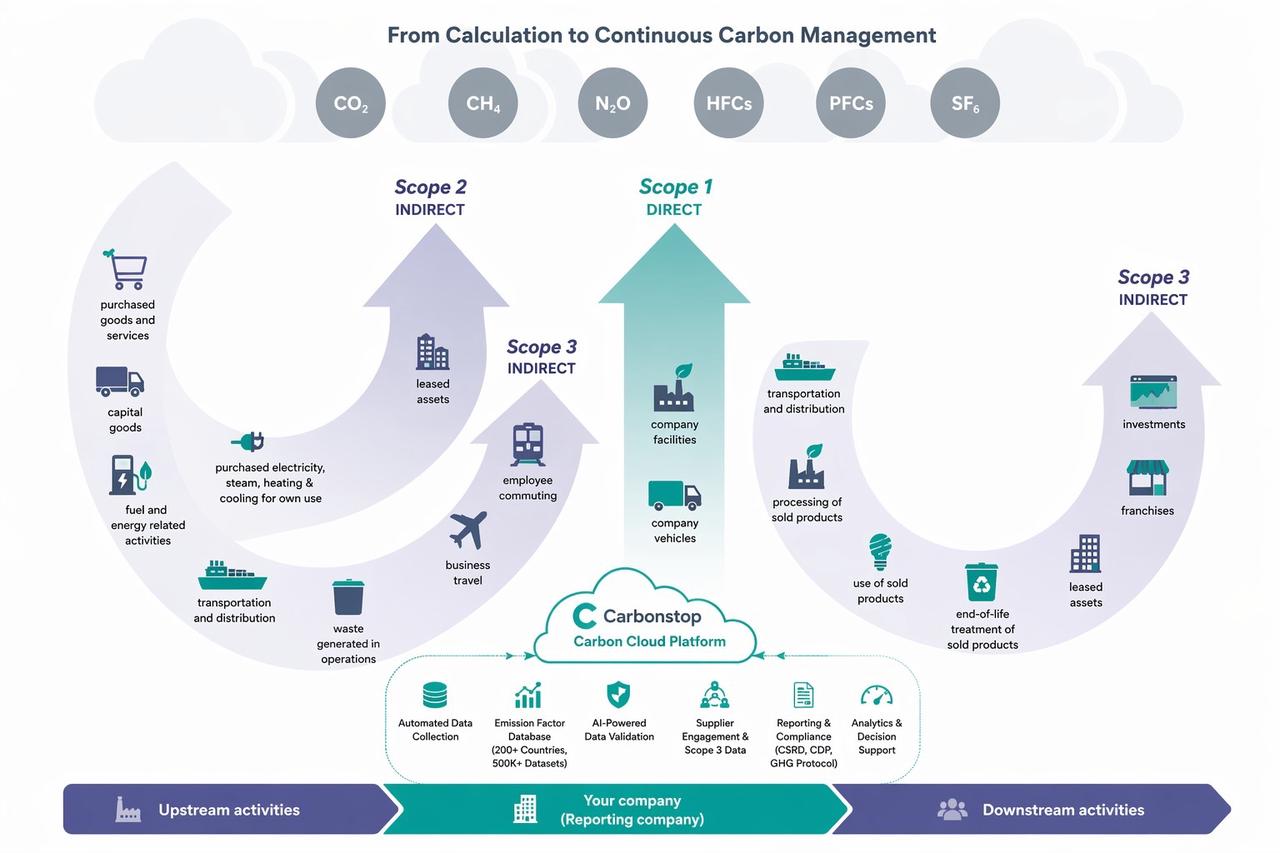
By focusing Carbon Agent and Ccloud on product carbon footprinting, carbon emissions tracking, data quality checks, and automated anomaly detection, procurement teams gain focused carbon accounting software without unnecessary software bloat. Scope 3 inventory aggregation, ESRS alignment, and bespoke audit preparation remain structured as governed advisory and advisory-assisted workflows.
This modular structure allows Carbonstop to operate as a carbon management software provider while keeping responsibilities visible. Accountable technical experts review calculations, and approved outputs can connect to wider ERP, procurement, and reporting systems. The result is a more scalable enterprise carbon management architecture than a single opaque ESG suite.

Four Practical Actions for Procurement Leaders
Building a resilient carbon footprint management capability requires operating discipline alongside software deployment. Procurement and supply chain leaders should start with four practical steps:
- Segment Suppliers by Decision Risk: Categorize suppliers by spend, carbon intensity, CBAM exposure, and data maturity. Focus supplier carbon management and primary-data collection where improved accuracy changes a sourcing decision or protects commercial margins.
- Establish an Evidence Contract: Define required boundaries, reporting periods, emission factor hierarchies, and supporting documentation upfront. This transforms carbon emissions tracking from a passive questionnaire into a standard procurement workflow.
- Separate Estimation from Assurance: Use secondary regional factors for initial category screening, but mandate verified primary supplier data for high-emission categories. A robust carbon management platform should preserve data lineage, version history, and technical exception reviews.
- Integrate Carbon Metrics into Commercial Terms: Feed verified emissions hotspots into supplier development, engineering specifications, and RFP evaluations. Supply chain carbon management creates commercial value only when carbon data influences sourcing contracts and procurement specifications.

Turn Supply Chain Carbon Data Into a Sourcing Advantage
Closing the China supply chain data gap will not happen through generic questionnaires or static global averages. It occurs when localized emission factors, primary supplier evidence, automated validation logic, and expert review operate inside one controlled carbon data management platform.
A strong decarbonization platform should do more than calculate historical emissions. It should help procurement teams identify reduction opportunities, compare supplier scenarios, and turn verified data into a practical carbon reduction solution.
When evaluating carbon management software providers, demand a live demonstration on a complex Chinese supplier file—tracing raw activity data through factor selection, uncertainty documentation, and reduction scenarios. That test reveals the true capability of a carbon accounting software platform far better than any marketing feature list.

Benchmark Your China Supply Chain Data
Schedule a 1-on-1 technical walkthrough with Carbonstop's carbon accounting specialists. We will run one of your actual Chinese supplier files through Carbon Agent and the China Carbon Database (CCDB) to demonstrate how a specialized carbon management platform can turn raw activity data into an audit-ready product carbon footprint and support more scalable supplier carbon management.
[Request a Live Data Walkthrough]
FAQ
What is the core difference between a Product Carbon Footprint (PCF) and Scope 3 accounting?
A PCF measures greenhouse gas emissions across the life cycle of an individual product unit. Scope 3 accounting measures a company's corporate value-chain emissions across 15 categories under the GHG Protocol. While PCF data can inform Scope 3 Category 1 and broader corporate carbon accounting, the boundaries and aggregation logic differ significantly.
Does CBAM compliance require a full corporate carbon footprint?
No. CBAM focuses on embedded emissions in covered imported goods under its specific regulatory methodology. It does not require a complete corporate GHG inventory, although a governed enterprise carbon management system can help organizations manage related evidence consistently.
When should procurement teams mandate China-specific emission factors?
China-specific factors should be prioritized whenever local electricity grid mixes, regional raw material processing, or specific industrial technologies make global averages unrepresentative. A reliable carbon footprint management process should document geography, vintage, technology, source, and uncertainty for material factors.
What key capabilities should buyers test in carbon accounting software?
Test complete data lineage, factor governance, unit normalization, exception handling, version control, supplier evidence management, and auditor access. A capable carbon management software provider should make every material calculation traceable from primary evidence through final output.


