


 60
60
Executive Summary: Carbon management trends 2026 show that carbon management has crossed a decisive threshold. Corporate carbon management now goes beyond yearly reports or separate sustainability updates. It serves as a main business practice that influences product design, buying choices, supply chain strength, regulatory compliance risks, and how funds get allocated.
Multinational firms, especially those with Asian supply chains or European sales exposure, see carbon data quality shape their commercial choices and market access. With rules tightening, companies need a carbon management strategy backed by reliable carbon data management, local emission factors, supplier details, and clear audit trails. Top organizations are turning to one carbon management platform that handles CBAM compliance, product-level calculations, Scope 3 management, and corporate decarbonization.
Why 2026 Changes the Executive Carbon Agenda
The regulatory and commercial landscape is shifting from voluntary reporting toward more structured and auditable carbon management requirements.
• CSRD and ESRS: Require traceable sustainability metrics, clear internal controls, and stronger data provenance.
• ISSB (IFRS S2): Expands investor-focused climate and financial risk disclosure expectations across multiple markets.
• CBAM Definitive Regime: Makes embedded product emissions increasingly relevant to European import costs, putting greater pressure on companies to improve CBAM compliance and product-level data quality.
As a result, procurement, finance, operations, and sustainability teams need a coordinated corporate carbon management framework. A modern carbon management platform must transform operational data into consistent inventories, product calculations, supplier assessments, and decision-ready business insights.
Trend 1: Accountable AI Replaces Generative Hype in Carbon Accounting
One of the most important carbon management trends 2026 is the transition from generic AI tools toward accountable AI carbon management workflows embedded directly into carbon accounting processes.
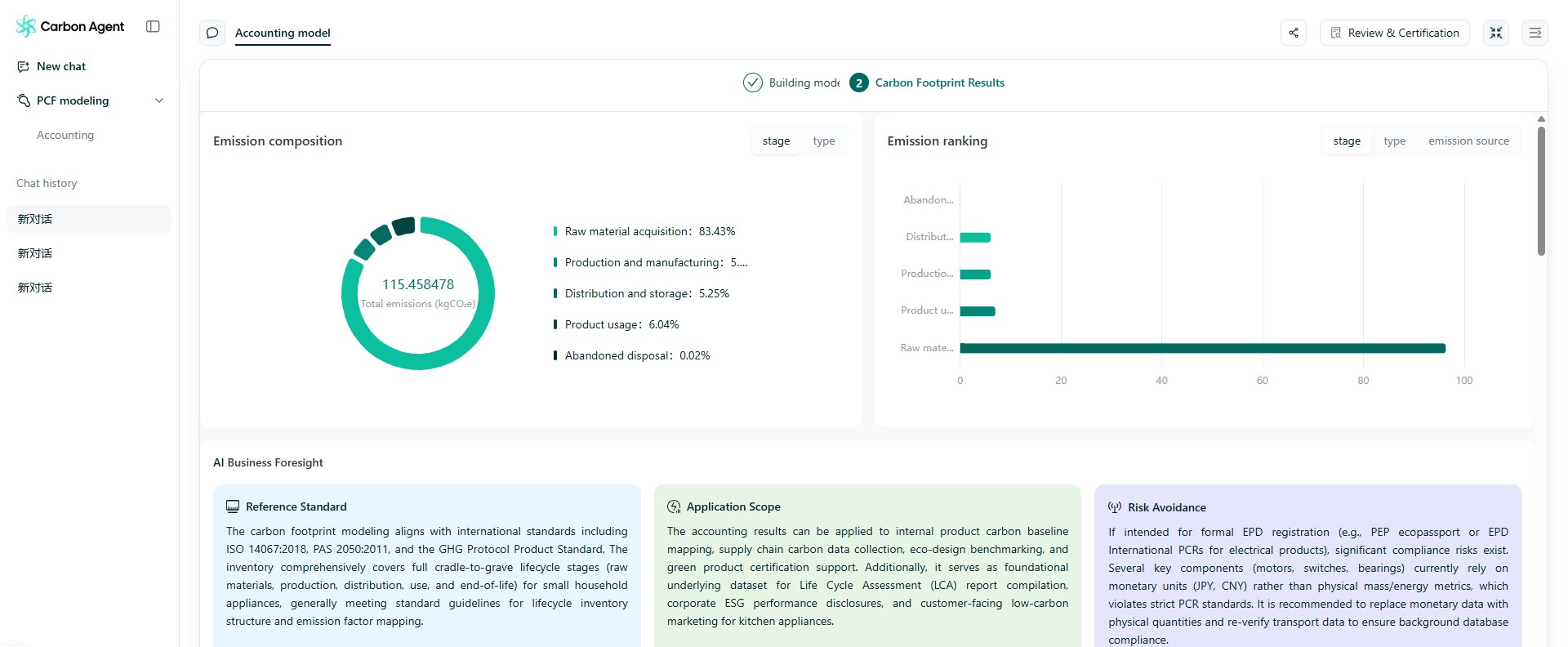
AI carbon accounting can help accelerate data preparation and review, but enterprise adoption requires transparency and human oversight.
What Enterprise AI Must Deliver:
• Contextual Factor Matching: AI carbon accounting systems can help match activity data with relevant regional emission factors while preserving source, vintage, and unit information.
• Automated Data Hygiene: AI carbon management can identify missing values, unusual changes, inconsistent units, and potential boundary errors across large datasets.
• Audit-Ready Reasoning: AI-supported workflows should maintain clear calculation logic rather than producing unexplained estimates that cannot be reviewed.
Inside Carbonstop’s Ccloud platform, vendor document processing, and report preparation. Human experts retain responsibility for assumptions, methodology, approvals, and final outputs.
This combination of automation and human governance enables enterprises to use AI carbon management without weakening auditability or data control.
Trend 2: Scope 3 Transforms Procurement from Estimation to Supplier Action
For manufacturers and consumer brands, Purchased Goods and Services can account for a major share of total value-chain emissions. As a result, supply chain carbon management is evolving from broad estimation into a practical procurement capability.
Effective supplier decarbonization requires companies to move beyond spend-based estimates and collect more decision-useful supplier data.
Bridging the Primary Data Gap:
Leading enterprises are building a structured supply chain carbon management process:
• Materiality Tiering: Segment suppliers by emissions impact, spend, geography, and regulatory exposure.
• Primary Data Workflows: Collect supplier information covering energy use, fuel mix, production volume, transportation, and allocation methods.
• Data Quality Hierarchy: Distinguish verified supplier information from calculated or secondary estimates within the broader carbon data management framework.
• Targeted Decarbonization: Use carbon hotspots to prioritize supplier decarbonization programs involving renewable electricity, efficiency improvements, alternative materials, or process electrification.
Carbonstop’s supply chain management capabilities help buyers connect with suppliers and standardize data collection across different reporting formats. This supports both corporate carbon management and practical supplier decarbonization initiatives.
Trend 3: China-Specific Factor Data Becomes Core Risk Infrastructure
For companies with manufacturing or sourcing exposure in China, localized emission data is becoming an important part of carbon data management.
Using overly broad global emission factors can distort supplier comparisons, product carbon footprint calculations, and regulatory reporting. A stronger carbon management strategy therefore requires factor databases that reflect local power grids, fuel profiles, production technologies, and geographic differences.
The Value of Localized Carbon Intelligence:
Carbonstop’s China Carbon Database (CCDB) provides a large repository of localized and international factor data designed to support enterprise carbon calculations.
• Granular Process Matching: Enables organizations to use more specific data for regional manufacturing and energy consumption.
• Methodological Consistency: Helps align Scope 3 inventories with product carbon footprint accounting and supplier assessments.
• Complete Factor Provenance: Supports stronger documentation of factor sources and methodologies within the overall carbon data management process.
Localized factor selection helps improve the reliability of corporate carbon management, supplier evaluation, and CBAM compliance.
Trend 4: Product Footprints Drive Commercial and Engineering Decisions
Another major element of carbon management trends 2026 is the growing role of product carbon footprint data in product development, procurement, customer tenders, and international trade.
Product carbon footprint accounting is no longer limited to environmental labeling. It increasingly informs engineering choices, material sourcing, supplier selection, and corporate decarbonization priorities.
Integrating PCF into Product Lifecycle Management:
Step Objective Key Requirement
• Boundary Definition Establish lifecycle scope. Align methodology with relevant PCF standards.
• BOM Data Synthesis Combine materials, energy, and logistics data. Connect ERP, PLM, and supplier data.
• Scenario Analysis Compare alternative materials and suppliers. Model cost and carbon impacts before production.
• Enterprise Rollup Feed product results into corporate inventories. Connect product carbon footprint accounting with Scope 3 reporting.
A connected carbon management platform allows businesses to link product carbon footprint results with corporate inventories. This makes it possible to evaluate how a change in raw material, supplier, production location, or logistics route affects the broader corporate decarbonization pathway.
Trend 5: Compliance and Enterprise Strategy Converge
Compliance alone does not create competitive advantage. Leading companies are increasingly connecting regulatory workflows with a broader carbon management strategy.

Establishing an Audit-Ready Operational Rhythm:
• Unified Evidence Base: Maintain centralized carbon data management that can support CSRD, ISSB, CDP, and CBAM compliance outputs.
• Governance & Approvals: Establish clear ownership across sustainability, procurement, finance, operations, and legal teams.
• Scenario Modeling: Use a carbon management platform to evaluate energy prices, carbon costs, supply chain disruptions, and investment choices.
• Reproducible Audit Trails: Preserve calculation records, emission factors, supplier evidence, and approval histories.
This convergence turns corporate carbon management from a reporting exercise into a strategic operating system supporting risk management and corporate decarbonization.
The CSO’s 90-Day Execution Agenda
To build decision-grade carbon intelligence in 2026, sustainability leaders can follow a structured implementation sequence:
• Day 1–30 (Governance & Exposure): Identify major emissions sources, regulatory exposure, internal data owners, supplier gaps, and immediate CBAM compliance requirements.
• Day 31–60 (Factor Policies & Pilots): Establish factor governance rules, strengthen carbon data management, launch a supplier data pilot, and complete one priority product carbon footprint accounting project.
• Day 61–90 (AI Guardrails & Abatement): Configure AI carbon accounting validation workflows, define human approval controls, and translate findings into funded supplier decarbonization and corporate decarbonization initiatives.
Transform Your Carbon Data into Strategic Advantage
Navigating carbon management trends 2026 requires accurate data, reliable supplier engagement, product-level intelligence, and an integrated carbon management strategy.
Schedule a Strategic Platform Demo of Carbonstop Ccloud & CCDB
Discover how Carbonstop helps global enterprises strengthen corporate carbon management, improve supply chain carbon management, support product carbon footprint accounting, and turn carbon data into measurable corporate decarbonization progress.
FAQ
What is the single most critical carbon management shift in 2026?
The biggest shift is from static annual reporting toward continuous corporate carbon management supported by product-level data, supplier information, localized emission factors, scenario analysis, and a connected carbon management platform.
How can global companies improve supply chain carbon management?
Prioritize high-impact suppliers, request primary activity data, standardize supplier workflows, improve carbon data management, and use results to build targeted supplier decarbonization programs.
Does AI replace carbon accounting consultants and auditors?
No. AI carbon management and AI carbon accounting can accelerate data processing, factor matching, anomaly detection, and reporting support, but experts remain essential for methodology, governance, assurance, and final approval.
How should CBAM compliance connect with broader corporate strategy?
CBAM compliance data should also inform product carbon footprint, supplier selection, sourcing decisions, product redesign, and the wider carbon management strategy rather than operating as a standalone compliance task.


