


 1042
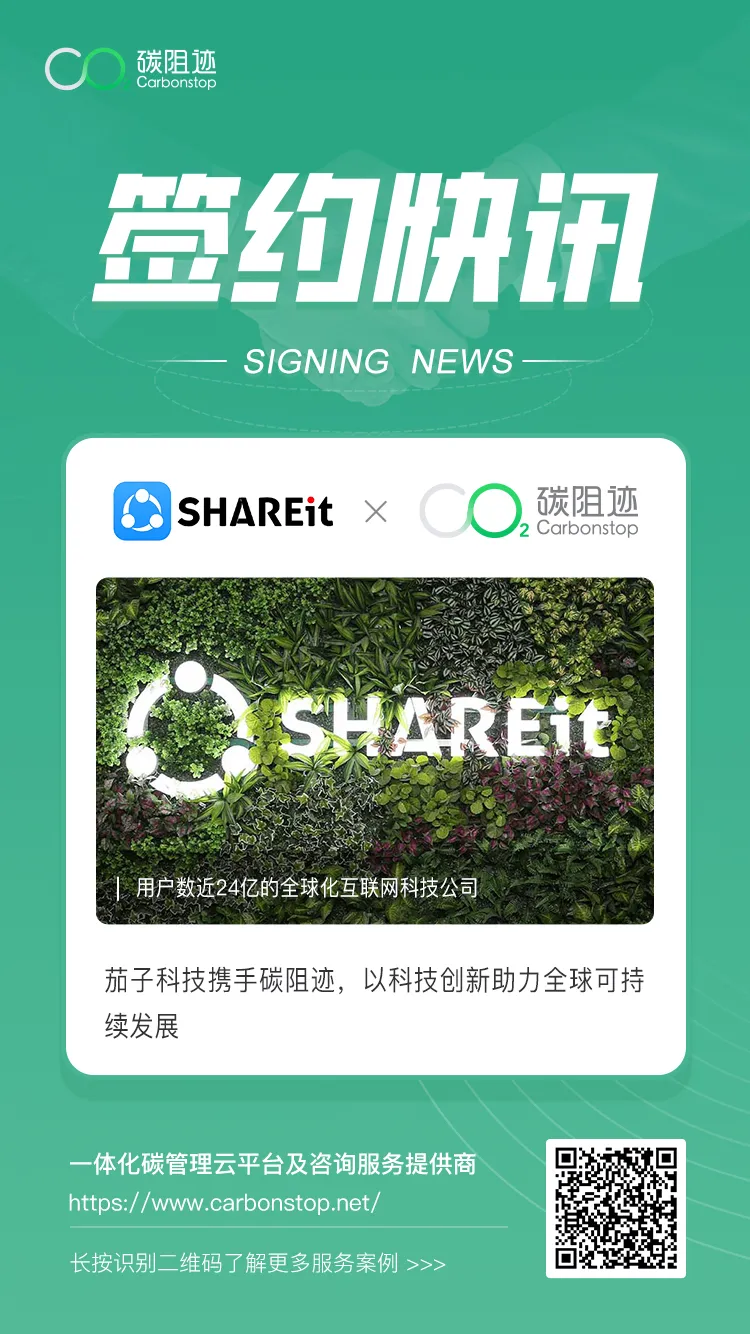
1042Recently, global internet technology company ShareChat jointly published its carbon reduction achievements with Carbonstop. The results show that its product SHAREit's near-field transmission function has achieved carbon reduction compared to hardware transmission and 3G, 4G network transmission, among other primary alternatives.According to professional calculations by Carbonstop, compared to using 3G transmission, global users using SHAREit's near-field transmission technology can reduce 19,224.63 tons of CO2 emissions daily, equivalent to planting 10.51 million trees.
About "ShareChat"
Founded in 2015, ShareChat's flagship product SHAREit primarily targets emerging markets in Southeast Asia, the Middle East, and Latin America. SHAREit uses peer-to-peer transmission between mobile phones without consuming user data, creating a "third network" parallel to mobile networks and Wi-Fi, rapidly becoming the cheapest and most convenient way to access digital content in these regions, reaching hundreds of millions of internet users whose digital service needs were previously poorly met. Currently, ShareChat has accumulated over 2.4 billion users globally, and SHAREit ranks 9th among the most downloaded apps on Google Play over the past decade, making it a "national application" in emerging markets such as Southeast Asia, the Middle East, and Africa.
As a one-stop platform for high-quality digital entertainment content and cross-platform rapid resource sharing, SHAREit uses near-field transmission technology to establish a local network between devices solely through two devices, meeting users' needs for file, image, game installation package, and app transmission. Compared to traditional 3G network transmission, which requires supporting network base stations, transmission lines, and data centers, this method consumes significantly fewer resources and energy.

Moreover, the near-field transmission speed of SHAREit is about 200 times faster than Bluetooth transmission, and the higher transmission speed also significantly reduces the energy consumption caused by file transmission.
No measurement, no management; carbon data is the first step in carbon reduction and carbon neutrality. To more scientifically and efficiently quantify the carbon reduction of its products, ShareChat chose to collaborate with Carbonstop.
Based on Carbonstop's largest global carbon emission factor database, using the one-stop carbon management platform Carbon Cloud's product carbon footprint calculation system, and relying on Carbon Cloud's carbon reduction analysis function, the carbon footprint calculation and carbon reduction analysis of SHAREit were completed.
The results show that compared to other transmission methods, using SHAREit's near-field transmission technology for file transmission has significant emission reduction effects: compared to 3G network transmission, near-field transmission can reduce emissions by 5.5133 gCO2e/MB; compared to Bluetooth transmission, the reduction is 0.3860 gCO2e/MB. Compared to using 3G networks, global users using SHAREit for transmission can reduce 19,224.63 tons of CO2 emissions daily, equivalent to taking 240.308 million bus trips, planting 10.51 million trees, or cycling 411.748 million kilometers.

As global ESG practices continue to deepen, the concept of sustainable development has become an intrinsic driving force for corporate development.
Recently, ShareChat announced that it has officially joined the global carbon trading platform Climate Impact X, co-founded by DBS, Standard Chartered Bank, Singapore's Temasek Holdings, and the Singapore Exchange, providing high-quality carbon credits to global enterprises or organizations to address hard-to-abate emissions.
ShareChat stated that in the future, it will launch the SHAREit personal carbon account product to foster public awareness of low-carbon living and encourage more people to participate in low-carbon transmission. Carbonstop will also leverage its professional knowledge and digital technology accumulated over a decade to help more companies scientifically and efficiently manage every ton of carbon, contributing to global sustainable development.


