


 1948
1948Have you heard of the first carbon-neutral ballpoint pen and dish soap, and now even batteries can be carbon-neutral?
Recently, Nanfu Yiyuan ECO, in collaboration with Carbonstop, officially launched the first carbon-neutral battery in China. By integrating the concepts of circular economy and carbon neutrality with battery products, this initiative fills the gap in the domestic small battery sector, offering consumers a battery that does not require recycling, is mercury-free, cadmium-free, lead-free, and can be disposed of with household waste. It is durable, more environmentally friendly, and comes with "zero" carbon emissions and no burden.
As a pioneering carbon-neutral product in the small battery sector, this time Yiyuan ECO collaborated with Nanfu Battery, a leading company in the domestic market, for joint research and development. With technical support from Carbonstop, they successfully created the first carbon-neutral battery by Yiyuan.
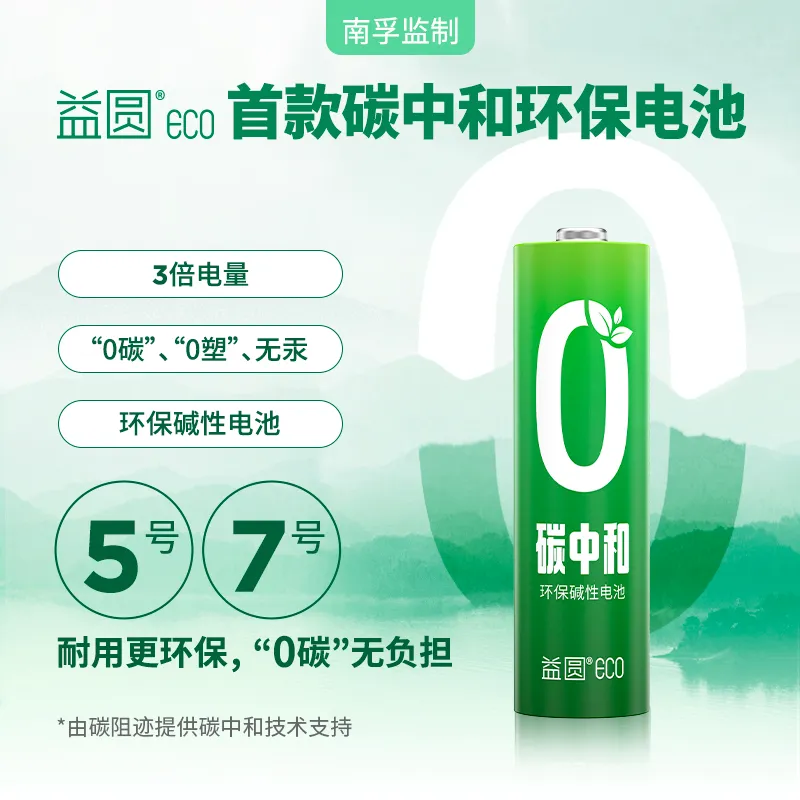
Based on the PAS2050:2011 and ISO14067:2018 standards, Carbonstop used a Cradle to Grave lifecycle quantification method to calculate the carbon footprint of the Yiyuan ECO AA and AAA batteries, ensuring that they achieve carbon neutrality across all lifecycle stages, from raw material extraction, production processing, transportation, and distribution to use and disposal.
During the entire lifecycle of the battery, the carbon emissions from raw material extraction are often the highest. Yiyuan ECO uses high-quality recycled materials and advanced production processes to continuously increase the proportion of recycled materials in the batteries, reaching up to 5%. During production, centralized production and energy-saving renovations of central air conditioning systems reduce greenhouse gas emissions. In the transportation phase, large cargo deliveries using recyclable pallets reduce the need for disposable packaging, thereby lowering packaging material consumption and waste generation.
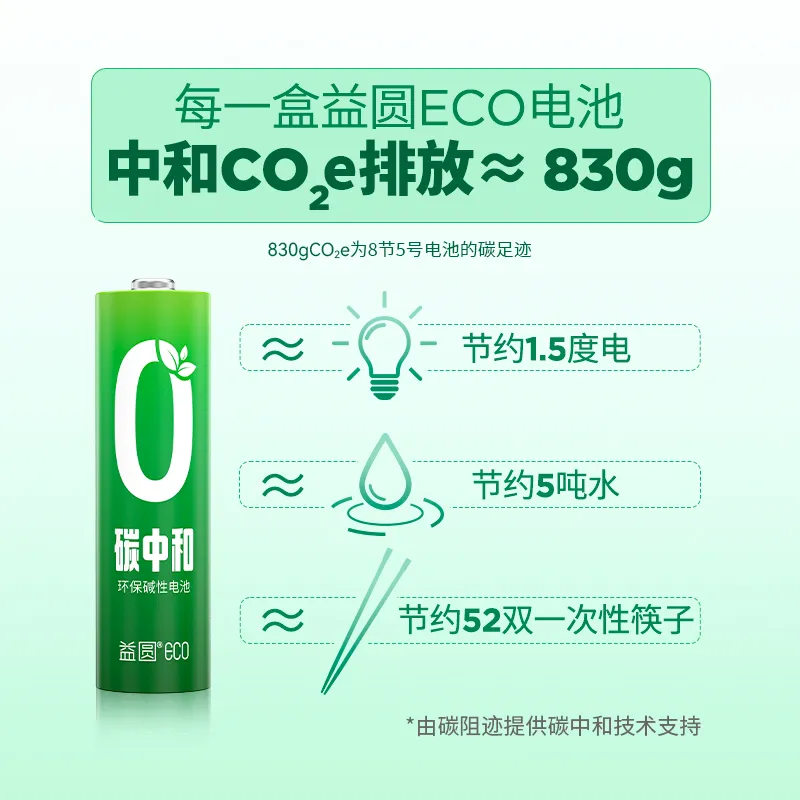
At the same time, Yiyuan ECO actively responds to green packaging initiatives, continuously enhancing the recyclability and reusability of packaging while reducing its complexity. The outer box and battery label use eco-friendly inks such as water-based ink and UV ink, FSC-certified original paper, and lightweight labels, achieving a 25% reduction in plastic use. The display of the carbon-neutral logo on the packaging informs consumers about the environmental attributes of the product, encouraging them to consider more eco-friendly shopping options and promoting green consumption.
Ultimately, the carbon-neutral product underwent a full lifecycle carbon footprint calculation completed by Carbonstop. By purchasing CCERs generated from the 48 MW wind power project in Liuchuan, Hubei, the greenhouse gas emissions of the two Yiyuan ECO carbon-neutral battery models were offset, further achieving carbon neutrality across the entire lifecycle of the product.
Since 2020, guided by the "dual-carbon goals," carbon-neutral products have been continuously introduced across various industries globally. The launch of China's first carbon-neutral battery marks a milestone achievement in the small battery sector. It is also the latest practical outcome of Carbonstop's carbon neutrality methodology, CREOS, which has been refined over many years in the industry.
In addition to assisting Yiyuan in launching its first carbon-neutral battery, Carbonstop has also applied this methodology to help M&G launch China's first carbon-neutral stationery and partnered with Anchor to introduce China's first "zero-carbon cake." They have also supported Zhenggu Brand in achieving carbon neutrality for over 30 products.
Achieving carbon neutrality is not something that happens overnight, but in this unprecedented wave of carbon reduction, it requires unwavering and persistent efforts and breakthroughs from companies. Carbonstop will continue to leverage its expertise and over a decade of industry experience to assist more products in achieving carbon neutrality, steadily moving towards the bright future where "every product has a carbon footprint."


