


 927
927Recently, Carbonstop signed an agreement with China Construction Bank (CCB) to provide technical support for building individual “Carbon Accounts.” Through the individual “Carbon Accounts,” CCB aims to quantify individuals' contributions to environmental protection, the country, and the planet, guiding consumers to actively practice a low-carbon lifestyle and supporting the realization of the national dual-carbon strategy.
About 「China Construction Bank」
One of the four major state-owned commercial banks, CCB is the second-largest bank in mainland China and ranked second globally in the "Top 1000 World Banks" list published by The Banker magazine in 2019. It is also one of the eight banks and five insurers representing Hong Kong's financial industry. In the Fortune Global 500 list of 2021, it ranked 25th.
Since the announcement of the "Dual-Carbon" targets, CCB has been actively implementing major national policies and strategies, steadily advancing its green finance practices according to its own pace, and putting actions into words.
In early March, CCB had already filed for personal financial services based on the “Carbon Account,” relying on the construction and operation of a model ecological scenario for a “Low-Carbon Life.” Through various low-carbon scenarios, including both financial and non-financial settings, CCB identifies users' green behaviors in daily low-carbon life and financial activities via its Life APP and Mobile Banking APP.

Source | Today's CCB Official Account
Simultaneously, CCB introduced authoritative carbon emission measurement rules and utilized digital technologies such as big data and artificial intelligence. Based on the data platform, CCB established a carbon reduction measurement data service that can be shared across the bank, conducting carbon reduction assessments to form individual “Carbon Accounts” and record personal carbon footprints from the consumer end.
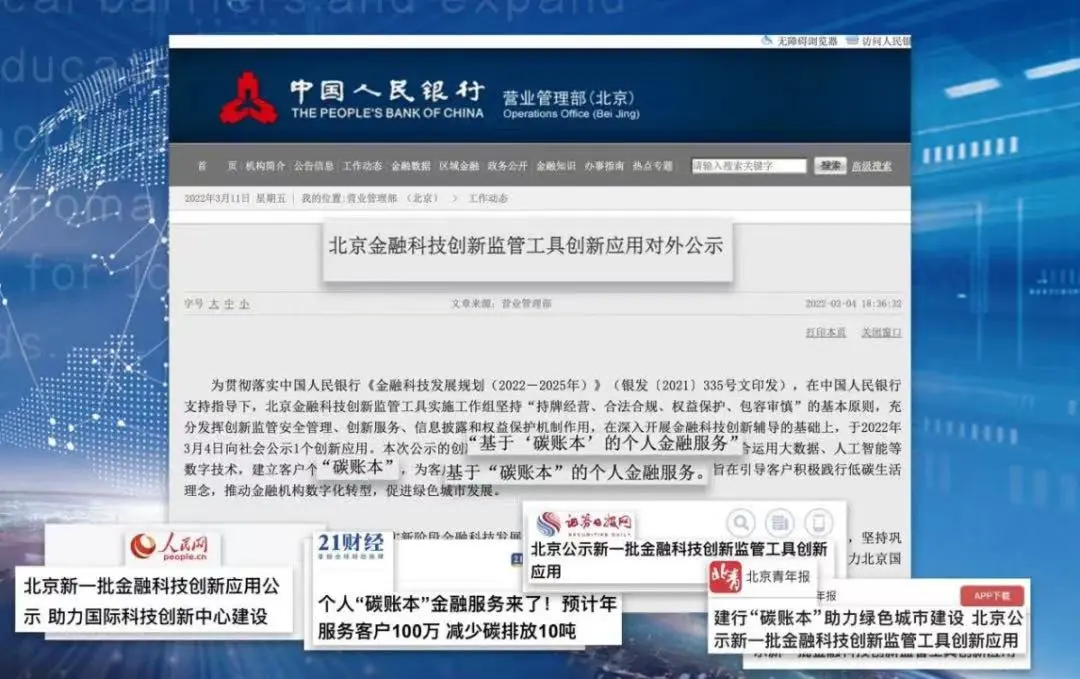
It is reported that CCB's application for “Personal Financial Services Based on the ‘Carbon Account’” was selected as the only case in the fourth batch of innovation applications under the Beijing Financial Technology Innovation Supervision Tool and is now on public display on the People's Bank of China's official website.
Source | Today's CCB Official Account
However, the development of new things inevitably involves both progress and setbacks. How to solve the problems of difficult data collection and inaccurate calculation? How to enrich and innovate low-carbon application scenarios to attract more users to participate continuously? These challenges have emerged one after another for CCB in the innovation of the “Carbon Account” scenario.
To address these issues, Carbonstop leveraged its industry-leading carbon neutrality methodology and practical experience to help CCB complete the calculation of carbon reduction in relevant low-carbon scenarios. Carbonstop also collaborated with Fei Ant (the largest online second-hand clothing recycling platform in China) to build a second-hand clothing recycling application, further enriching the low-carbon scenarios in CCB’s “Carbon Account.”
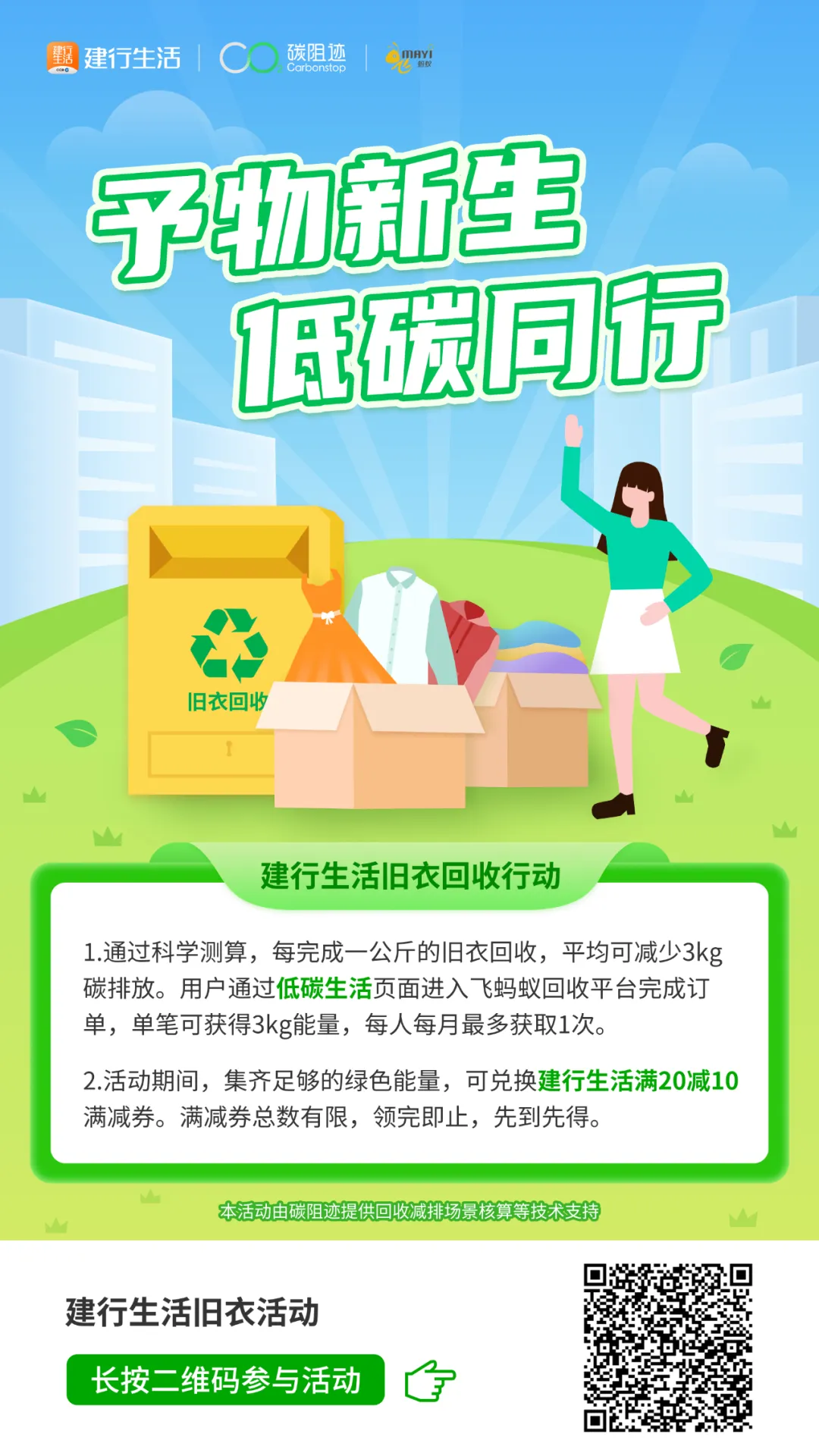
Moreover, to encourage more users to engage in carbon reduction actions, CCB and Carbonstop jointly launched a “Renew Old Clothes, Walk Together in Low-Carbon” second-hand clothing recycling campaign. According to scientific calculations by Carbonstop, completing the recycling of one kilogram of old clothes can reduce an average of 3 kg of carbon emissions. Users can enter the Fei Ant recycling platform through the “Low-Carbon Life” page on CCB’s app to complete orders and earn 3 kg of energy per transaction, with a maximum of one reward per person per month.
During the campaign, users can accumulate sufficient green energy by practicing low-carbon behaviors in the “Low-Carbon Life” feature section and redeem CCB’s life discount coupons.
Under the dual-carbon background, the financial industry, as an essential part of the global economy and society, will play a significant role. Besides sustainable finance helping enterprises achieve innovative green transformations, individual “Carbon Accounts” can also raise public awareness of low-carbon practices and contribute uniquely to the energy conservation and carbon reduction efforts of the entire society.
Mountains have their peaks, and lakes have their shores. In the future, Carbonstop will continue to rely on its professional knowledge and technological innovations in the low-carbon field to support CCB’s green transformation.


