


 645
645On the afternoon of October 27th, the inaugural event of the Carbon Workshop organized by Carbonstop was successfully held, with enthusiastic interaction and exchanges between guests and online/offline audiences.

In the first session, Professor Yang Xiu from Tsinghua University's Institute of Climate Change and Sustainable Development opened the sharing session, particularly introducing the recently released "1+N" policy background and guiding directions for dual carbon goals, giving us insight into China's attitude and determination towards dual carbon issues. Following this, a guest from Carbonstop shared insights and case studies on the application of product carbon footprints and introduced how the Carbon Cloud SaaS can assist in the calculation of product carbon footprints.
Below is a highlight review of this sharing event.
International Background of Carbon Neutrality and China's Actions
Tsinghua University's Institute of Climate Change and Sustainable Development, Yang Xiu
Where does carbon neutrality come from? What is its relationship with climate change?
According to statistics, from 2000 to 2019, a total of 7,348 natural disasters were recorded globally, affecting 4 billion people, causing 1.23 million deaths, and resulting in $2.97 trillion in economic losses. In 2021, floods in Europe and Henan Province, and extreme heatwaves in North America, caused hundreds of deaths and billions of dollars in economic losses.
According to the World Meteorological Organization report, the average global temperature in 2020 had risen by 1.2°C compared to pre-industrial levels. Human activities have led to warming of the atmosphere, oceans, and land, causing widespread and rapid changes in the atmosphere, oceans, cryosphere, and biosphere, making global climate change a crisis faced collectively by human survival and development.
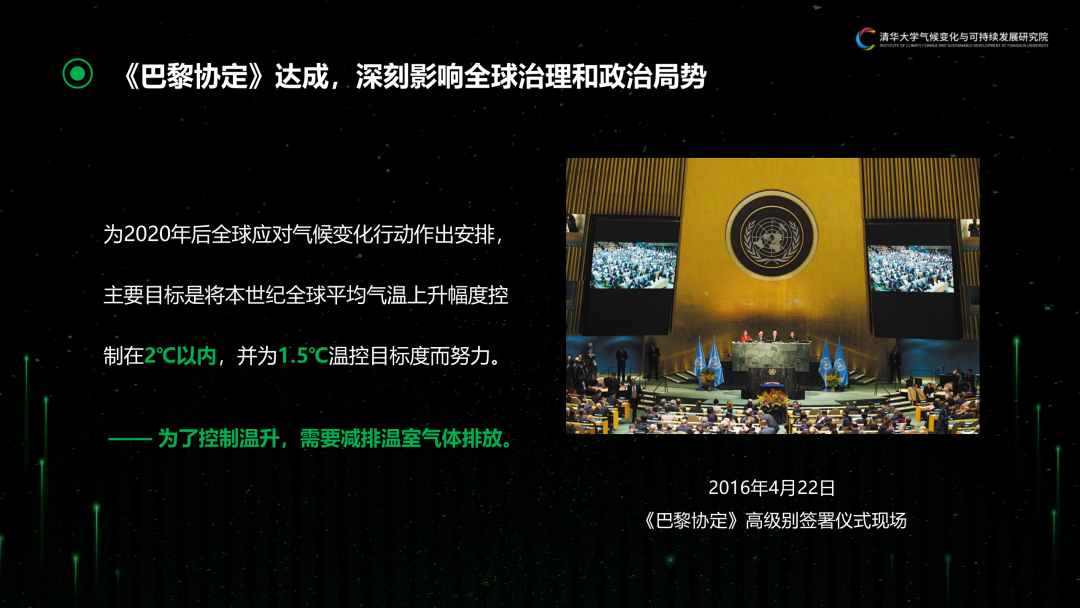
In 2016, the Paris Agreement, signed by 178 contracting parties worldwide, proposed a long-term goal to limit the increase in global average temperature to well below 2°C above pre-industrial levels and to pursue efforts to limit the temperature increase to 1.5°C.
To address climate change, countries, organizations, and enterprises around the world have set carbon neutrality goals:
● The EU has launched the European Green Deal, which is not only a climate strategy but also a long-term socio-economic development strategy.
● By the end of 2020, over 100 countries had pledged to achieve carbon neutrality.
● By February 2021, approximately 110 companies globally had announced net-zero emission targets.
According to the statistics from the United Nations Climate Ambition Alliance (Net Zero 2050), as of April 16, 2021, 191 countries, 243 regions, 1,174 investors, 10,748 cities, 1,985 organizations, and 5,031 companies had joined the alliance.
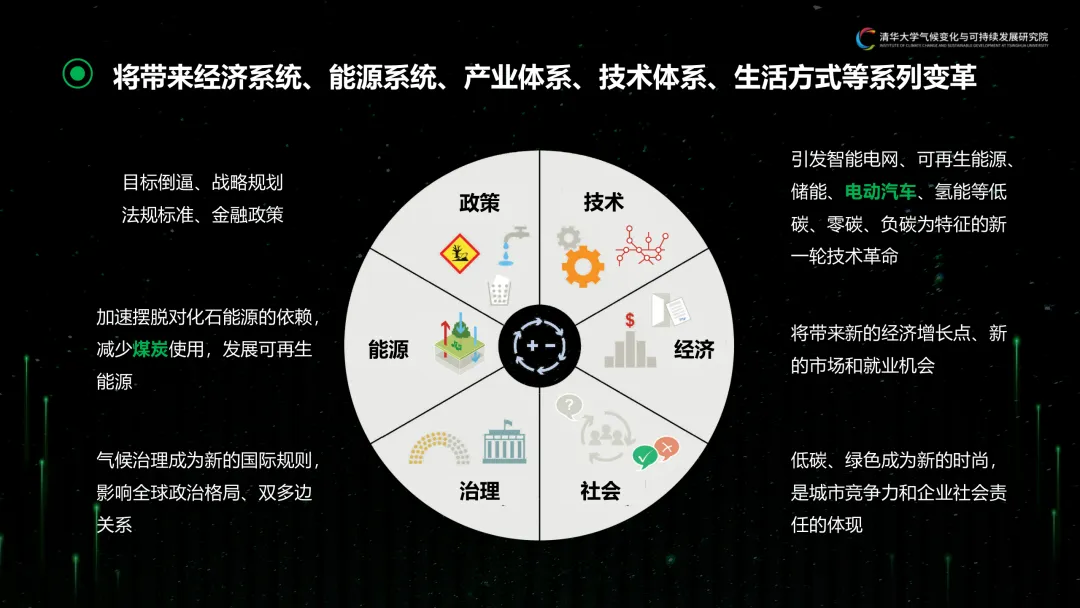
China, as the world's largest carbon emitter, accounts for about 28% of global emissions. Our current technological means are far from meeting the enormous carbon reduction needs. To achieve the required carbon reductions by 2050, half still need to rely on technological innovation and breakthroughs, which will also force us to undergo a series of transformations.
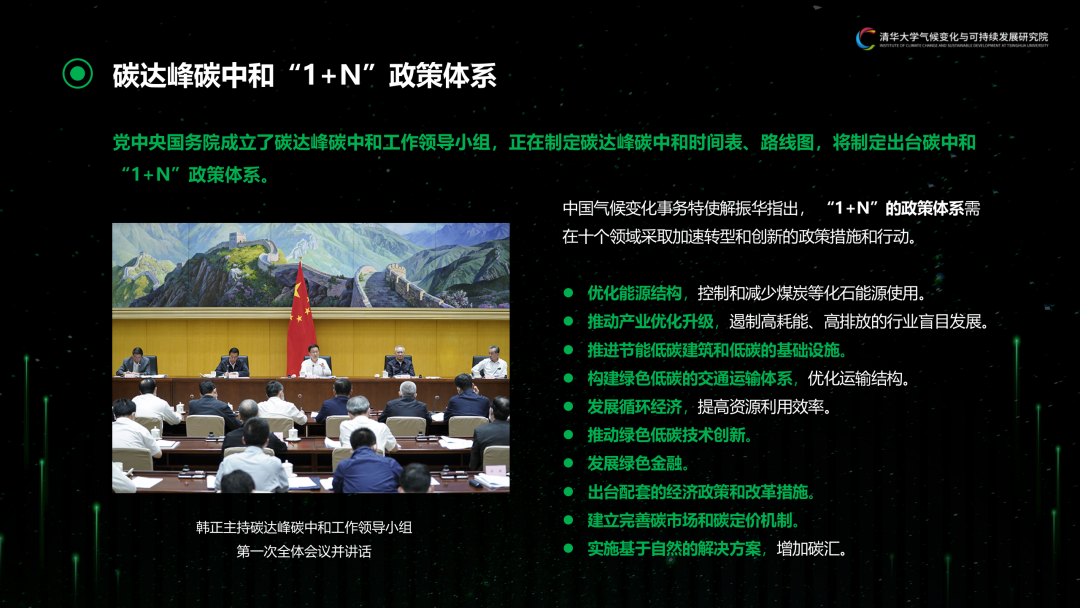
Since September 22, 2020, when China first proposed striving to achieve carbon peaking before 2030 and carbon neutrality before 2060, this marks a firm commitment to a sustainable development path toward carbon neutrality.
With the recent release of theGuiding Opinions on Fully and Accurately Implementing New Development Concepts to Achieve Carbon Peaking and Carbon Neutrality and the Action Plan for Achieving Carbon Peaking Before 2030, these highest-level guiding documents provide further guidance and requirements for China's carbon peaking and carbon neutrality development path.
China's carbon reduction process, from peak to carbon neutrality, is roughly half the time taken by European developed countries, presenting significant challenges. To truly achieve carbon neutrality, deep industrial transformation is needed. Comprehensive reforms must be carried out on the supply side, transitioning from carbon reduction to clean energy substitution. On the demand side, energy savings, emissions reduction, and efficiency improvements must be expedited in high-emission sectors such as transportation and construction.
To address the common, long-term, and profound challenges of climate change to human survival and development, there is a consensus globally on cooperation to tackle climate change. This will bring about profound transformations in the economy, society, energy, and technology, reshaping the international political landscape. China has declared its commitment to achieving carbon neutrality by 2060, positioning it as a major strategic move concerning the sustainable development of the Chinese nation and the building of a community with a shared future for mankind.
We believe that each of us will be part of this transformation toward carbon neutrality.
Practical Application and Case Studies of Product Carbon Footprint Accounting
Carbonstop, Ouyang Cheng
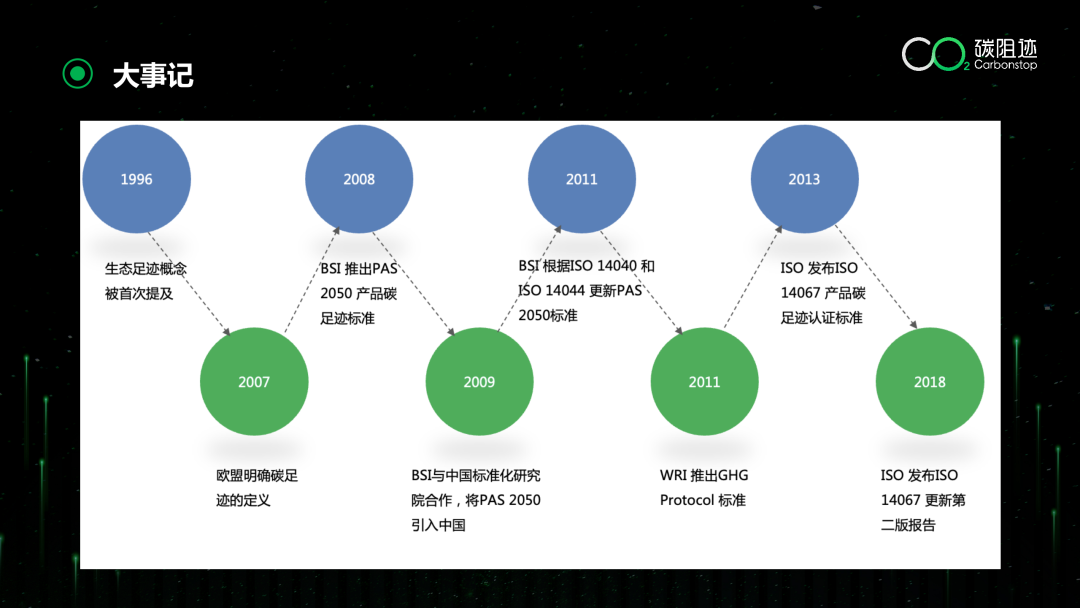
The concept of carbon footprint originated from the ecological footprint concept proposed by Columbia University and has gradually evolved into a core topic in today's discussions on carbon management.
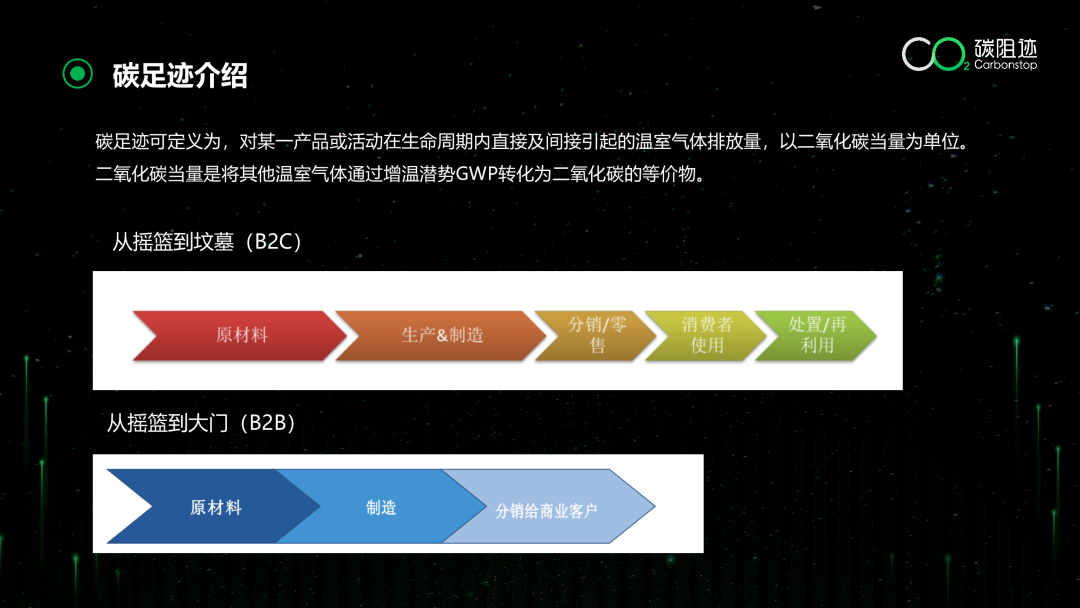
Carbon footprint (Carbon Footprint) refers to the amount of greenhouse gas emissions, expressed in CO2 equivalents, directly and indirectly caused by a product or activity throughout its lifecycle.
Since its inception in 1996, the concept has become clearer, developed, and formed corresponding standards. Today, the most widely used internationally is the ISO 14064 standard, first published in 2013 and revised in 2018.
A product carbon footprint generally refers to the greenhouse gas emissions from the raw material acquisition stage to production, distribution, use, and disposal stages of a product. By calculating and analyzing the carbon emissions throughout the product's lifecycle, it can reflect the energy consumption and environmental friendliness of the entire product phase.
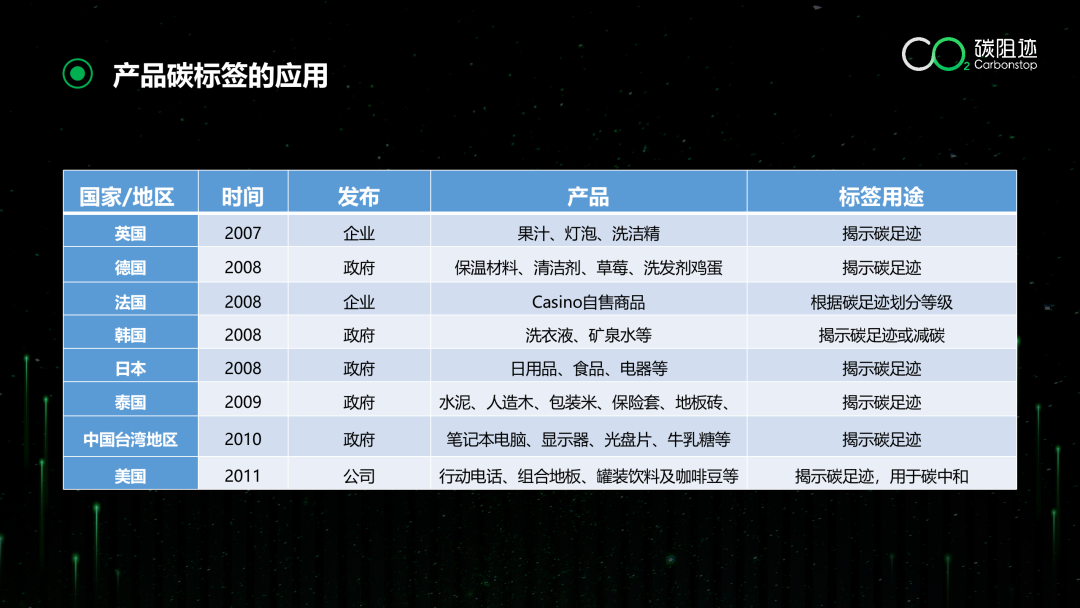
Enterprises can inform consumers about their products' carbon footprints by labeling them with "carbon labels," thus conveying environmental impact information to consumers in a straightforward manner and guiding consumer purchasing behavior.
In March 2007, the UK launched the world's first batch of products labeled with carbon footprints, including potato chips, milkshakes, and shampoos.
Currently, product carbon footprint assessment has become an important avenue for enhancing brand value and is increasingly valued by enterprises.
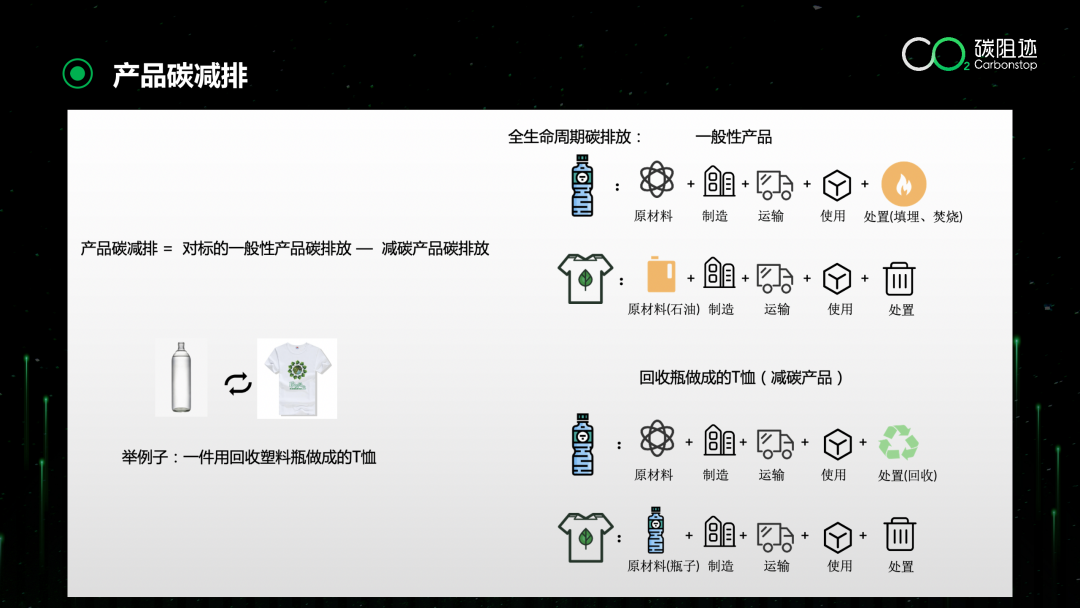
Product carbon footprint involves calculating the carbon emissions throughout the product's lifecycle. If the product can be recycled and reused, it can achieve a certain level of carbon reduction. We encourage enterprises to consider environmental aspects and recycle and reuse certain products. For example, the cultural shirts of the Carbonstop team are made from recycled plastic bottles.
8 Plastic Bottles = 1 Short-Sleeved T-Shirt
Isn't that a cool thing!
Besides calculating the carbon footprint of a specific product, carbon reduction can also be calculated for specific scenarios. The public can clearly see the carbon reduction of each scenario and even participate in carbon reduction actions.
For example, the calculations provided by Carbonstop for Fei Ant, a second-hand recycling platform:
Recycling 1kg of clothing = 5.35kg of carbon reduction
Recycling 1 book = 0.84kg of carbon reduction
Recycling 1 appliance = 13.27kg of carbon reduction

Carbon Cloud SaaS Empowers Product Carbon Footprint Management
Carbonstop, Yang Fucheng
Carbon Cloud is a one-stop carbon management SaaS platform launched by Carbonstop.
Based on over 100,000 carbon emission factor data accumulated over many years and thousands of enterprise cases from surveys and collaborations, it fully combines the actual carbon management needs of major Chinese enterprises. Combined with in-depth consulting services, it provides intelligent and productized carbon management solutions for customers.
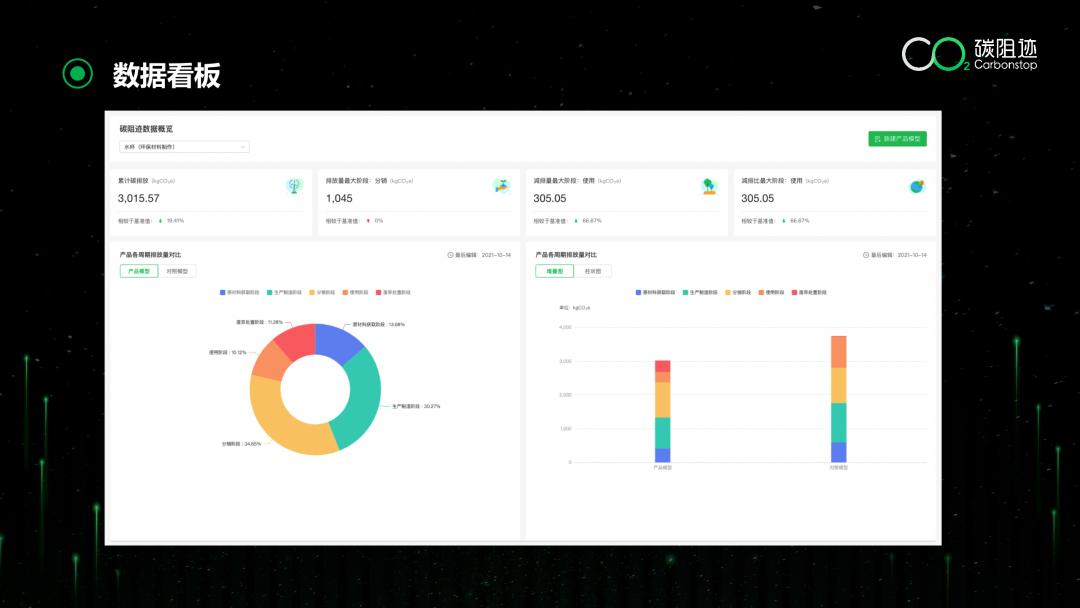
The product carbon footprint software represents the carbon emissions of products produced or sold by enterprises from a full lifecycle perspective. Based on a database of over 100,000 carbon emission factors, it helps enterprises scientifically, accurately, and conveniently calculate specific carbon footprints and carbon reduction information and automatically generates reports.
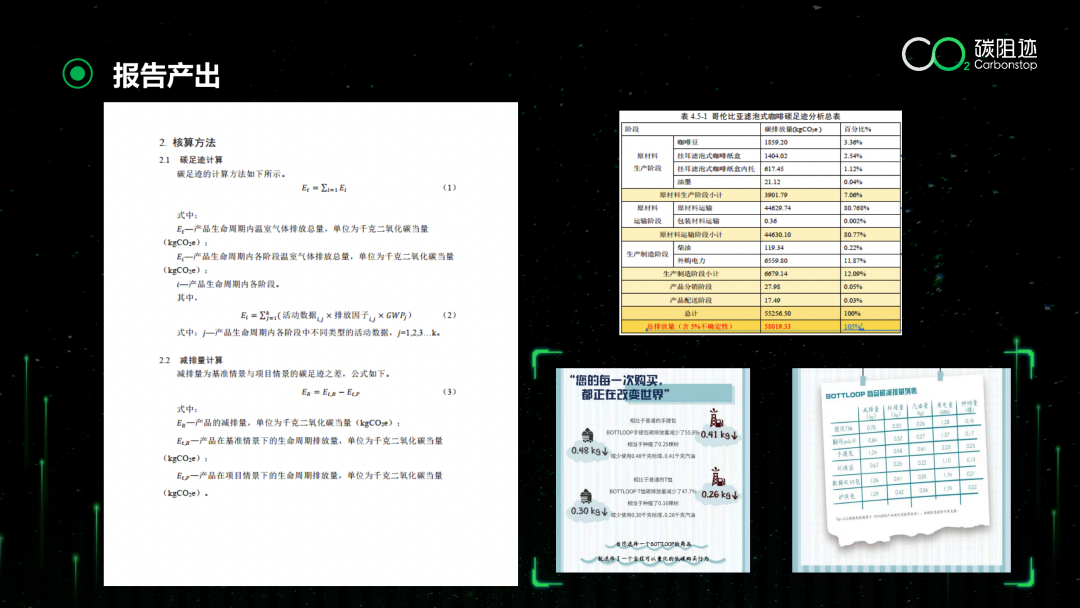
The current version 1.0 of the product carbon footprint software aims to solve the problem of enterprises not knowing how to calculate, helping them establish a data sample of product carbon emissions from scratch;
The upcoming version 2.0, currently under development, will significantly improve calculation efficiency, helping more enterprises calculate larger quantities of products;
In the future, we hope that through the Carbon Cloud SaaS platform, we can truly help enterprises calculate the carbon footprint of every product.
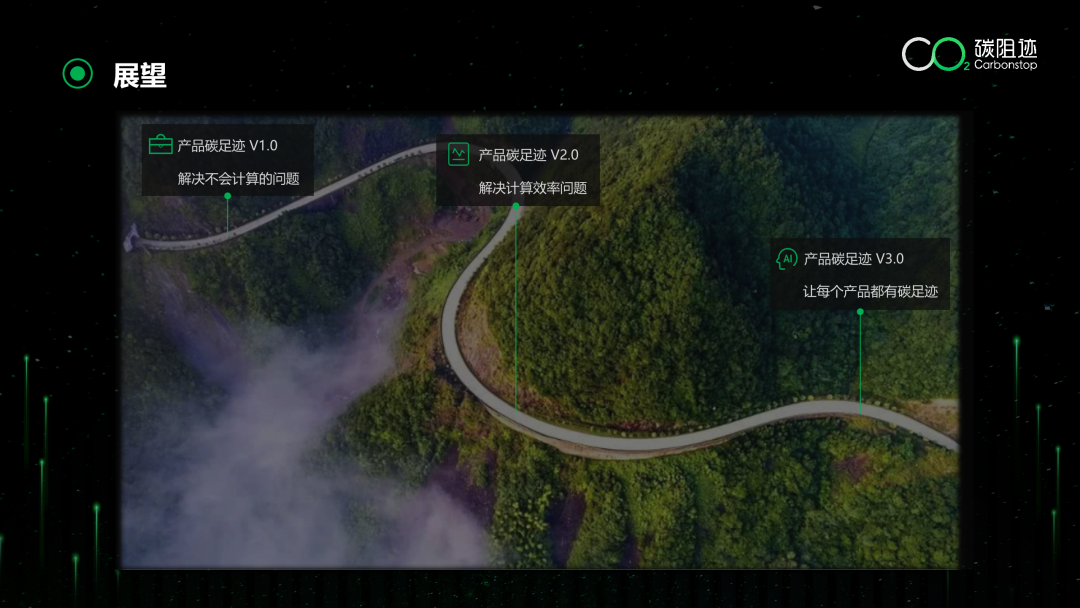
Just as Carbonstop's vision: Let every product have a carbon footprint.


