


 1099
1099In the spring of 2026, the hottest buzzword in the tech world is no longer “large model parameters,” but rather “raising lobsters.”
OpenClaw—an open-source AI agent with a red Boston lobster as its icon—is permeating industries at astonishing speed. Amid this nationwide “lobster-raising” craze, a deeper question is emerging: what exactly can AI do for ESG? When AI is no longer limited to answering questions, but can autonomously execute tasks—reading policies, tracking carbon data, comparing supply chain information, and drafting reports—ESG begins to shift from a “written commitment” to “action in motion.” This is the real transformation AI brings to sustainable development.


Why ESG Needs AI
A mismatch between the data tsunami and processing capacity
ESG implementation is facing the challenge of a “data tsunami.” About 80–90% of enterprise-generated data is unstructured and remains to be processed—from corporate carbon emissions reports to supply chain traceability information, from ESG rating indicators to climate risk assessment data. This information is pouring in at an exponential rate, far beyond the limits of human processing capacity, creating a gap between supply and demand that is difficult to bridge.
The disconnect between information disclosure and corporate action
The deeper dilemma of ESG lies in the disconnect between “what is said” and “what is done.” According to the IFRS Foundation’s 2024 report, fewer than 3% of companies worldwide disclosed all 11 TCFD recommendations. Traditional ESG management is largely “after-the-fact reporting” rather than “real-time intervention,” making it difficult to embed ESG principles into daily decision-making and operations. When data is scattered across hundreds of supplier systems and unstructured texts, no team can respond in real time.
The contradiction between complex standards and effective execution
The third major challenge of ESG comes from increasingly complex standards systems such as GRI, SASB, TCFD, and ISSB. Companies invest significant manpower in collecting data and preparing reports, costs continue to rise, yet information remains difficult to compare and circulate. What investors and regulators see is a pile of numbers that “speak different languages.” Worse still, fragmented standards create room for greenwashing—without a unified yardstick, companies can selectively disclose favorable indicators while avoiding unfavorable data.
Taken together, ESG is facing the entanglement of these three dilemmas, and AI—a tool capable of reading data at machine speed, integrating information across standards barriers, and identifying real signals amid massive noise—may be the key to unlocking them.

What AI Can Do for ESG
Recognition and perception: awakening dormant data
The starting point of ESG management is the acquisition and identification of information. AI’s most fundamental capability is to extract valuable signals from an ocean of information: analyzing reports, capturing carbon emissions data, interpreting legal documents, and identifying litigation risks. This shortens ESG information screening from weeks to minutes and turns fragmentation into integration.
Prediction and early warning: shifting from retrospective tracing to proactive foresight
The value of AI lies not only in seeing the past clearly, but also in foreseeing the future. In ESG management, AI can use multi-source data to conduct forward-looking risk assessments: predicting supply chain disruptions through weather data, forecasting carbon emissions trajectories using energy consumption data, and tracking public sentiment to provide early warnings of labor disputes. This shift from “passive response” to “active prevention” enables companies to intervene and resolve risks at an early stage, truly achieving an intelligent leap in ESG management.
Transparency and verification: moving ESG from a “word game” to something verifiable
AI is becoming the “third eye” for resolving the ESG trust crisis. Through cross-verification across multiple sources, AI can compare self-reported corporate data with satellite remote sensing and supply chain data in real time, promptly identifying signs of greenwashing. OpenClaw’s “file-driven design” makes decision logic transparent, controllable, traceable, and auditable. When AI becomes an objective verification tool, ESG evaluation is no longer a “word game” that can be dressed up at will.
Accessibility and empowerment: moving ESG from an exclusive privilege of leading firms to a standard capability for all
The exponential improvement in algorithmic efficiency is lowering the threshold for ESG management. With AI, small and medium-sized enterprises can obtain carbon accounting services at low cost; non-specialists can quickly grasp complex analyses through visual dashboards; and developing economies can leapfrog traditional stages and directly connect to the global governance system. AI is transforming ESG from a “compliance burden” for a few companies into a “management tool” for all companies.

Case Studies of AI Empowering ESG
Case 1: AI × the UN’s 17 Sustainable Development Goals
In 2015, 193 UN member states jointly adopted the 17 Sustainable Development Goals (SDGs) and committed to achieving them by 2030. Today, less than five years remain, while the annual financing gap has expanded from USD 2.5 trillion to USD 4.2 trillion. The emergence of AI is opening up new possibilities for what once seemed like an impossible mission.


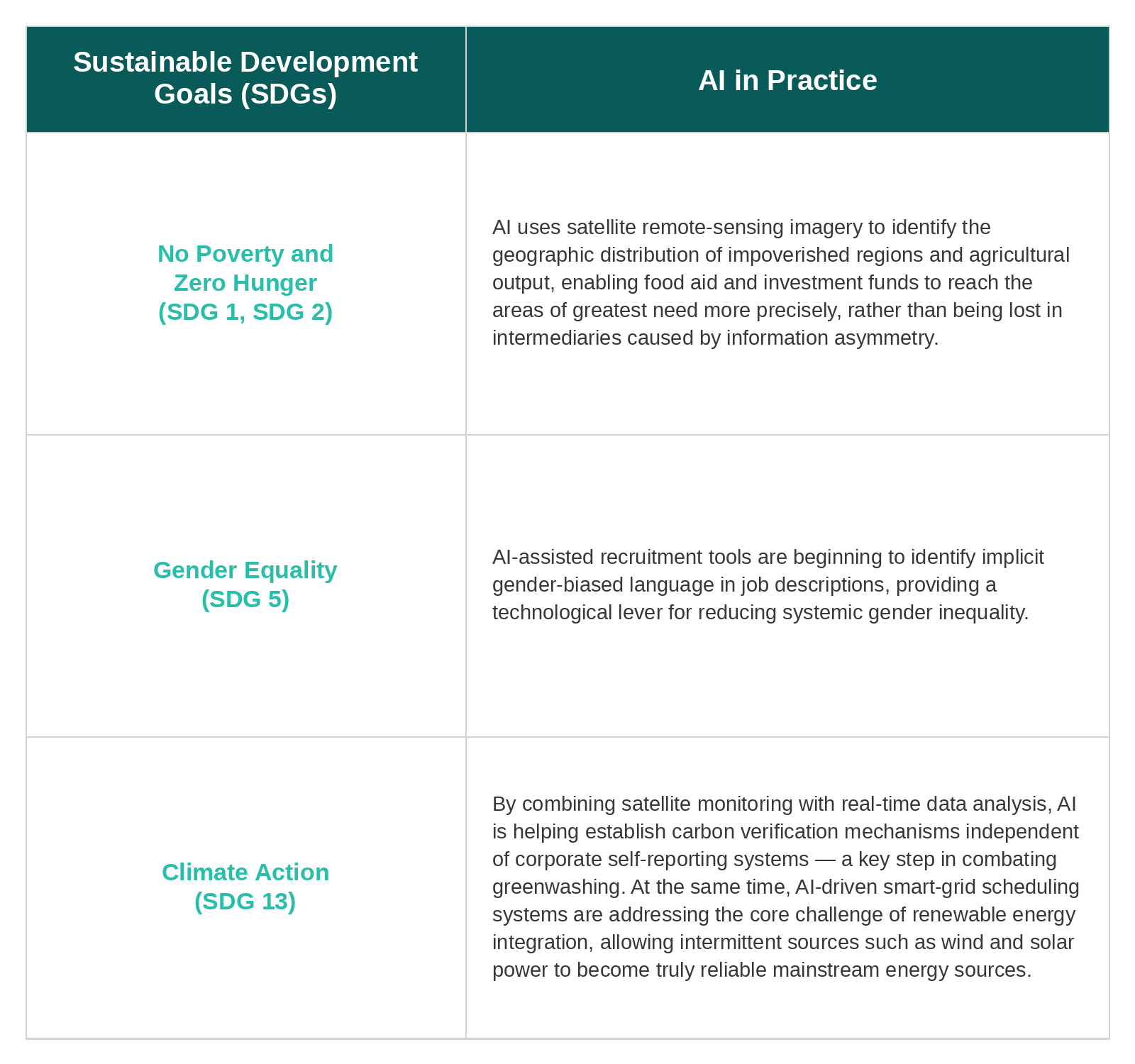
Case 2: AI accelerates ESG research
At Carbonstop, our consultants have already begun using OpenClaw and internally developed AI tools to comprehensively improve work efficiency. Take a typical ESG literature review task as an example: under traditional working methods, consultants would need several days to read through regulatory policies, corporate governance practices, and sustainable technology trends one by one, extracting key data and conducting cross-comparisons. AI tools, by contrast, can complete document reading within minutes, accurately identify the core arguments and data boundaries of each report, and automatically organize the ESG analytical hierarchy of “macro policy framework → corporate implementation practices → technology trend outlook.” More importantly, the behavioral rules of AI are written in human-readable configuration files, making its capability boundaries and decision logic transparent and auditable throughout the process.
Of course, AI provides the analytical framework and information synthesis, while final judgment and decision-making still rest with consultants. What AI changes is not just efficiency, but the way we work—it frees people from information processing so they can focus on the parts that truly require professional judgment.

The Other Side of AI Empowering ESG—Risks Cannot Be Ignored
When discussing how AI empowers ESG, there is one paradox that cannot be avoided: AI itself may also become part of ESG’s burden.
According to Google’s 2024 Environmental Report, water consumption in Google’s data centers during the reporting period approached 6 billion gallons. In recent years, this has continued to rise with AI computing demand, driven mainly by the cooling requirements of AI model training and inference. Some studies also estimate that training a model at the GPT-3 scale produces carbon emissions roughly equivalent to 112 gasoline-powered cars driving for an entire year—and that is only the training phase. Every invocation and every iteration continues to add to this environmental bill. When we use AI to solve ESG problems, AI’s own environmental cost is also quietly increasing.
The risks brought by AI are also reflected in the reshaping of employment structures. The World Economic Forum’s Future of Jobs Report points out that in the coming years, AI and automation will accelerate the disappearance of certain occupations, while newly created jobs will often be concentrated in more digitalized and technically demanding fields. This means the impact of technological substitution will first fall on low-skilled, low-income workers—precisely the groups that the “social” dimension of ESG is meant to protect the most.
AI is powerful, but tools are not inherently aligned with the good. Their direction depends on the values of those who use them and, even more importantly, on the strength of the governance frameworks that constrain them. If companies truly want to achieve “AI for good,” they cannot focus only on efficiency gains; they must also confront the environmental costs, ethical biases, and social disruptions that AI may bring. Only when the use of AI itself aligns with ESG principles can it truly qualify as a driver of ESG.

How Should Companies Act?—Building a Practical AI × ESG Pathway
To address the challenges of AI × ESG, companies need to coordinate efforts across three levels: technology, management, and ecosystem. At the technology level, companies should establish regular AI model review mechanisms to ensure that tools remain reliable and compliant throughout their full lifecycle. At the management level, they should break down the barriers between ESG teams and AI teams, build cross-functional governance mechanisms, and directly embed ESG indicators—such as energy constraints, data ethics, and human-machine boundaries—into the key stages of AI development and application. At the ecosystem level, they should actively participate in improving regulatory rules, co-building industry standards, and coordinating social oversight to promote a governance ecosystem based on multi-stakeholder collaboration.
At the same time, as a company driven by the dual engines of consulting and digitalization, Carbonstop continues to explore the deep integration of AI. From using Carbon AI Agent to rapidly build product carbon footprint accounting models, to supporting ESG report writing, from AI-based rating prediction and gap analysis to the establishment of climate risk scenario analysis models, we are committed to injecting intelligent technology into more service scenarios, empowering our clients’ ESG management, enabling technology to serve people, and allowing development to benefit the world.


