


 1371
1371This article provides a systematic overview of the core updates to the CDP 2026 questionnaire, analyzes the policy and market forces shaping them, and offers forward-looking recommendations for companies. The aim is to help organizations quickly benchmark against new requirements, identify existing gaps in data and management, develop targeted improvement plans, and achieve steady progress in CDP ratings—while staying ahead of an increasingly demanding climate and nature disclosure landscape.

China's CDP Landscape: Growing Participation, Persistent Leadership Gap
In 2025, 3,328 companies in Greater China disclosed on the Climate Change theme, while 1,597 participated in the Water Security theme. But growth in numbers does not automatically translate into improvement in quality:
The share of Chinese companies achieving Leadership-level ratings remains lower than that of peers in Japan, the UK, and India.
37 companies appeared on the CDP A List—a meaningful number, but modest compared to 877 A-rated companies globally.
A notable shift is underway: A ratings are no longer the exclusive domain of renewable energy companies. Firms in electronics manufacturing, packaging, and pharmaceuticals are entering the Leadership tier at an accelerating pace. For non-listed supply chain companies, a strong CDP rating is increasingly seen not as a compliance cost, but as a competitive differentiator.
In 2025, Carbonstop's clients collectively earned three A ratings and three A- ratings, helping companies achieve top-tier leadership recognition across all three questionnaires—Climate, Forests, and Water Security.

CDP 2026 Questionnaire: A Snapshot of Core Changes
New Addition: Ocean Topics
CDP introduces ocean topics for the first time in 2026, embedded across Modules 1–5 and 13. Coverage includes dependencies, risks and opportunities, governance, and strategy.
- Ocean questions will not be scored this cycle—this year functions as a data-building window.
- High-impact sectors such as shipping, fisheries, and offshore energy should prioritize early action.
- Future alignment with TNFD and the Blue Finance Initiative is anticipated.
Forests: Seven Commodities, Unified Scoring
Cocoa, coffee, and rubber are formally incorporated into the scoring framework for the first time, joining beef, palm oil, soy, and timber. All seven commodities are now evaluated under a consistent standard.
- The commodity disclosure exclusion threshold has been raised from 1% to 5%, reducing the reporting burden for some companies.
- No-deforestation and no land-conversion commitments must align with frameworks such as SBTN and AFi.
- Companies with exposure to these commodities should begin building traceability systems immediately.
Water Security: From Volume Management to Integrated Stewardship
The focus of water security disclosure shifts from raw water use to science-based targets, wastewater compliance, pollutant identification, and full value chain risk assessment.
- Wastewater treatment levels, discharge volumes, and regulatory compliance will carry greater scoring weight.
- Pollutant management is no longer optional; companies that have not identified relevant pollutants must explain why.
- Alignment with SBTN freshwater targets is supported, and companies that have already set such targets will receive additional recognition.
Plastics: Greater Data Granularity
Plastics remain unscored in 2026, but the questions have become significantly more detailed—covering packaging format breakdowns, reuse models, and design-for-recyclability tools. Companies should treat this as a transition year for building circular economy data infrastructure, in preparation for future regulatory alignment with the EU Packaging and Packaging Waste Regulation (PPWR) and the Global Plastics Treaty.
Adaptation and Resilience: From Identification to Action
The evaluation emphasis shifts from whether companies identify physical risks to whether they describe concrete responses. Measures must be tied to:
- Infrastructure upgrades, supply chain diversification, and insurance arrangements
- Financial linkages to capital expenditure and operating costs
- Clearly defined oversight responsibilities at the board and management level
General Revisions: Tighter Boundaries and Verification Standards
- The Forests module now clarifies the treatment of post-consumer recycled materials and third-party branded products.
- Emissions verification documentation must now include: verification scope, methodology, verification body, data coverage, and applicable standards.
- A new option to reference SBTN Step 1 assessment reports has been added, with further alignment to TNFD, GRI, and ESRS.

SME Questionnaire: Three Major Upgrades
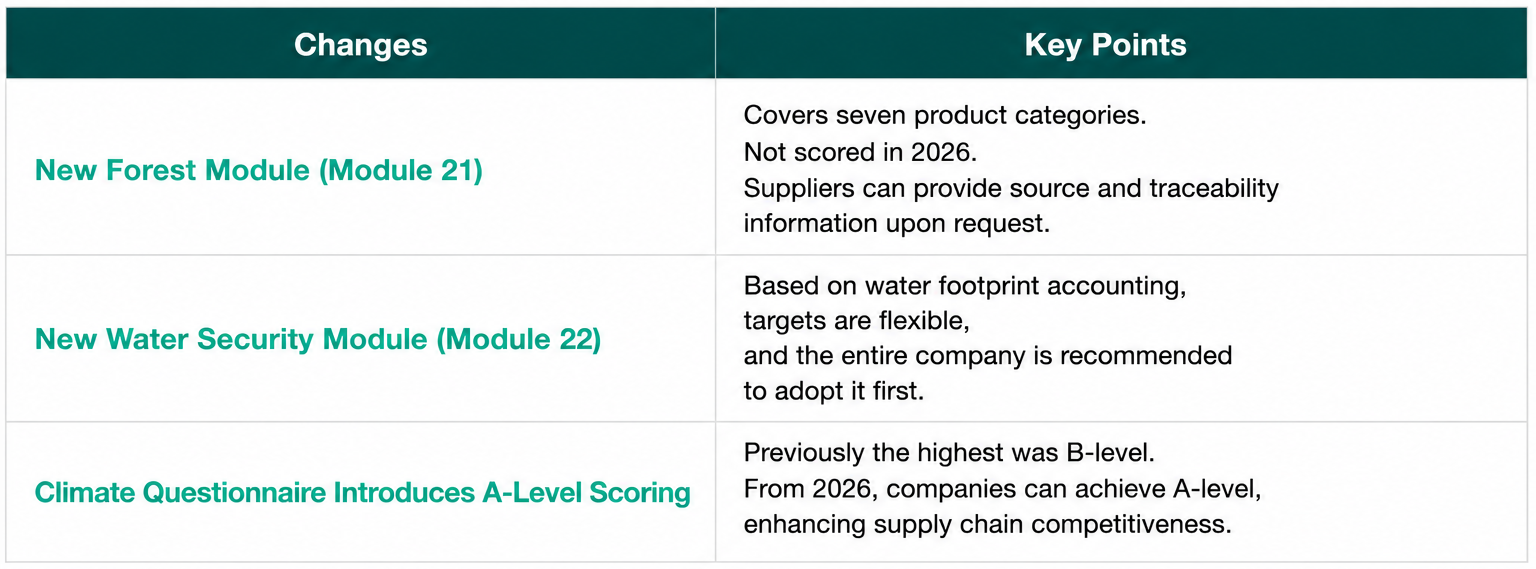

What It Takes to Reach B and A: Core Requirements
CDP's scoring framework follows a four-tier progression: Disclosure, Awareness, Management, and Leadership. Companies must meet the score threshold and baseline criteria for each tier before advancing to the next.
B Level (Management): Taking Action on Environmental Issues
Achieving a B rating signals that a company has established systematic environmental management. Core requirements include:
- Full disclosure of Scope 1 and Scope 2 greenhouse gas emissions, with clearly defined accounting boundaries
- Quantified emissions reduction targets with annual progress tracking
- A formal process for identifying climate-related risks and opportunities, covering both physical and transition risks
- An environmental management policy with defined responsibilities and implementation mechanisms
- Concrete emissions reduction actions (e.g., energy efficiency upgrades, renewable energy adoption, process optimization) with disclosed reduction outcomes
- A climate governance structure with clear accountability at the management level
A Level (Leadership): Best-Practice Transparency and Performance
An A rating represents the highest global standard of environmental disclosure and management. In addition to all B-level requirements, companies must:
- Set science-based emissions reduction targets (e.g., validated by SBTi), demonstrating alignment with a 1.5°C pathway
- Disclose Scope 3 (value chain) greenhouse gas emissions across major upstream and downstream categories
- Have emissions data independently verified by a third-party organization
- Quantify the financial impact of climate risks and opportunities, integrated into financial planning
- Publish a climate transition plan outlining short-, medium-, and long-term decarbonization pathways and capital deployment
- Actively engage with suppliers, customers, and investors on climate topics
- Establish a board-level climate governance mechanism with regular review of climate performance and strategy
- Provide verifiable, high-quality emissions reduction results—not just target-setting
Practical note: The earlier you start, the stronger your final score improvement. Carbonstop can help companies conduct gap assessments and identify the most direct path from a B to an A.

Recommendations: Start Early, Score Higher
The difficulty of CDP 2026 has not jumped dramatically—its scope has. The companies that improve their ratings this cycle will be those able to extend existing frameworks to cover new topics. Carbonstop recommends a four-step approach:
- Conduct a Gap Analysis — Systematically review changes in the 2026 questionnaire and identify data and process gaps across ocean, plastics, newly scored forest commodities, and water security topics.
- Strengthen the Data Foundation — Fill in facility-level, product-level, and supply-chain-level data to improve granularity and traceability.
- Use the Non-Scored Window Strategically — Modules like ocean and plastics are unscored this year, making now the ideal low-cost opportunity for experimentation and capability building.
- Align with Leading Frameworks — Bring CDP reporting into alignment with GHG Protocol, SBTi, SBTN, and TNFD—building one underlying data logic that serves multiple frameworks.

Carbonstop AI Scoring Tool: Smarter CDP Preparation
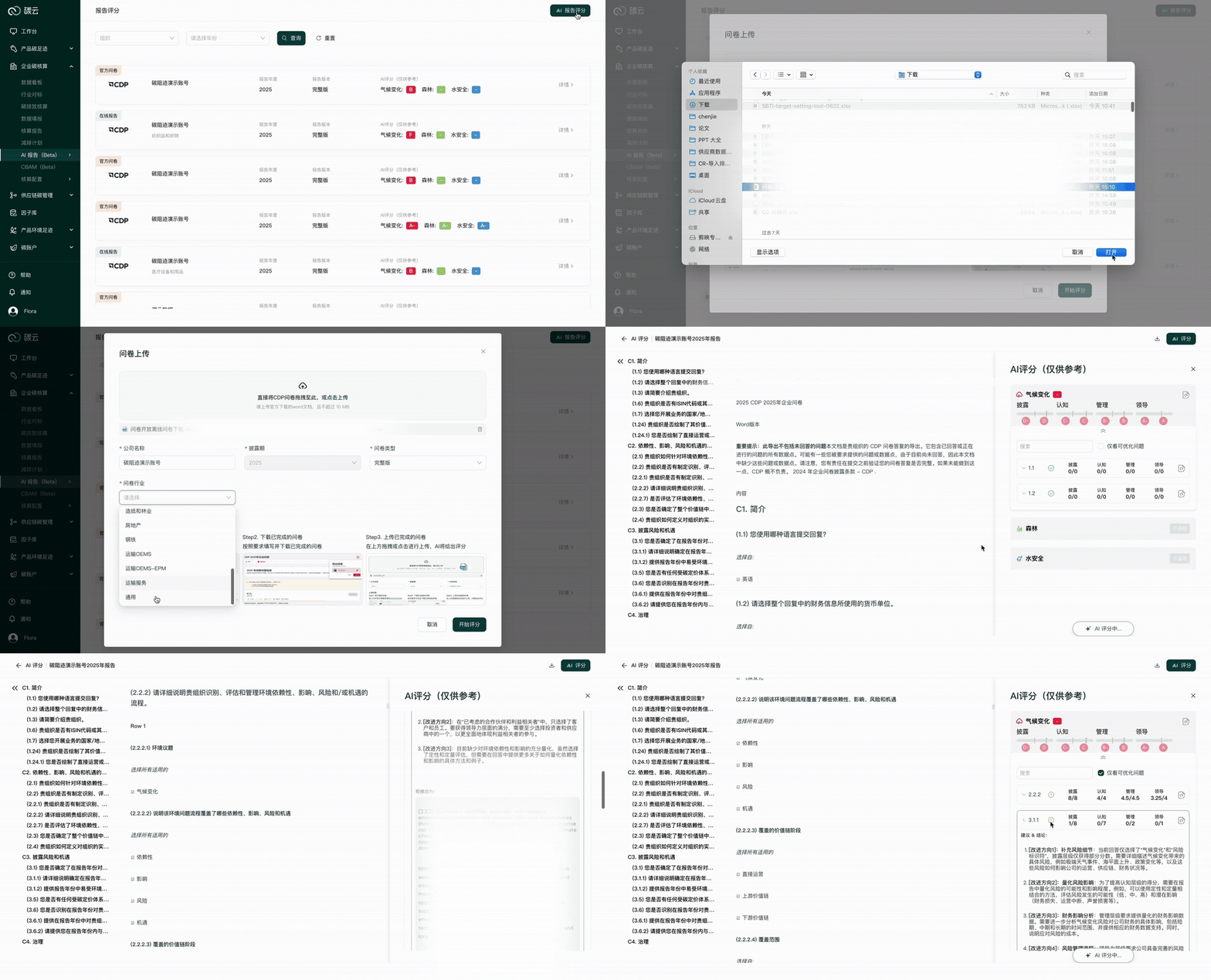
Based on the 2026 CDP questionnaire changes, Carbonstop has launched an upgraded AI-powered scoring tool designed to improve disclosure efficiency in two key ways:
- AI-Assisted Completion: Analyzes historical questionnaire responses in full, provides precise translation and refinement, and ensures professional accuracy in international communication.
- AI Score Prediction and Optimization: Runs multiple simulation rounds to forecast scoring outcomes, pinpoints areas of score loss, and generates targeted improvement recommendations.

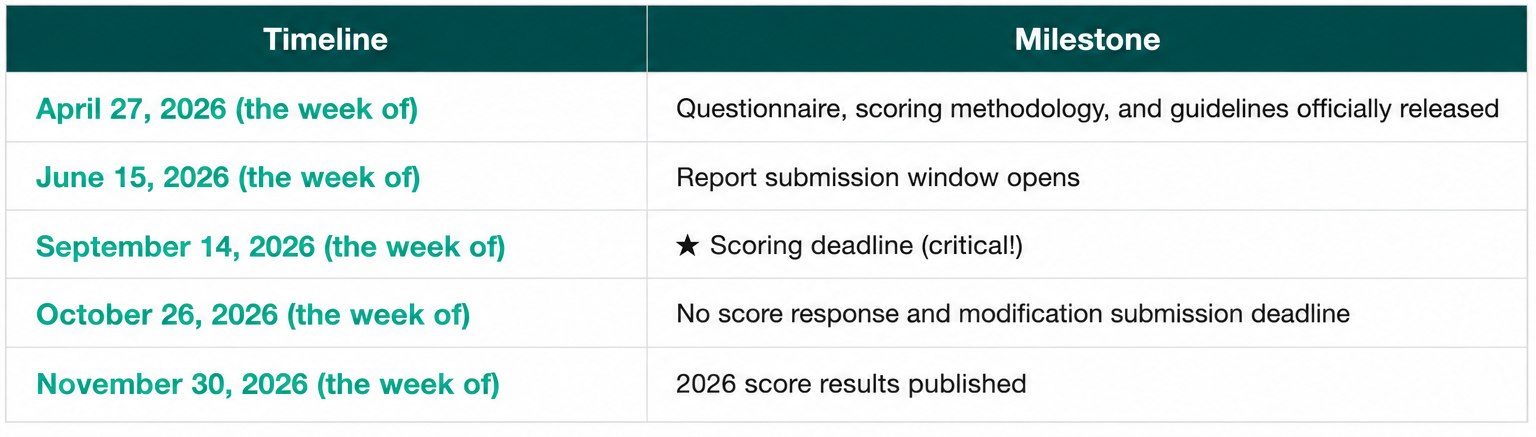
Key 2026 Disclosure Milestones
Abbreviations:
PPWR — EU Packaging and Packaging Waste Regulation; TNFD — Taskforce on Nature-related Financial Disclosures; SBTN — Science Based Targets Network


