


 1922
1922Not an Upgrade, a Generational Shift: Carbonstop Officially Launches Carbon Agent
On June 30, Carbonstop officially launched its new carbon management Agent product: Carbon Agent.
This is not a product upgrade. It is a complete generational shift:

From the AI Era to the Agent Era: Why Carbon Management Needs a Generational Shift
In 2023, ChatGPT swept the world, and AI entered public consciousness for the first time as a “brain.” In 2025, Manus was born, a name derived from the Latin word for “hand.” For the first time, AI gained a “hand,” marking its evolution from answering questions to taking action.
For the carbon management industry, this shift is especially important. Carbon management has never been a single-point Q&A problem. It is a systematic discipline that depends heavily on professional expertise, data quality, workflow coordination, and the credibility of results. In the past, many software products improved efficiency in certain steps. But whether a project could truly be delivered, accepted by clients, and verified by a third party still depended on a complex end-to-end workflow behind the scenes.
In March this year, Yan Luhui visited Silicon Valley and had in-depth conversations with teams from OpenAI and Gemini. “Everyone was excited, and everyone was anxious,” he observed. In the AI era, people largely fall into two camps: those who ignore it, and those who fear it.
But for Carbonstop, what matters more is action.

Why Carbon Management Needs a Specialized Agent
If AI is already so powerful, and large models are already so capable, is a dedicated carbon management Agent still necessary?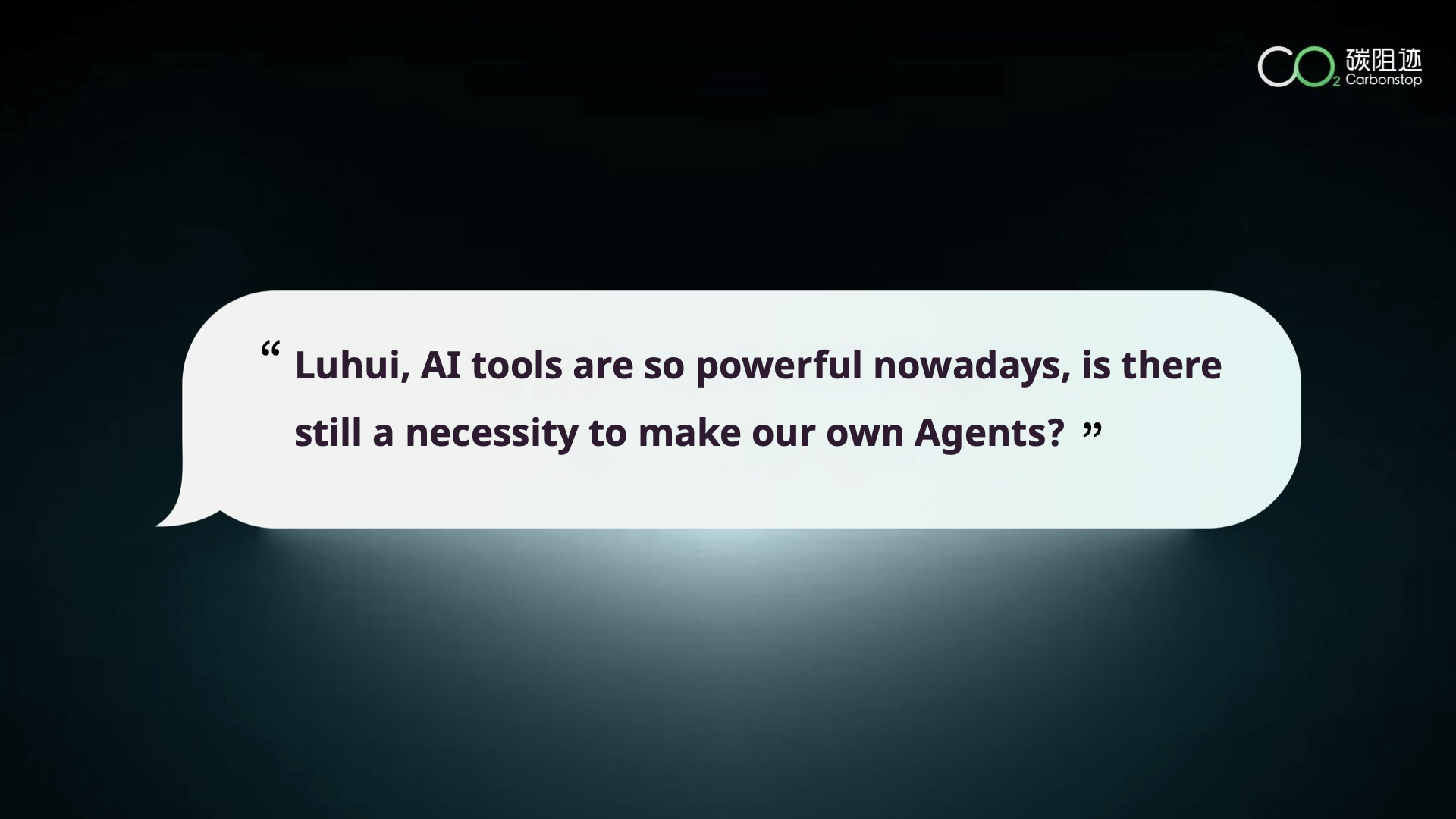
There were different views within Carbonstop when the project was first proposed. But Yan Luhui’s judgment was clear: carbon management is exactly the kind of field that needs a vertical Agent most.
First, uncertainty is high. Accounting boundaries and methodologies vary across industries and products.
Second, complexity is high. The work involves extensive emission factor databases, emission sources, and deeply nested supply chain data.
Third, the data is private. Each company’s production processes, energy structure, and supplier information are highly customized and not publicly available.
Fourth, the results must be credible. This is not something that can be brushed over with casual conversation. It requires real expert capability as the foundation.
For this reason, Carbonstop believes the carbon management industry does not lack AI that can “chat.” What it lacks is an Agent product that can enter real workflows, take on professional tasks, and stand behind the results.
That is why carbon management needs a specialized Agent.

A Generational Shift, Not Just an Upgrade: Carbon Agent Is Officially Launched

As early as July 2025, Carbonstop had already released AI capabilities embedded into its SaaS software, a full year ahead of the industry. But as the Agent era arrived, Carbonstop chose self-renewal. Instead of patching the existing product, it made a complete generational shift.
Why is this a “generational shift” rather than an “upgrade”?
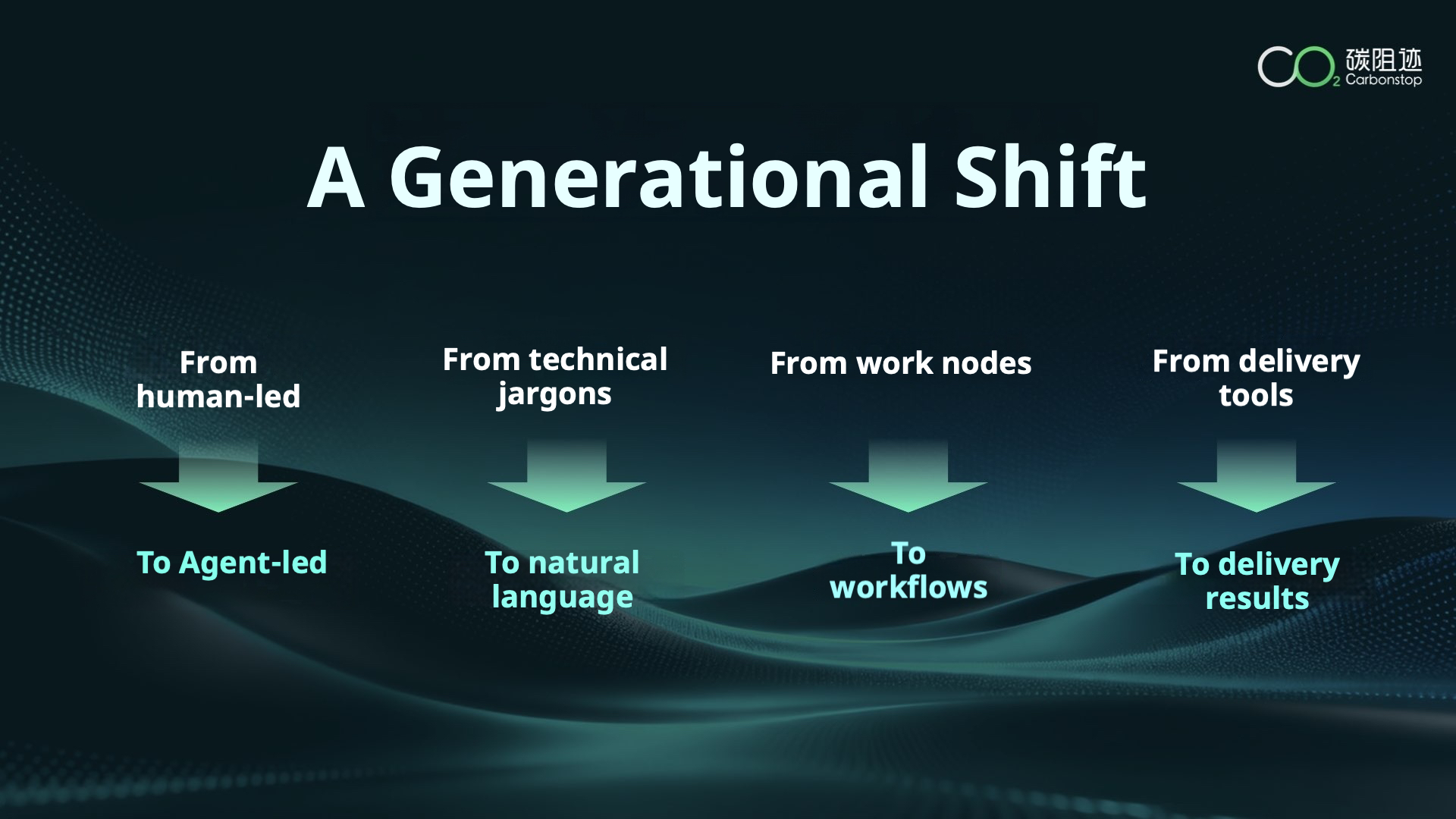
From embedded AI to native Agent: it is no longer about adding an AI entry point to SaaS, but making the Agent the core work interface.
From clicking through functions everywhere to a unified conversational entry point: users no longer need to understand complex menus and feature paths. They can launch tasks directly around their goals.
From single workflow-node capability to full workflow capability: it is not just about completing one action, but organizing the entire carbon management process.
From delivering tools to delivering credible results: the ultimate value is not merely that the product is “usable,” but that it can deliver, be reviewed, and be accepted.
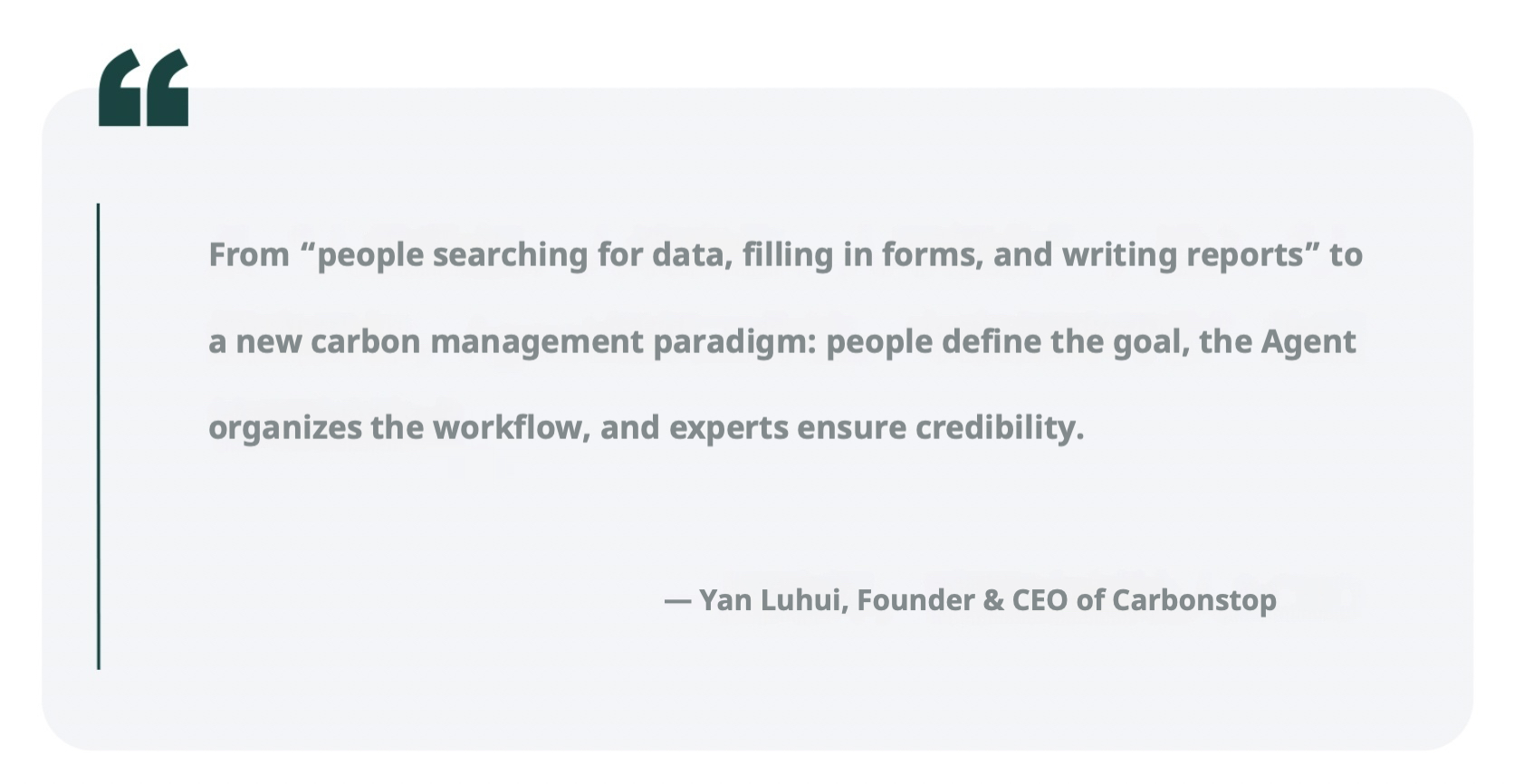
“Previously, users had to click around different functions. Now there is one unified entry point, all inside the dialogue box,” Yan Luhui said when describing the change brought by the Agent. “With Carbon Agent, we have achieved a complete transformation in product logic, interaction experience, and business model.”

Understand What Carbon Agent Can Do With One Scenario
Carbonstop’s newly released carbon management Agent is not simply a Q&A product. It is built around real corporate carbon management tasks and provides more complete workflow capabilities.
At the launch event, Carbonstop demonstrated how the new Carbon Agent can perform product carbon footprint accounting for a football product.
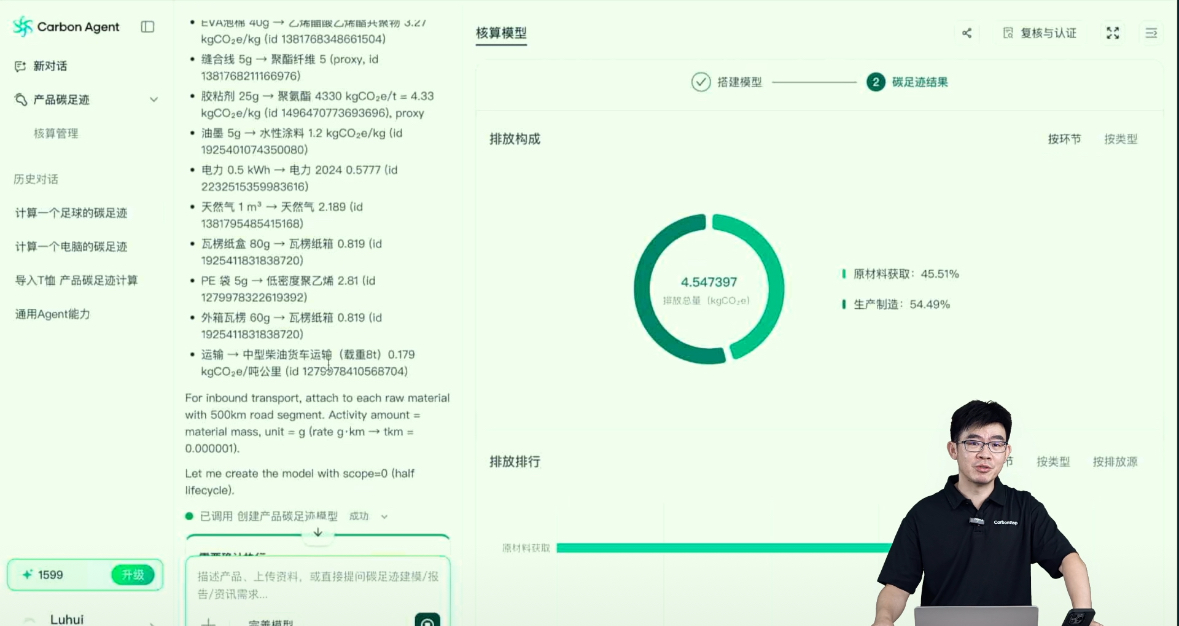
Work that used to take several weeks was compressed into tens of minutes. More importantly, every step of the process, including emission sources, activity data, factor selection, and accounting logic, is traceable and reviewable.
This is the essential difference between “people searching for data” and “an Agent organizing the workflow.”
This is not a “new feature.” It is the first full productization of Carbonstop’s more than decade-long carbon management practice. Product carbon footprint accounting is being condensed into an AI Agent, making time and cost no longer the threshold and enabling product carbon accounting to truly operate at scale.

Five Revolutions: Redefining the Carbon Management Industry
The launch of Carbon Agent is not only the iteration of a single product. It also reflects the deeper transformation taking place across the carbon management industry.
Compliance Revolution: From “generated” to “trusted.”
With Agent guidance, professional consultant support, and connected certification services, AI-generated product carbon footprint results can become traceable and reviewable.
Value Revolution: Pay for results, aligning value with price.
Payment is shifting from “annual subscription” to “usage-based.” “As product builders, we should double down on value creation, so that every yuan users spend is justified.”
Accessibility Revolution: ESG should not be a game for only a few companies.
“Lower barriers are the only path to a bigger future.” Product carbon footprinting should be a standard capability in this era.
Efficiency Revolution: 1 + 1 > 10.
One person plus one Agent can deliver the output of a ten-person team. Inefficiency, by nature, is unsustainable.
Cost Revolution: From tens of thousands to thousands, and then to hundreds.
“Cost is the biggest enemy of scalability.” Carbonstop aims to bring costs down and make carbon management scalable.

A Carbon Management Agent That Anyone Can Afford
Carbon Agent brings not only a generational shift in capability, but also true accessibility in carbon management.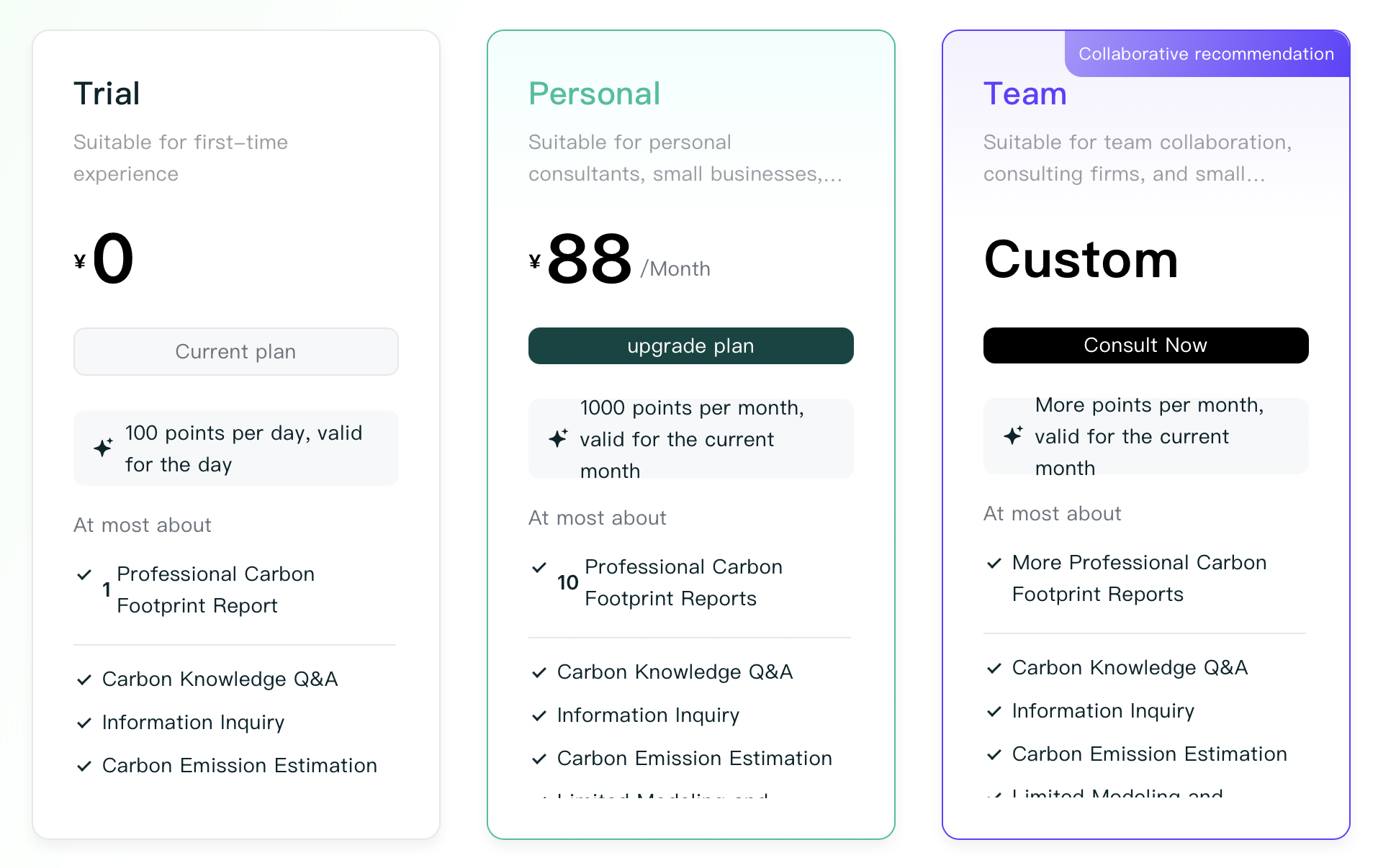
The Individual Plan is priced at RMB 88 per month. It includes 1,000 tokens per month, which can support the generation of up to 10 professional carbon footprint reports. It also includes carbon knowledge Q&A, consulting queries, carbon emission estimation, and many other functions. For individual users, consultants, or SMEs who need frequent carbon accounting, this means they can have a professional carbon management assistant online 24/7 for less than RMB 100 per month.
The Team Plan builds on the Individual Plan with customized service configurations, more flexible modeling and reporting functions, deeper access to advanced carbon emission factors, and full-process modeling and reporting capabilities to meet the complex needs of enterprise users. For detailed pricing, please contact Carbonstop’s official team.
During the livestream, Yan Luhui revealed a key signal: “Only by bringing costs down can we scale carbon management.” From consulting services that once routinely cost tens of thousands of yuan to today’s Agent product priced at the hundred-yuan level, Carbonstop is pushing its mission of “giving every product a carbon footprint” into the next stage.

AI Handles Today. Humans Explore Tomorrow.
At the launch event, Yan Luhui raised an open-ended question: “If AI can help us do so many things, are we becoming more idle, or busier?”
His answer was: “When AI takes over simple and repetitive work, people can free up time to do what they could not do before: explore a bigger future. So people will become busier, but they will be busy with work that has value and meaning.”
Carbonstop’s exploration of AI began in 2023. From launching China’s first carbon management AI product at COP28, to integrating large model capabilities into CCloud, to releasing a carbon Agent and enabling all employees to use frontier AI tools deeply, Carbonstop has continued to track the boundaries of AI technology over the past two years and turn each iteration into the foundation for product evolution. That sustained investment and accumulation led to the official launch of Carbon Agent today. Every step has been a solid footprint toward the Agent era.
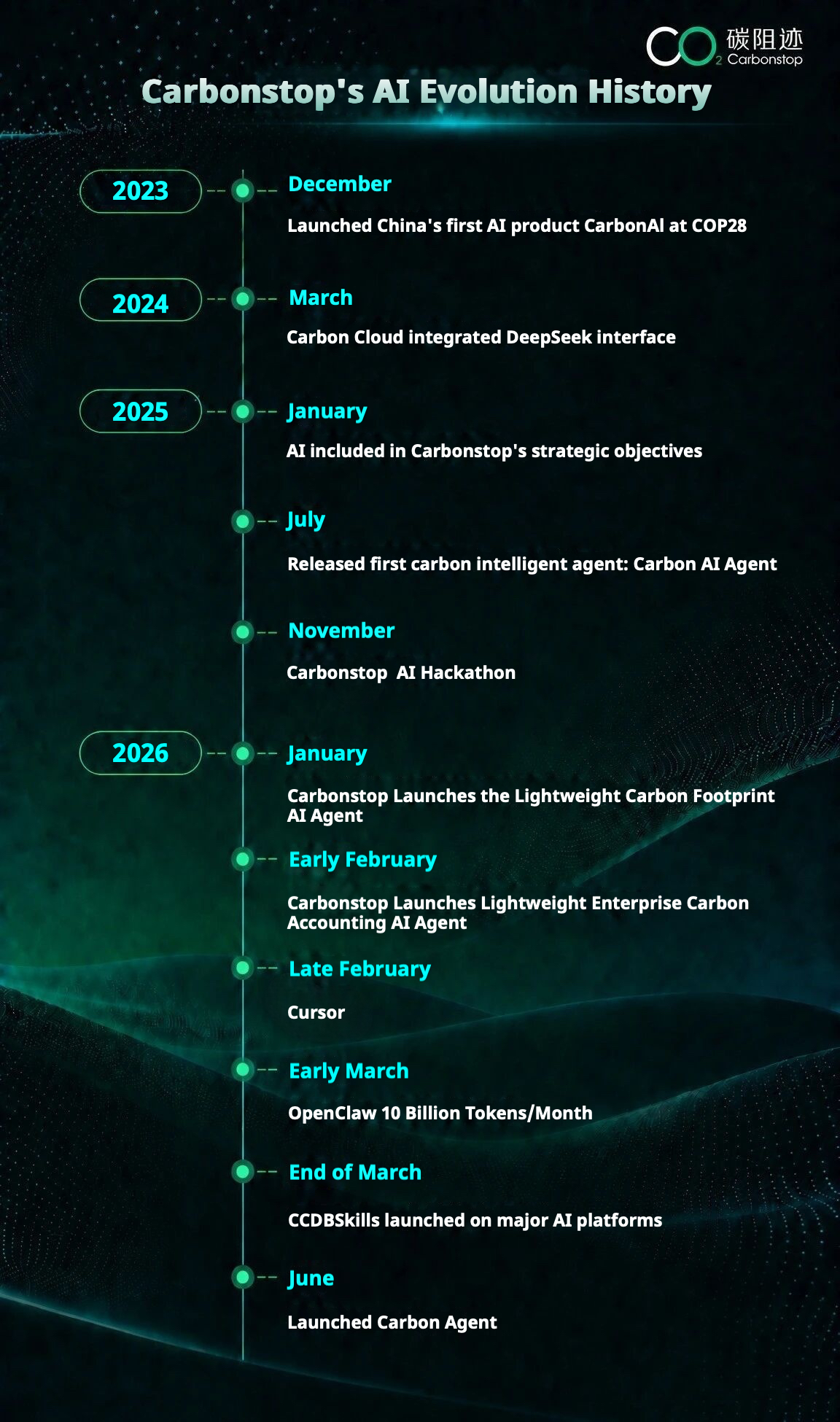
Carbonstop is also using the same logic to explore its own “bigger future.” This is not just a product launch, but a continued commitment to deep industry cultivation. To this end, Carbonstop has officially launched its “AI + Carbon Management” livestream series. With two sessions each month, the series will continue to explore the rapid evolution of AI and Agents, as well as new demands in the carbon management industry, bringing in-depth insights and practical sharing. Please follow Carbonstop’s official channels for more updates.

Peak Dialogue: Carbon Agent Makes Carbon Footprints Accessible, SGS Makes the Results Trusted Globally
In the second half of the launch event, Carbonstop founder Yan Luhui and Xin Bin, Vice President of SGS China and Head of Carbon Business, held an in-depth dialogue under the theme “AI Reshapes the Carbon Footprint Era.”
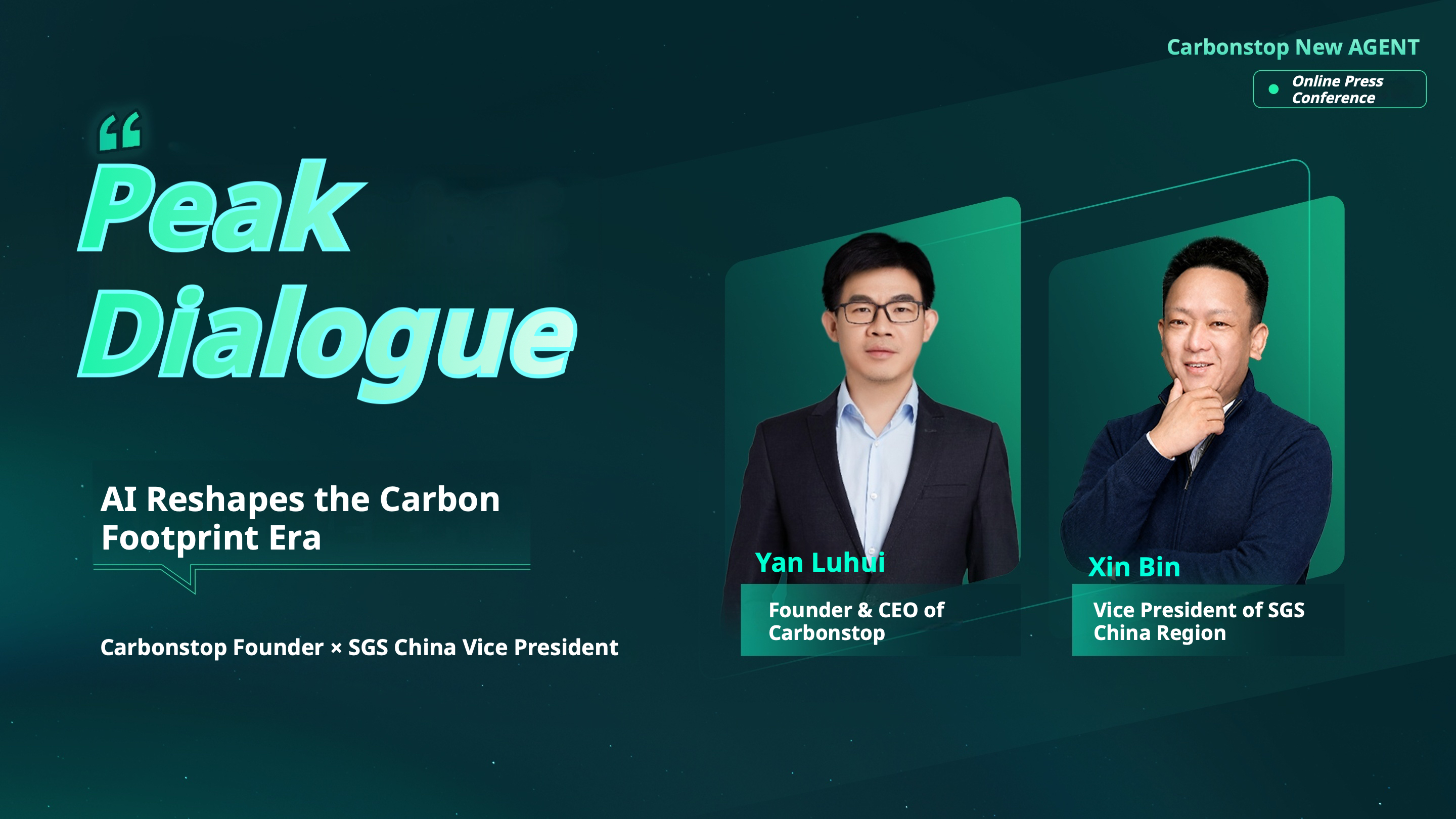
Yan Luhui stated directly that for product carbon footprints, it is not enough for a technology company to simply claim that it does the work well. In his view, AI makes carbon footprint accounting accessible, while SGS makes carbon footprint results globally trusted. Both are indispensable.
When asked about the level of trust in AI-generated accounting results, Yan Luhui gave a clear response: Carbonstop’s AI Agent has its own bottom line for credibility. The Agent improves efficiency, while experts and third parties ensure trust. “When Carbonstop’s AI conducts carbon footprint accounting, the underlying data it relies on most are the carbon factor database, industry know-how, and accumulated models. If the carbon factor database is not localized enough or accurate enough, even the smartest AI is useless.”
From SGS’s perspective, Xin Bin responded to the role of AI in carbon footprint accounting. He noted that carbon emissions accounting is not a simple math problem. The real challenges lie in early-stage data collection, database matching, and factor selection. For the same activity data, different methods can lead to significantly different results. Today, good AI can help companies solve these problems more efficiently, and third-party institutions can also improve both efficiency and credibility through the use of AI.
Xin Bin also shared that SGS itself is actively using AI tools for risk source identification, digital audits, and other work, effectively improving work efficiency and customer experience. As a third-party certification body, SGS is also promoting the credibility framework for AI products. He said: “A good AI product is not judged by how smart it is, but by whether it is trustworthy, whether its process logic complies with international standards. Only when the process is credible can the result be credible.” SGS is currently advancing AI product certification covering management systems, data quality assurance, algorithms, and other areas to help companies improve the credibility and compliance of AI products.
It is worth noting that Carbonstop’s CCloud system has previously been verified by SGS. Yan Luhui said that verification cooperation for AI products will also begin at the earliest opportunity, “so that our AI Agent product can become even more credible.”
Both the Carbon Agent Individual Plan and Team Plan are now officially available. Click the link below to try Carbon Agent now and experience for yourself whether the next-generation carbon management Agent can change the way you work.
For the best experience, we recommend using Carbon Agent on desktop.


