


 3586
3586After August 12, 2026, a batch of goods labeled as “compliant” may still fail to leave the port—not because of product quality issues, but because of a layer of shrink film, a divider inside the package, or a type of ink used on the packaging.
Sounds unbelievable? Yet this is exactly the type of “compliance hidden reef” that the PPWR is creating.
PPWR: From an Old “Directive” to a New “Regulation”
For nearly 30 years, the European packaging industry has operated under the Packaging and Packaging Waste Directive (PPWD 94/62/EC). Under this framework, each country implemented the rules independently, leaving considerable flexibility. In practice, it functioned more like a set of recommendations.
However, the Packaging and Packaging Waste Regulation (PPWR), which officially entered into force in February 2025 and will fully apply from August 12, 2026, represents a fundamental change.
Unlike the previous directive, which relied on individual national implementation, PPWR is directly applicable across all EU member states as a binding regulation. It covers the entire packaging lifecycle—from design, materials, and production to distribution and waste management.
If packaging fails to meet the requirements, companies may face risks including restricted market access, failed customer audits, increased compliance costs, and sales limitations.
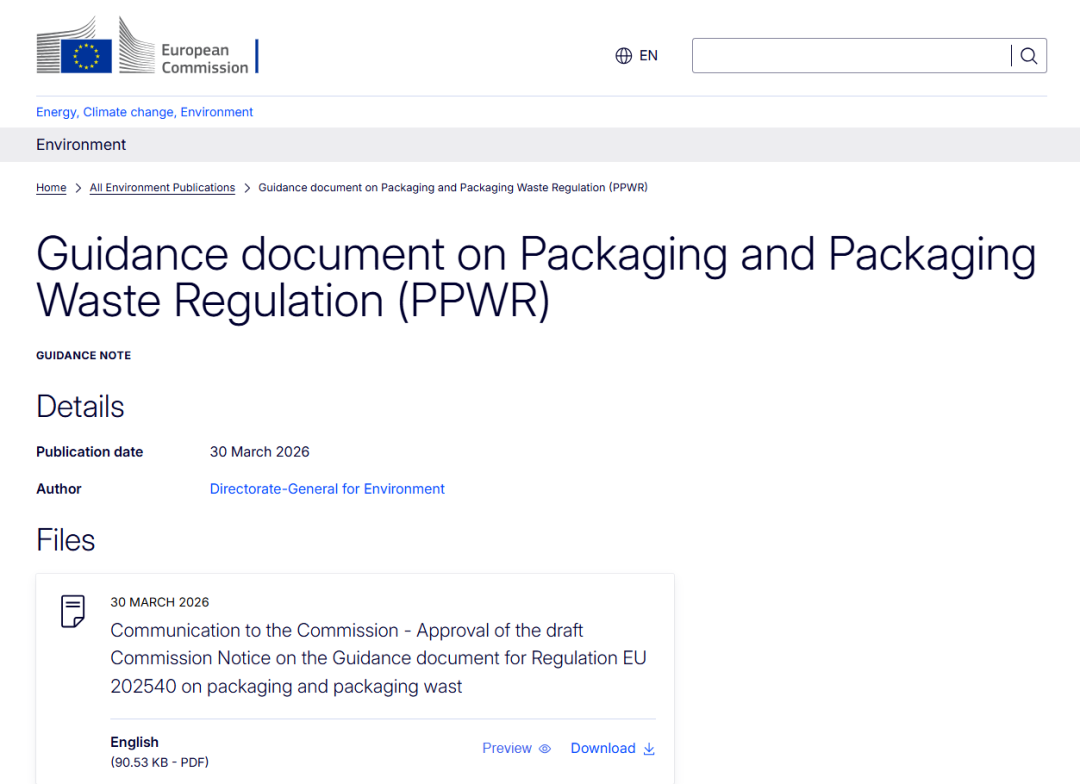
Source: European Commission official website
Simply put: in the past, companies could adopt different approaches across countries. Now, they must comply with a unified, mandatory, and increasingly stringent regulatory framework.

Six Key Requirements Under PPWR
PPWR is not a single-point regulation, but a comprehensive framework that introduces systematic requirements across the entire packaging lifecycle. For companies, at least six core areas require immediate attention—failure to comply may mean products are no longer eligible for the EU market.
| Core Requirement | Explanation |
|---|---|
| 🏭 Extended Producer Responsibility (EPR) | Starting August 12, 2026, companies selling products in EU member states must independently complete the full “registration–declaration–payment” process in each country of sale and obtain a valid EPR registration number for each market. |
| 🧪 Hazardous Substance Control | Starting August 12, 2026, the total content of four heavy metals—lead, cadmium, mercury, and hexavalent chromium—in all packaging must not exceed 100 mg/kg. Food-contact packaging containing per- and polyfluoroalkyl substances (PFAS) must comply with strict limits: individual PFAS substances <25 ppb, total PFAS substances <250 ppb, and total fluoropolymers <50 ppm. |
| ♻️ Mandatory Recyclability | Starting August 12, 2026, all packaging must be recyclable and classified into three recyclability grades: A, B, and C (Grade A ≥95%, Grade B ≥80%, Grade C ≥70%). From 2030, packaging must achieve at least Grade C recyclability, meaning products with recyclability below 70% by weight cannot be sold. From 2038, only packaging achieving at least Grade B recycling performance will be allowed on the market. |
| 🏷️ Packaging Labeling Requirements | Starting August 12, 2028, packaging must include detailed information labels. From February 12, 2029, reusable packaging must include QR code labels. |
| 📦 Packaging Minimization and Reduction | Starting January 1, 2030, unnecessary packaging elements such as false bottoms and excessive layers will be prohibited. Packaging must achieve minimization requirements, and empty space ratios for transport packaging, grouped packaging, and e-commerce packaging must not exceed 50%. |
| 🔄 Recycled Material Content Requirements | Starting January 1, 2030, plastic packaging must contain a certain percentage of post-consumer recycled plastic (PCR). Requirements include ≥30% for PET food-contact-sensitive packaging (excluding beverage bottles), ≥10% for non-PET food-contact-sensitive packaging, ≥30% for single-use plastic beverage bottles, and ≥35% for other plastic packaging. |

Industry Impact: A Systematic Supply Chain Restructuring
PPWR will affect companies in multiple ways. While it creates challenges and pressure, it also opens new opportunities for growth.
|Compliance Pressure for Export Companies
The impact of this regulatory shift is extensive. Whether they are EU-based companies or exporters targeting European markets, businesses must now comply with the same set of requirements.
For Chinese companies, this often means additional challenges in understanding standards, connecting certification systems, and fulfilling cross-border responsibilities.
Industries with high packaging intensity—including retail, fast-moving consumer goods (FMCG), food and beverages, and e-commerce—will likely experience cost and process changes first.
|New Industry Opportunities Created by PPWR
PPWR is not simply a burden. It is also reshaping the allocation of industry opportunities.
The implementation of new rules is directly driving demand in emerging sectors: sustainable alternative materials, packaging reduction design, recyclable structure optimization, labeling and certification services, and EPR compliance services.
The stricter the regulations become, the more predictable the demand for these solutions will be.
🧪 Materials | Accelerating Adoption of Alternative Materials
Restrictions on traditional plastic packaging are accelerating the large-scale adoption of paper-based, bio-based, and biodegradable materials.
Green material suppliers that were once considered niche players are now facing a structural transformation opportunity across the European market.
📦 Design | From “Added Value” to Market Entry Requirement
Packaging reduction and recyclable structural optimization have shifted from optional advantages to mandatory purchasing requirements.
Packaging companies with lightweight design capabilities and mono-material solutions will gain an advantage in the next round of supplier selection.
🧾 Services | Growing Demand for Compliance Solutions
With the full implementation of EPR, brand owners will be responsible for packaging recovery throughout the product lifecycle. They will face increasing demands for registration, reporting, compliance tracking, and data management.
Label certification organizations, EPR service providers, and compliance consulting companies are expected to see sustained business growth.
|Potential Global Regulatory Impact
The impact of PPWR extends beyond the EU.
To achieve consistent global management, multinational brands often apply EU standards across their worldwide supplier networks. Even companies that do not directly export to Europe may still be required to align with PPWR requirements if they are upstream suppliers in global supply chains.
Currently, e-commerce platforms including Amazon, Temu, SHEIN, and AliExpress have issued comprehensive compliance notices. The consequences of non-compliance are becoming increasingly severe: at a minimum, product listings may be removed or traffic restricted; at worst, shipments may be detained or destroyed by customs, and companies may permanently lose access to the EU market.
The impact of PPWR is spreading both through supply chains and distribution channels. Companies must shift from “one-time corrective actions” toward long-term compliance capability building.

PPWR Response Cases from Companies in China and Overseas
The rules are already here. What are companies actually doing?
|Anta Group: A Path of Proactive Compliance
While many companies are still asking “What exactly is PPWR?”, Anta Group has already integrated related priorities into its ESG strategy and advanced implementation proactively.
Since 2022, Anta has promoted packaging reduction initiatives, reducing the weight of individual shoe boxes by 15% and shopping bags by 16%. It has eliminated plastic bags from 99.9% of footwear products.
At the same time, Anta has gradually replaced traditional packaging with sustainable PE plastic bags. FILA and DESCENTE have achieved 100% coverage, while FILA packaging paper and paper bags have obtained 100% FSC certification.
In terms of circularity, Anta has recycled and reused 570,000 shoe boxes and 18 million packaging paper sheets, while setting a long-term goal of achieving 50% sustainable packaging adoption by 2030.
The group’s sustainable packaging ratio increased from nearly 20% in 2023 to approximately 46% in 2025, with the FILA brand exceeding 80%.
Anta’s practices demonstrate that PPWR compliance does not require starting from scratch. Instead, companies can integrate regulatory requirements into existing ESG systems, reducing transition costs while improving implementation efficiency.
During this process, Carbonstop conducted carbon footprint accounting for multiple Anta products and provided supply chain emission reduction planning support. By helping identify key carbon reduction opportunities, Carbonstop transformed initiatives such as packaging reduction and material substitution into measurable and verifiable carbon data—making proactive compliance part of an actionable and sustainable transformation pathway.

(Anta Zero Carbon Mission Store)
|Unilever’s “Subtraction” Strategy
PPWR requires packaging reduction and improved recyclability. Unilever chose to start with promotional packaging.
Shrink film has long been the standard solution for promotional bundle packaging. However, as PPWR raises recyclability requirements, this approach faces increasing pressure.
Unilever partnered with a Spanish paper manufacturer to replace traditional shrink film with paper straps and paper tape. This solution not only anticipates PPWR requirements but also supports Unilever’s commitment to reducing virgin plastic footprint by 40% compared with 2019 by 2028.
Compliance does not always mean “adding more.” Sometimes, the most direct path is subtraction—removing unnecessary packaging.

Response Strategies: How Export Companies Can Navigate the Compliance Cycle
Facing PPWR, there is no “almost compliant”—only compliance or exclusion.
Effective compliance requires companies to proactively establish a systematic assessment mechanism covering PPWR’s six core requirements.
Companies should comprehensively review the gaps between existing products and packaging solutions and EU market requirements, then prioritize actions based on market distribution, business exposure, and transformation difficulty.
From a longer-term perspective, PPWR compliance is highly aligned with the sustainability initiatives many companies are already pursuing.
Instead of building separate systems, companies should integrate these efforts. This not only reduces duplicated investment but also creates opportunities to strengthen customer relationships, enhance brand value, and compete in higher-barrier markets.
The real test of PPWR is whether companies can continuously adapt to evolving regulations.
Companies need to gradually establish internal collaboration mechanisms across R&D, procurement, quality, legal, and sales functions. At the same time, they must strengthen information sharing and responsibility coordination with packaging suppliers, certification organizations, recycling system providers, and customers.
Only when packaging compliance becomes embedded into corporate management systems and operates together with the broader supply chain ecosystem can companies maintain resilience in the evolving global packaging regulatory environment.

Conclusion
If you are unsure where to start, ask yourself three questions:
- Which of the six PPWR requirements represents the greatest risk for my packaging?
- How far is my supply chain from meeting PPWR requirements?
- Is my compliance capability a one-time response or a sustainable capability?
The less clear the answers are, the more urgent the action becomes.
Carbonstop’s consulting team is helping export companies transform fragmented PPWR requirements into actionable compliance pathways—from regulatory interpretation, gap assessment, and carbon footprint accounting to supply chain optimization and sustainability disclosure support.
Meanwhile, Carbonstop’s latest next-generation carbon management Agent product—Carbon Agent—provides comprehensive workflow capabilities built around real-world enterprise carbon management tasks.
Work that previously required weeks can now be completed within tens of minutes. More importantly, every step of the process—including emission sources, activity data, emission factor selection, and calculation logic—is traceable and reviewable.
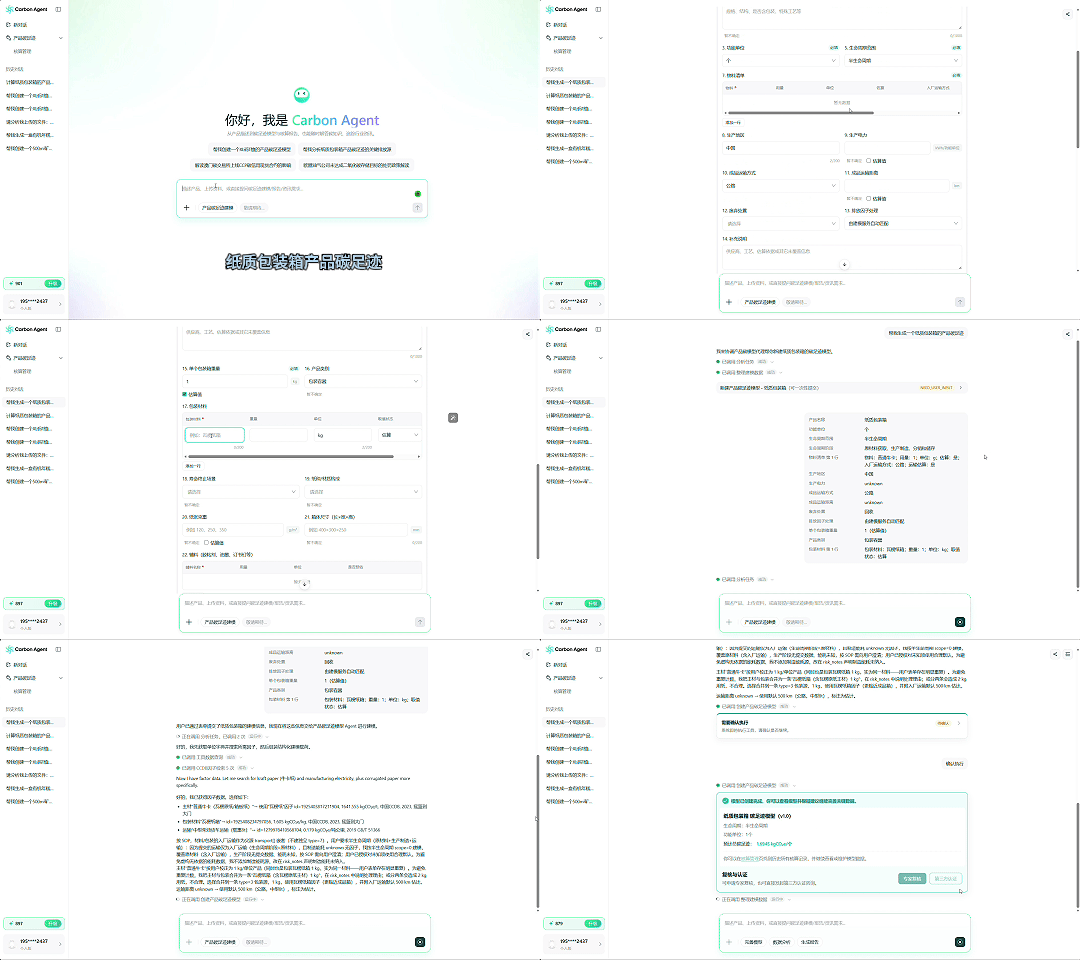 (Carbon Agent operation interface)
For packaging companies, brand owners, and export manufacturers, the earlier they understand PPWR and systematically identify compliance risks, the more likely they are to take the initiative in the next round of competition.


