


 1742
1742On July 7, 2026, the Science Based Targets initiative (SBTi) and the United Nations Global Compact (UNGC) held a special webinar on the Corporate Net-Zero Standard 2.0. During the event, SBTi representatives systematically explained the new standard’s core changes, corporate transition pathways, implementation tools, and future timeline. They also highlighted the rapid growth and strategic importance of Chinese companies in the global movement for science-based targets. Carbonstop experts attended the webinar and, drawing on the experience of Chinese companies, further analyzed what the new standard will mean in practice.
SBTi Corporate Net-Zero Standard V2.0: What Has Changed, and How Should Chinese Companies Respond?
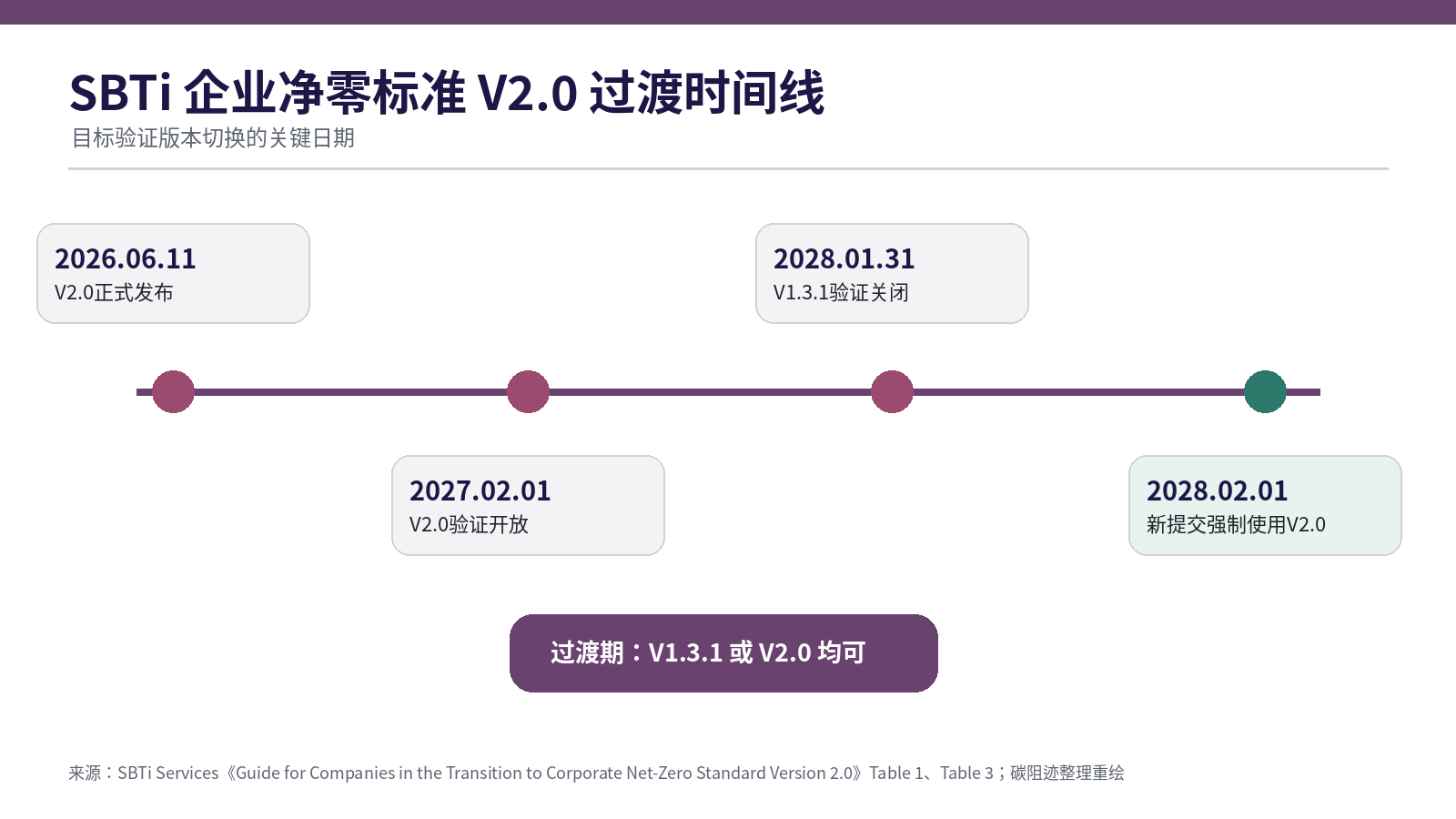
On June 11, 2026, SBTi released the final version of the Corporate Net-Zero Standard V2.0. According to SBTi, V2.0 may be used for target setting and validation from February 1, 2027. The SBTi Services validation portal is expected to open for V2.0 target submissions in the first quarter of 2027. From February 1, 2027, through January 31, 2028, companies may choose to submit targets under either V1.3.1 or V2.0. From February 1, 2028, all new target submissions must use V2.0. This is the most consequential upgrade since the standard was first introduced.
But this is not a patchwork update. It represents a fundamental shift in strategic direction.
The central question for companies has changed from “Can I set a science-based target?” to “Can I prove that I have the data, governance, and supply chain coordination needed to deliver it?”
At the July 7 webinar, SBTi sent a clear signal: corporate climate action is entering the “implementation era.” The ambition of a target remains important, but even more important is whether a company can translate that target into action across assets, procurement, suppliers, energy contracts, and annual management processes.
For Chinese companies, this is not a distant change to an international standard. SBTi data shows that more than 850 companies in China have had targets validated by SBTi, representing growth of approximately 92% over the past year—one of the fastest rates worldwide. In other words, Chinese companies are no longer observers of these rules. They are now one of the most important forces driving the global expansion of science-based targets.
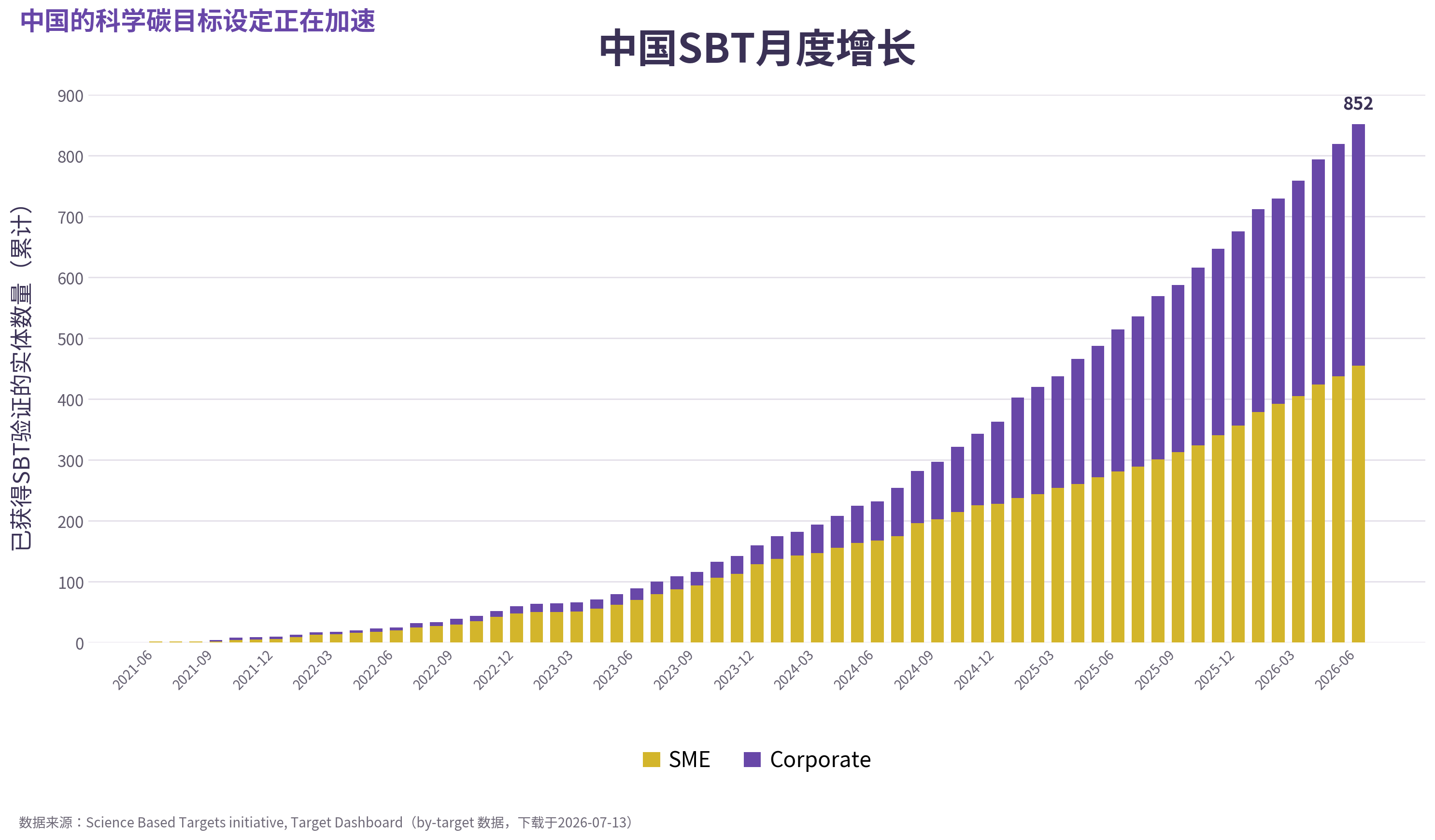
Data source: SBTi Target Dashboard; redrawn and compiled by Carbonstop.
Rather than listing every clause in the standard, this article focuses on the changes V2.0 will bring in practice—and what they mean for Chinese companies.

A Shift in SBTi’s Core Role: From “Referee” to “Coach”
Under its 2026–2030 strategy, SBTi has repositioned itself. Instead of focusing primarily on whether a target is “scientific enough,” it will increasingly support companies in turning their targets into real-world action.
Over the past decade, the greatest challenge was persuading companies to make commitments. Commitments are no longer scarce. The real bottleneck is whether companies can deliver on them.
V2.0 therefore places greater emphasis on transition planning, governance and accountability, validation of implementation outcomes, data quality, and progress assessment. SBTi repeatedly emphasized during the webinar that the new standard is not simply about raising the bar. It is designed to help companies continue reducing emissions under more realistic business conditions.
The implication is clear: a target document that merely looks “credible enough” is no longer sufficient. Companies need institutional systems capable of supporting the commitment.
The underlying logic of V2.0 can be summarized in one sentence: net zero is not a one-time submission, but a cyclical management system. Companies will no longer simply set a distant target for 2030 or 2050. They must enter a five-year cycle of “setting—validation—implementation—disclosure—assessment—resetting.” This closely resembles the five-year planning approach familiar to Chinese companies: a target is not a slogan on a wall, but something that must be broken down into phased tasks, resource allocation, organizational responsibilities, and performance tracking.

Category A or Category B? The First Question Companies Must Answer
V2.0 divides companies into two categories:
Category A (higher requirements):
•Large companies in any country, with net turnover of at least €450 million or at least 1,000 full-time employees.
•Medium-sized companies in high-income countries with Scope 1 and Scope 2 emissions of at least 10,000 tCO₂e, or that meet at least two of the following three thresholds: a balance sheet total of at least €25 million, net turnover of at least €50 million, and at least 250 employees.
Category B:
•All other companies that do not meet the Category A criteria.
This classification is not a formality. It directly determines the scope of a company’s obligations.
The key difference concerns Scope 3. All companies must set near-term Scope 1 and Scope 2 targets, but only Category A companies are required to set near-term Scope 3 targets. Category B companies face comparatively lighter requirements, as the standard seeks to avoid imposing excessive data burdens on small and medium-sized enterprises.
This reflects an important change in V2.0: a shift from a one-size-fits-all approach to differentiated requirements. SBTi recognizes that companies in different regions, industries, and size categories begin from different decarbonization baselines and have different levels of resources. While maintaining scientific integrity, the new standard aims to enable more companies to enter the implementation phase instead of leaving them outside because the rules are too complex.
💡 Carbonstop’s View: A company’s category determines the boundaries of its obligations. Large Chinese companies and most China-based subsidiaries of multinational companies will generally need to prepare to meet the higher Category A requirements. This means that Scope 3 targets are no longer optional. Companies should first confirm their category at the consolidated group level and then work backward to define the target scope, data boundaries, and supply chain coordination requirements.

Scope 1 and Scope 2: Separate Targets from Now On
The previous standard allowed Scope 1 and Scope 2 to be combined into a single emissions reduction target. V2.0 separates them and requires companies to set independent targets for each scope.
The logic is straightforward. In the past, some companies used strong Scope 1 performance to obscure slow progress on Scope 2 emissions, such as those associated with purchased electricity. V2.0 closes that loophole.
This change is particularly important for manufacturers. Scope 1 generally covers direct emissions from company-owned boilers, kilns, vehicles, and industrial processes. Scope 2 relates to purchased electricity, heat, steam, and cooling. Their decarbonization pathways are entirely different. Scope 1 tests a company’s ability to replace equipment, switch fuels, and optimize processes. Scope 2 tests its capabilities in green power procurement, electricity-contract design, the quality of energy attribute certificates, and participation in electricity markets.
The webinar also noted that V2.0 provides more flexible target-setting tools, including absolute emissions reduction, emissions-intensity reduction, sectoral decarbonization pathways, and Asset Decarbonization Plans (ADPs) for high-emitting assets. This means that companies do not have to set only an aggregate target. They may also establish replacement or retrofit schedules for critical assets such as boilers, kilns, vehicle fleets, and production lines.
💡 Carbonstop’s View: For Chinese companies, setting separate Scope 1 and Scope 2 targets means carbon management must move beyond annual reporting and reach the level of individual assets and energy contracts. What matters is not simply how much emissions fell this year, but whether the company can explain which equipment, facilities, and electricity procurement arrangements drove the reduction—and whether those changes are sustainable.

Scope 3 Targets: Category A Companies Must Prioritize Significant Categories and Emissions-Intensive Activities
V2.0 does not require companies to spread their efforts evenly across every Scope 3 category. Instead, Category A companies must prioritize the major sources that truly shape the trajectory of their value chain emissions. Companies must first identify significant Scope 3 categories and then determine the emissions-intensive activities (EIAs) within them, directing management resources toward the main drivers of global emissions.
Specifically, Category A companies must complete three additional tasks:
•Identify significant Scope 3 categories. Companies must identify and disclose the categories among Scope 3 Categories 1–14 that account for at least 5% of total Scope 3 emissions, rather than providing only an aggregate figure.
•Identify emissions-intensive activities. Using the non-exhaustive list in Annex A of the standard, companies must identify and quantify emissions-intensive activities in their value chains. For every significant EIA that accounts for at least 5% of total Scope 3 emissions, the company must disclose its absolute emissions and its share of total Scope 3 emissions.
•Obtain third-party validation. Companies must obtain third-party validation of their GHG inventory and other relevant indicators required by the standard, strengthening the credibility of base-year emissions, the identification of significant categories, and the basis for target setting.
The EIAs listed in Annex A cover three typical areas:
•Commodities, using a cradle-to-gate boundary for upstream activities: cement, steel, aluminum, ammonia, methanol, FLAG-related commodities, ethylene, propylene, benzene, toluene, xylene, plastics, and others.
•Transportation, using a well-to-wheel, full fuel-cycle boundary: *road transport involving light- and heavy-duty vehicles, rail freight, shipping, and air freight and passenger transport.
•Use of sold products: combustion of sold fossil fuels; energy-consuming products powered by fossil fuels or electricity; products that directly generate GHG emissions; and services that support fossil fuels.
After identifying significant emission sources, companies may use the pathways permitted under V2.0 to set Scope 3 targets. These can include overall emissions reduction targets, supplier or customer alignment targets, and dedicated targets for specific categories or activities. The priority is not mechanical coverage of every category, but ensuring that all significant categories and EIAs are clearly quantified, incorporated into targets and implementation plans, and tracked continuously.
This requirement is particularly important for export-oriented industries. Value chain emissions in the automotive, electronics, battery, machinery, chemical, home-appliance, and textile sectors are often concentrated in steel, aluminum, plastics, chemicals, logistics, product use, and upstream energy structures. Average emission factors alone are unlikely to support significant-EIA identification and third-party validation. Companies need to progressively build traceable data for high-emitting materials, priority suppliers, critical transportation activities, and the use phase of sold products.
💡 Carbonstop’s View: For Chinese companies, Category A Scope 3 requirements have moved beyond “accounting for 15 categories” to “identifying significant categories—pinpointing emissions-intensive activities—obtaining third-party validation—implementing targets and actions.” Even Category B companies may be required to provide facility-level emissions, product carbon footprints, transportation activity data, and supplier emissions reduction data when they sit within the value chain of a Category A customer. The earlier a company builds a traceable Scope 3 data chain and supplier-engagement mechanism, the better equipped it will be to respond to future target validation and procurement audits.

From Target Setting to Target Implementation: V2.0 Adds the “How”
One of the most significant changes in V2.0 is the introduction and strengthening of a clear target-implementation framework.
SBTi has proposed an Implementation Hierarchy that can broadly be understood as four levels of action:
•Action within the company: prioritize reductions from emission sources the company can directly control in its own operations and value chain.
•Action within an activity pool: promote low-carbon alternatives within a specific activity or product pool, such as clean electricity, low-carbon materials, and low-carbon logistics.
•Sector-level action: participate in the development of shared industry technologies, infrastructure, or standards.
•System-enabling action: use finance, market mechanisms, policy advocacy, or supply chain collaboration to promote transformation across a wider system.
This framework recognizes that companies cannot always determine the pace of emissions reduction on their own. Low-carbon steel, low-carbon aluminum, sustainable aviation fuel, long-duration energy storage, green electricity trading, and low-carbon chemical feedstocks all depend on the maturity of market supply and infrastructure. Through procurement commitments, long-term contracts, supplier financing, and industry collaboration, companies can help accelerate the development of low-carbon supply across the system.
This does not mean companies may substitute “system contributions” for reductions in their own emissions. V2.0 still requires companies to prioritize direct emissions reduction within their value chains. External instruments, certificates, carbon credits, and system-level actions may only serve as supplements within clearly defined boundaries.
💡 Carbonstop’s View: Customers and investors will increasingly ask whether a company is actually reducing its own emissions or merely purchasing a plausible set of supporting claims. Companies need to report “actual emissions reductions,” “collaborative supply chain reductions,” “support from market instruments,” and “system-contribution claims” separately, rather than blending fundamentally different actions together.

“Best Efforts” Recognition: Not a Lower Standard, but a Higher Evidentiary Bar
V2.0 introduces a “best efforts” recognition mechanism. Even when a company acts in good faith and takes verifiable action but ultimately fails to meet its target in full, it may still remain on a net-zero pathway rather than being automatically judged to have “failed.”
Does that sound like a relaxation of requirements? It is exactly the opposite.
In practice, this mechanism raises the evidentiary bar. Companies must provide specific records of action and the underlying data. It is not enough to cite “changing market conditions,” “insufficient supplier cooperation,” or “a shortage of green electricity.” A company must demonstrate what procurement changes it made, which assets it retrofitted, which suppliers it engaged, which electricity contracts it signed, whether the obstacles lay beyond its reasonable control, and how it will remedy the gap during the next cycle.
This is also why V2.0 places greater emphasis on reporting, progress tracking, and end-of-cycle assessment. SBTi will analyze corporate target progress more systematically. It may initially provide companies with confidential benchmarking and could later publish sector-level performance reports to address the question that matters most to the external market: did companies actually achieve their targets?
💡 Carbonstop’s View: “Best efforts” is not an exemption clause; it is an evidence clause. The earlier a company establishes data trails, action registers, supplier communication records, and annual progress reviews, the better able it will be to explain target deviations and demonstrate that it remains on a credible transition pathway.

BVCM Is Incorporated and Expanded into OER: Responsibility for Ongoing Emissions Becomes a Long-Term Issue
V2.0 incorporates and expands the previous recommendation on Beyond Value Chain Mitigation (BVCM) into an Ongoing Emissions Responsibility (OER) framework. It also integrates BVCM and phased carbon removal arrangements into a unified recognition mechanism. OER is not simply a new name for BVCM. It is a more systematic framework for how companies contribute to climate action outside their value chains, use carbon removals, and take responsibility for ongoing emissions.
At this stage, companies may participate voluntarily in the OER recognition program. Under V2.0, Category A companies will also assume a minimum carbon removal responsibility from 2035. They must support eligible carbon removals equivalent to at least 1% of the company’s ongoing Scope 1, Scope 2, and Scope 3 emissions, including a minimum proportion of durable carbon removals. The core principle is that, while advancing decarbonization within the value chain, companies should progressively take responsibility for emissions that continue to occur.
This means that future assessments of “net zero” will consider not only whether a company has sufficiently reduced value chain emissions, but also how it addresses ongoing and ultimately residual emissions. Natural and technological carbon removals, storage durability, project quality, additionality, and the risk of double counting will all become central issues in corporate net-zero strategies.
It is important to emphasize, however, that climate contributions and carbon removals under the OER framework cannot replace actual Scope 1, Scope 2, and Scope 3 emissions reductions. Companies must continue to prioritize decarbonization of their own operations and value chains in line with the Implementation Hierarchy.
💡 Carbonstop’s View: Chinese companies should already begin distinguishing among three questions. First, which emissions can be reduced through their own operations and supply chain collaboration? Second, which emissions will be difficult to eliminate in the short to medium term and therefore require technological or commercial alternatives? Third, how will companies take responsibility in the future for emissions that continue to occur through eligible climate contributions and carbon removals? Conflating these three questions will weaken the credibility of a net-zero pathway.

Scope 2 Green Electricity Accounting: From Annual Matching to Hourly Matching
V2.0 raises the quality requirements for low-carbon electricity procurement. One important direction is temporal matching.
In the past, many companies used annual renewable energy certificates or green electricity procurement to match one year of electricity consumption with one year of renewable electricity attributes. This approach is simple to implement and has helped support the development of renewable energy markets. However, it can conceal an important issue: the time when a company consumes electricity may not coincide with the time when the renewable electricity is generated.
The webinar noted that SBTi encourages companies to move progressively toward more granular electricity matching. High electricity users, in particular, need to pay greater attention to the temporal attributes and delivery boundaries of electricity procurement. Hourly matching will not immediately become a mandatory threshold for every company, but it is emerging as an important indicator distinguishing high-quality green electricity procurement from general certificate coverage.
This is particularly important for Chinese companies. As green electricity trading, green certificates, distributed solar power, energy storage, and long-term power purchase agreements continue to develop, companies cannot look only at whether they have purchased green electricity. They must also consider where the electricity comes from, which power system it covers, whether it is traceable, whether the certificates have been retired, whether supply matches the company’s load profile, and whether customers and third parties will recognize it.
💡 Carbonstop’s View: Scope 2 management is evolving from “certificate management” into “energy strategy management.” In future customer audits, two companies that both claim to use green electricity may have entirely different levels of supporting evidence. Long-term power purchase agreements, new low-carbon generation within the same region, certificate-retirement records, and load-matching data will become increasingly valuable forms of proof.

The Transition Timeline: You Have Less Time Than You Think
| Milestone | Description |
|---|---|
| June 11, 2026 | SBTi releases the final Corporate Net-Zero Standard V2.0. |
| Q1 2027 | The SBTi Services validation portal is expected to open for V2.0 target submissions; companies may begin submitting targets under the new standard. |
| Q1 2027–January 31, 2028 | During the transition period, companies may submit targets using either V1.3.1 or V2.0. |
| After January 31, 2028 | V2.0 becomes mandatory for all target submissions. |
| From 2035 | SBTi plans to make requirements related to ongoing emissions responsibility mandatory for Category A companies. |
In the months following the standard’s release, SBTi will issue additional supporting documents, including guidance on Methods, Metrics and Paths, an Assurance Framework, a claims system, and mutual-recognition rules. These documents will further determine how companies prepare data, undergo assurance, and communicate target progress externally.
What Does This Mean for Chinese Companies and China-Based Subsidiaries of Multinational Companies?
In summary, V2.0 has five core implications for participants in the Chinese market:
① Chinese companies have become one of SBTi’s fastest-growing groups. The rapid increase from around 300 to more than 850 validated companies shows that SBTi is becoming deeply embedded in the context of Chinese supply chains and capital markets. Science-based targets will no longer be a requirement limited to a small number of multinational companies. They will appear increasingly in export orders, customer audits, financing discussions, and ESG ratings.
② You are likely to be a Category A company—or to be managed by one. Large Chinese companies and most China-based subsidiaries of multinational companies will need to address higher requirements for Scope 3 targets, transition plans, data assurance, and progress disclosure. Even when a company is not itself in Category A, it may be incorporated into the Scope 3 management system of a large customer as a supplier.
③ You are already part of someone else’s Scope 3 management framework. As Tier 1 suppliers to European and global brands, whether Chinese companies set and implement science-based targets directly affects whether those customers can meet their supplier-engagement targets. An SBT has become a ticket to maintaining relationships in multinational supply chains.
④ Data is the real test. Whether setting its own target or proving emissions reduction outcomes to a customer, a company depends on traceable, auditable facility-level emissions data, product carbon footprint data, and supplier activity data—areas where generic emission factors are insufficient.
⑤ Carbon management will move from the sustainability department into business management. V2.0 requires companies to embed targets in governance, assets, energy, procurement, supply chains, reporting, and ongoing responsibility. Boards, finance, procurement, operations, legal, supply chain, and sustainability teams must all participate. A truly mature company will not merely “have a carbon target”; it will be able to make that target part of its business decisions.
How Can Carbonstop Help?
Carbonstop has built a comprehensive data foundation and delivery-capability system around the core requirements of V2.0.
Supported by the China Carbon Database (CCDB)—currently the most comprehensive China-specific emission factor database, containing more than 510,000 carbon data entries and 300,000 carbon emission factors—Carbonstop can provide:
•More accurate Scope 1, Scope 2, and Scope 3 accounting
•Product carbon footprint assessment and customer-disclosure support
•Supplier data collection, tiered management, and collaborative emissions reduction
•Carbon target setting and pathway planning based on the new standard
•Identification of high-emitting assets and the design of Asset Decarbonization Plans
•Strategic planning for green electricity, green certificates, and Scope 2 accounting, together with access to emissions reduction resources
•Annual progress tracking, data trails, and preparation for third-party assurance
Carbonstop has already helped BOE companies in multiple locations, Nanjing King-Friend, Qiaxing Packaging, Anhui Longci, and other companies successfully submit SBTi targets and accelerate the implementation of emissions reduction plans. From building reliable carbon emissions data systems and scientifically planning decarbonization pathways to strengthening supply chain collaboration and tracking target execution, Carbonstop provides one-stop, managed services across the entire target-setting and implementation process. We help companies turn climate commitments into concrete action and make steady progress toward decarbonization and net zero.


