


 964
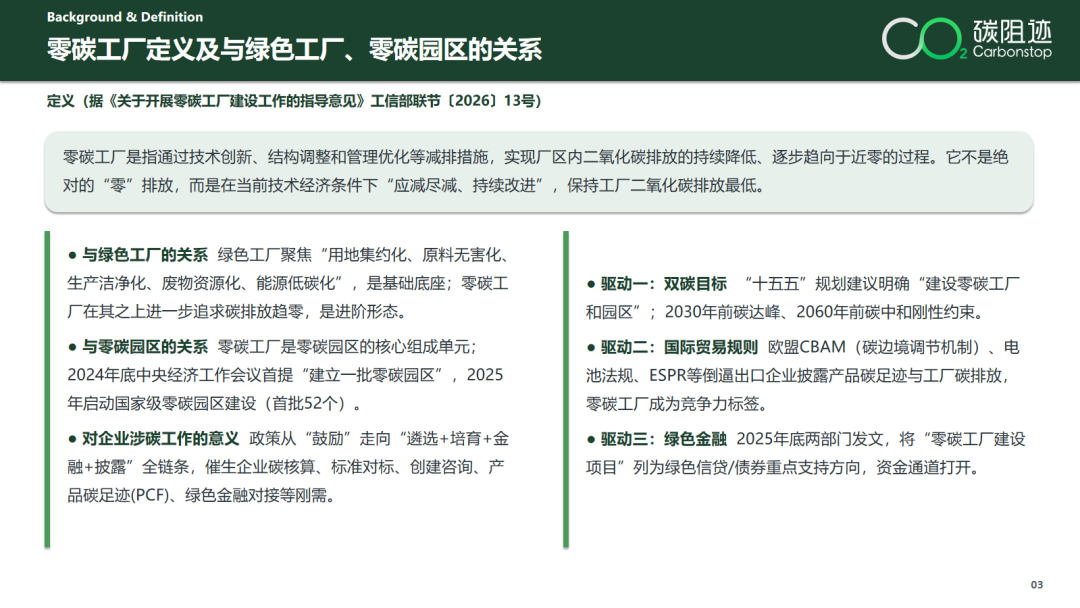
964In July 2026, the Ministry of Industry and Information Technology (MIIT) officially launched applications for the development of national zero-carbon factories. This is not a one-off exercise to obtain a designation, but a development program that must be completed no later than 2030. Who is eligible? How are the three core indicators calculated? Why can green certificates not replace physically delivered green power? Where should companies invest first? This article explains the essentials.
On July 22, 2026, the General Office of MIIT issued the Notice on Organizing the Development of National Zero-Carbon Factories (MIIT General Office Energy Conservation Letter [2026] No. 334). National zero-carbon factory development has now moved from policy advocacy into the application, construction, and acceptance stages.
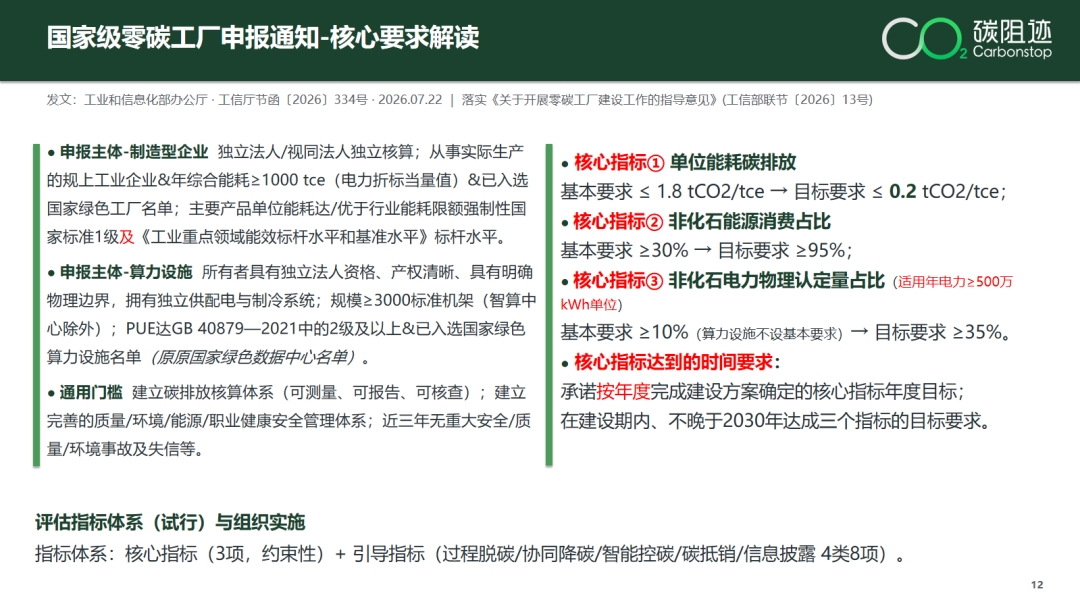
The notice contains three sets of figures that every manufacturing executive should remember:
- Carbon emissions per unit of energy consumption: reduced from no more than 1.8 metric tons of CO₂ per metric ton of standard coal equivalent to no more than 0.2 metric tons of CO₂ per metric ton of standard coal equivalent;
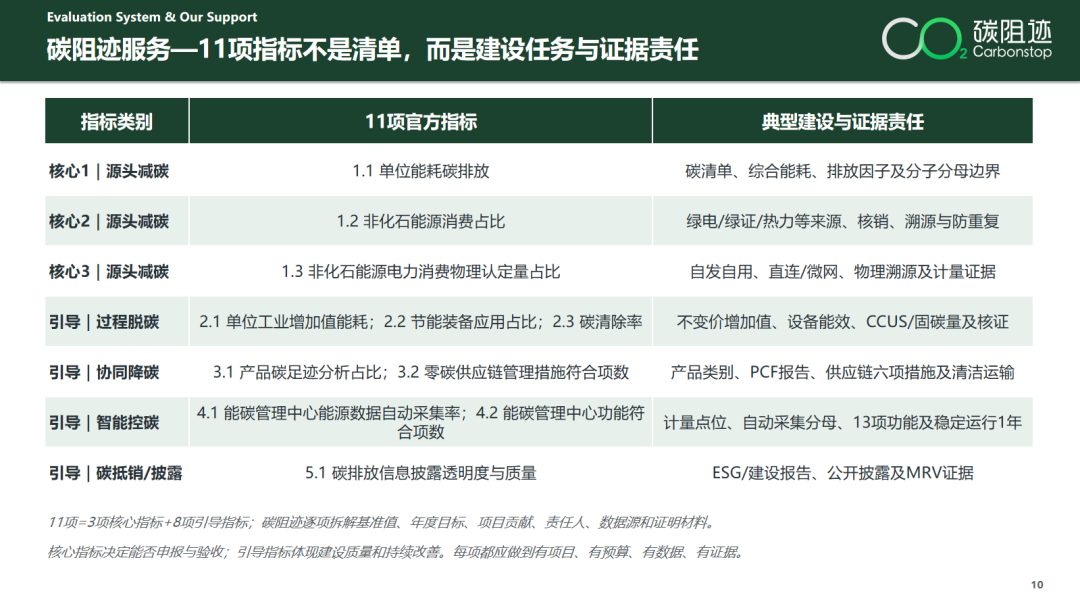
- Share of non-fossil energy in total energy consumption: increased from at least 30% to at least 95%;
- Share of physically recognized non-fossil electricity consumption: increased from at least 10% to at least 35%.
These are not bonus criteria. They are the core indicators that determine whether a company can enter the development list and ultimately pass acceptance.
More importantly, zero-carbon factory development does not end after a company prepares a set of materials and passes a single review. Once included in the national development list, a company must report its progress and changes in the core indicators every year, undergo ongoing monitoring and spot checks, and meet the target requirements within the development period—no later than 2030.
In other words, this is not simply a certificate. It is a medium- to long-term development program requiring the joint participation of energy, equipment, procurement, finance, information technology, sustainability, and other functions.
01
● ● ●
Before Calculating the Indicators: Which Companies Are Eligible to Apply?
For manufacturing companies, Notice No. 334 sets out clear baseline conditions. A company must meet at least all of the following requirements:
First, it must be an independent legal entity or an independently accounted unit treated as a legal entity.
Second, it must engage in actual production and qualify as an industrial enterprise above the designated size.
Third, its annual comprehensive energy consumption must be at least 1,000 metric tons of standard coal equivalent. For application eligibility, electricity is converted to standard coal using the calorific-value-equivalent coefficient.
Fourth, it must already be included on the national green factory list. In other words, national green factory status is an important entry ticket for a manufacturer applying to become a national zero-carbon factory.
Fifth, the energy consumption per unit of its main products must meet or outperform Grade 1—the advanced value—under the mandatory national energy-consumption limit standard for the relevant industry and the applicable benchmark. Where no standard applies, performance must be industry-leading.
The company should also have a carbon emissions accounting system and management systems covering quality, environment, energy, and occupational health and safety, and it must satisfy compliance requirements relating to safety, quality, environment, creditworthiness, and other areas over the past three years.
A company’s first step should therefore not be to start drafting a development plan. It should first conduct a red-line eligibility review. Any issue involving independent accounting, above-designated-size status, comprehensive energy consumption, national green factory status, product energy efficiency, or compliance records over the past three years may affect the application.
02
● ● ●
What Do the Three Core Indicators Really Test?
Indicator 1: Carbon Emissions per Unit of Energy Consumption
The calculation is:
Carbon emissions per unit of energy consumption = CO₂ emissions during the reporting period ÷ comprehensive energy consumption
It measures how much carbon dioxide a company emits per metric ton of standard coal equivalent consumed. The baseline requirement is no more than 1.8 metric tons of CO₂ per metric ton of standard coal equivalent, and the target requirement is no more than 0.2 metric tons of CO₂ per metric ton of standard coal equivalent. It should be noted that MIIT’s zero-carbon factory indicator for carbon emissions per unit of energy consumption covers carbon dioxide only and, for the time being, excludes non-CO₂ greenhouse gases.
This indicator cannot be achieved simply by using a little less energy. Companies need to advance changes in the energy mix, process energy efficiency, equipment upgrades, electrification, waste-heat recovery, and other measures, while ensuring that the accounting boundaries for CO₂ emissions and comprehensive energy consumption are consistent.
Factories expanding capacity must also incorporate future output, energy demand, and new equipment into scenario calculations. Otherwise, an indicator that appears compliant today may fall out of compliance after expansion.
Indicator 2: Share of Non-Fossil Energy Consumption
The calculation is:
Share of non-fossil energy consumption = non-fossil energy consumption ÷ comprehensive energy consumption × 100%
The baseline requirement is at least 30%, and the target requirement is at least 95%.
Eligible non-fossil energy includes not only directly used energy such as solar and wind power, but also non-fossil electricity, heating and cooling, biomass energy, green hydrogen, green synthetic ammonia, green methanol, and other sources whose attributes are clear, effectively traceable, and not double-counted for environmental value.
Green certificates may be counted toward this indicator, but the amount counted is not simply the amount purchased. Under the indicator guidance, electricity recognized through green certificates must be the cancelled volume and must correspond to electricity generated in the same year. In principle, the volume recognized through green certificate transactions may not exceed 50% of the electricity user’s grid-supplied consumption during the reporting period.
Therefore, making a concentrated purchase of green certificates shortly before acceptance cannot replace long-term restructuring of the energy mix.
Indicator 3: Share of Physically Recognized Non-Fossil Electricity Consumption
This indicator applies to applicants with annual electricity consumption above 5 million kWh. For manufacturing companies, the baseline requirement is at least 10% and the target requirement is at least 35%. Computing facilities have no baseline requirement but must still meet the target requirement.
This is the indicator most prone to misunderstanding.
“Physically recognized volume” emphasizes a genuine, traceable physical connection and use relationship for the electricity. It mainly includes:
- self-generated and self-consumed non-fossil electricity;
- direct green-power connections;
- industrial green microgrids;
- local integration of new energy into incremental distribution networks;
- self-consumed electricity under integrated generation-grid-load-storage models and similar arrangements.
Volumes recognized through electricity transactions, green certificate transactions, and provincial allocations do not count toward this indicator.
This means that purchasing green power or green certificates may help increase the share of non-fossil energy consumption, but it does not automatically increase the share of physically recognized consumption. Manufacturers with high electricity demand should incorporate on-site solar, direct green-power connections, microgrids, energy storage, and the corresponding metering systems into project planning as early as possible.
In one sentence, the three indicators measure:
The first asks how much carbon is emitted per unit of energy consumed; the second asks how green the energy mix is; and the third asks how much green electricity actually enters the factory through a physical pathway.
03
● ● ●
National Zero-Carbon Factory Development Is a Six-Stage Closed Loop, Not a One-Off Designation
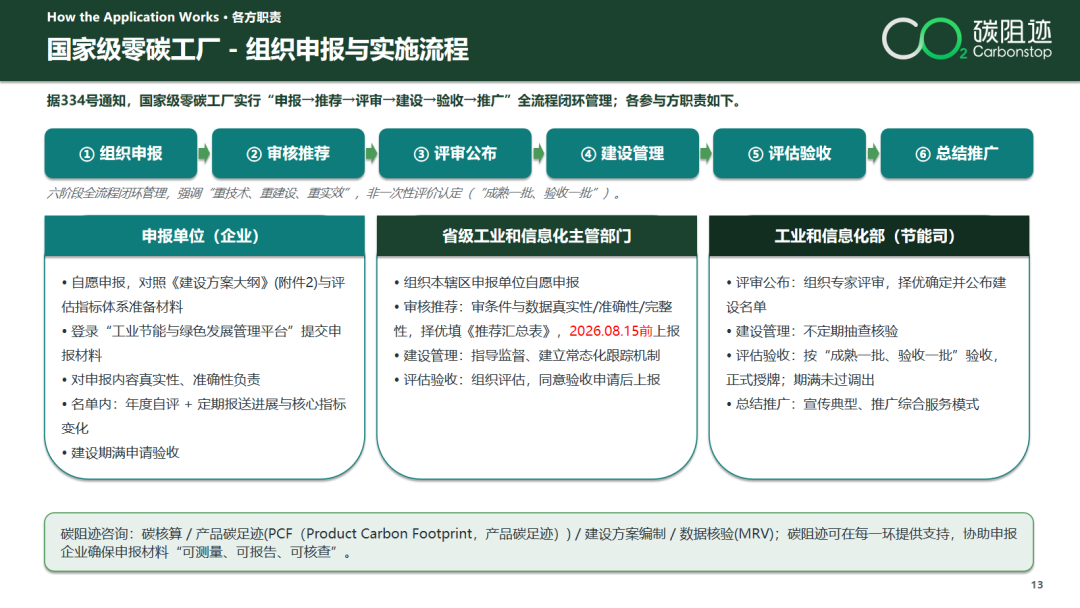
Under Notice No. 334, national zero-carbon factories follow a closed-loop process: application organization, review and recommendation, evaluation and announcement, development management, assessment and acceptance, and summary and promotion.
Provincial industry and information technology authorities must submit recommendation materials to MIIT by August 15, 2026. Local deadlines for receiving company materials will usually be earlier than the national deadline, so companies should follow notices issued by their local competent authorities.
Inclusion on the development list only means that a company has qualified to undertake the program. It does not mean the company has already obtained the title of “National Zero-Carbon Factory.”
Companies on the list must:
- conduct self-assessments against the annual targets defined in the development plan;
- regularly report development progress, changes in the core indicators, and relevant performance information;
- promptly adjust the development plan and complete the required review procedures when production capacity or energy-supply conditions change;
- undergo routine monitoring by the competent authorities and irregular spot checks by MIIT;
- apply for acceptance after completing the development tasks.
MIIT will carry out acceptance under the principle of accepting each group as it becomes ready. Companies that still fail acceptance at the end of the development period will be removed from the development list in accordance with the prescribed procedure.
Every annual target in the application materials should therefore be supported by a project, a budget, an accountable owner, a data source, and documentary evidence.
04
● ● ●
From Accurate Accounting to Successful Delivery: Six Pathways Companies Must Follow
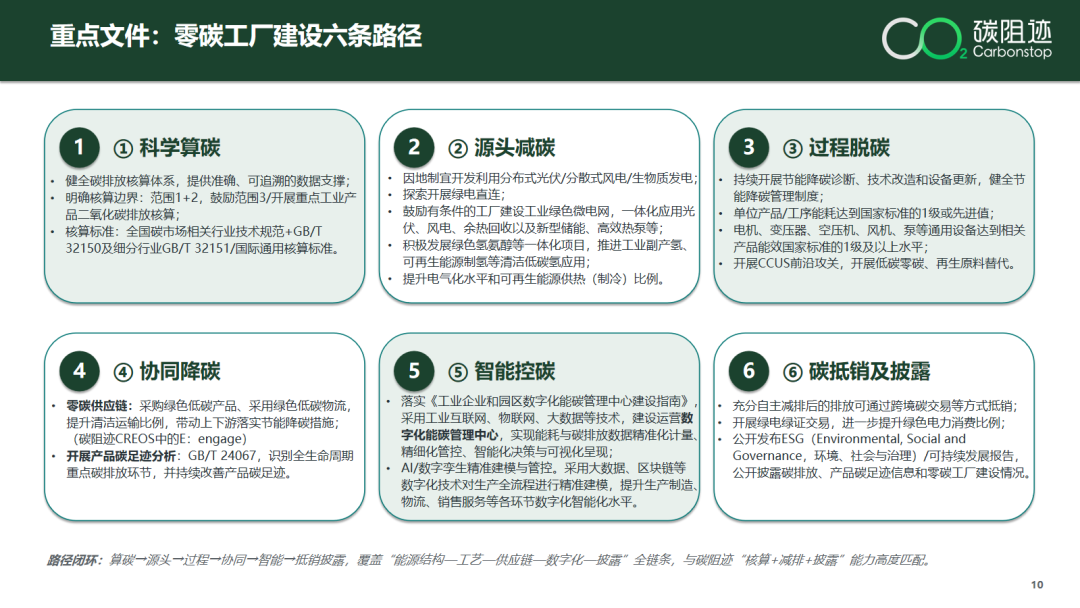
MIIT has identified six principal pathways for zero-carbon factory development:
Science-Based Carbon Accounting
Establish a traceable carbon emissions accounting system with clear boundaries and consistent methodologies. At a minimum, calculate Scope 1 and Scope 2 emissions accurately, then progressively extend the system to product carbon footprints and supply chain data.
Cut Carbon at the Source
Advance distributed solar, wind power, direct green-power connections, industrial green microgrids, energy storage, heat pumps, and green hydrogen, ammonia, and methanol projects to reduce carbon emissions from the energy-supply side.
Decarbonize Production Processes
Continuously conduct energy-saving and carbon-reduction diagnostics, upgrade processes and equipment, and improve the energy efficiency of key equipment such as motors, transformers, air compressors, fans, and pumps.
Collaborate on Carbon Reduction
Conduct product carbon footprint analysis and incorporate green procurement, supplier carbon data, circular use, and low-carbon logistics into supply chain management to drive joint emission reductions upstream and downstream.
Manage Carbon Intelligently
Build a digital energy and carbon management center that connects energy metering, production systems, carbon accounting, product carbon footprints, and supply chain data to support monitoring, accounting, analysis, forecasting, early warning, and decision-making.
Carbon Offsetting and Disclosure
After maximizing direct emission reductions, use compliant offsets for residual emissions and continuously disclose development outcomes through ESG reports, sustainability reports, or zero-carbon factory development reports.
The sequence of these six pathways matters. First, account for carbon; next, reduce emissions at the source and in production processes; then engage the supply chain and build digital capabilities; and only then use offsets and disclosure.
05
● ● ●
Five Common Pitfalls for Companies
Pitfall 1: Drafting the Application Before Reviewing Eligibility
National green factory status, above-designated-size status, comprehensive energy consumption, product energy efficiency, and compliance records over the past three years are all baseline conditions. Confirm eligibility before investing in application preparation.
Pitfall 2: Treating Green Certificates as the Solution to Every Indicator
Green certificates can support the accounting of non-fossil energy consumption, but they cannot be counted as physically recognized non-fossil electricity consumption. A plan that relies only on green certificate purchases without physical green-power projects may improve the second indicator while leaving the third indicator below target.
Pitfall 3: Inconsistent Numerators, Denominators, and Accounting Boundaries
Data on energy, carbon emissions, industrial value added, product output, green power, and green certificates are often distributed across different departments. Inconsistent boundaries, years, metering points, emission factors, or allocation methods will directly affect indicator results and the credibility of supporting evidence.
Pitfall 4: Committing to 2030 Targets Before Identifying Projects and Budgets
If capacity expansion plans, energy prices, green-power resources, technical upgrade projects, investment amounts, and payback periods are not incorporated into the model, annual targets can quickly become unmanageable and the development plan may require repeated revision.
Pitfall 5: Waiting Until Acceptance to Build the Digital Platform
The assessment indicators consider not only whether a system exists, but also the automatic collection rate of energy data and whether required functions have been implemented. Energy and carbon management center functions must operate reliably and accumulate data over time, so the platform, metering infrastructure, and system interfaces should be planned early.
The real challenge is not completing a report. It is keeping targets, projects, budgets, data, and evidence aligned over the years ahead.
06
● ● ●
What Should Companies with an Existing Foundation Do Now?
If a company is already a national green factory, meets the comprehensive energy-consumption threshold, and has relatively complete energy records, it should immediately complete three tasks:
First, conduct a rapid assessment of eligibility red lines and the three core indicators to establish current values, data gaps, and the completeness of supporting evidence.
Second, work backward from annual targets that must be achieved no later than 2030. Place green power, solar, microgrids, energy storage, equipment upgrades, metering, and energy and carbon platform projects into a single scenario model and calculate each project’s contribution to the indicators.
Third, establish a register linking indicators, projects, budgets, accountable owners, data sources, and supporting evidence. Materials created during the application stage should be directly reusable for subsequent annual self-assessments, spot checks, and acceptance instead of requiring a new data system after the application is complete.
Groups with multiple production sites should also rank their factories first. Which factory is closest to the baseline requirements? Which has the best access to physical green-power resources? Which can meet the targets with the most reasonable investment? Deciding which factory to apply with first is often more important than trying to apply with every factory at once.
07
● ● ●
How Carbonstop Helps Turn an Application into an Acceptance-Ready Development Program
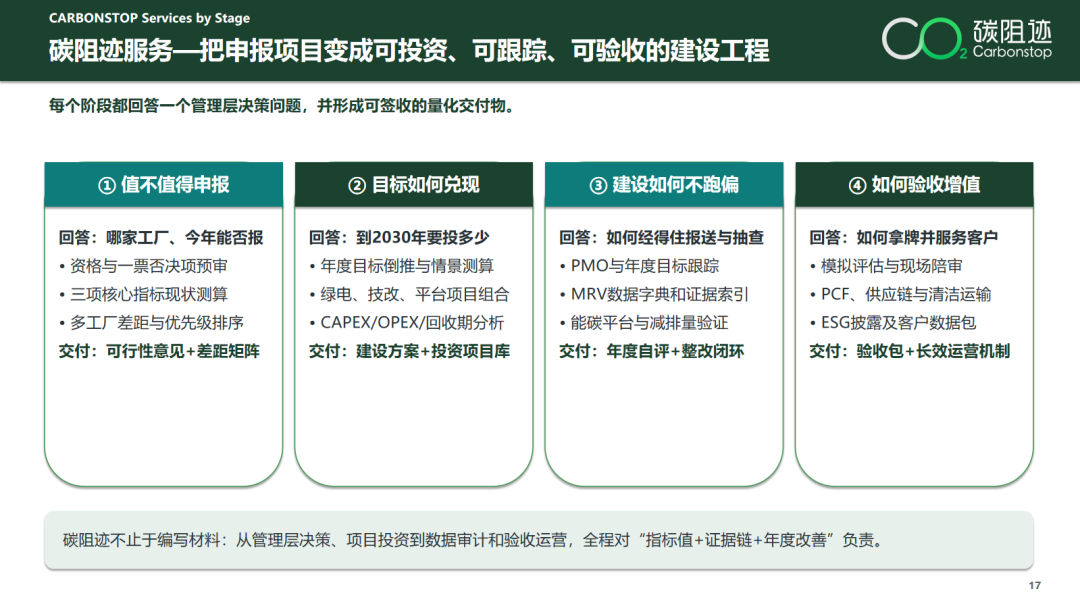
For national zero-carbon factory development, Carbonstop structures its services around four management questions:
Is It Worth Applying?
Conduct eligibility and disqualifying-factor reviews, calculate the three core indicators, and compare gaps across multiple factories to answer: Can we apply this year, and which factory should go first?
How Can the 2030 Commitment Be Delivered?
Work backward to define annual targets; combine green power, technical upgrades, metering, and platform projects; analyze investment, operating costs, payback periods, and sensitivities; and develop a delivery plan and investment project pipeline.
How Can the Program Stay on Track?
Use project management mechanisms, an MRV data dictionary, evidence indexes, annual self-assessments, and a closed loop for corrective actions so that changes in the indicators can be continuously monitored, reported, and verified.
How Can a Company Pass Acceptance and Create Long-Term Value?
Provide mock assessments, on-site verification support, product carbon footprint work, supply chain collaboration, ESG disclosure, and customer carbon data packages so that zero-carbon factory capabilities also support customer qualification, supply chain management, and green finance.
Conclusion
The value of a national zero-carbon factory is not limited to a designation.
It is better understood as a management approach that places energy costs, technical upgrades, carbon data, supply chains, and green finance on the same map. The earlier a company completes its baseline calculations, the more effectively it can direct limited budgets toward projects that genuinely affect the core indicators—and the more rework it can avoid during later spot checks, acceptance, and customer due diligence.
If your company is already listed as a national green factory or is assessing the feasibility of applying for national zero-carbon factory development, please contact the Carbonstop administrator and send the keyword “零碳工厂” to book a diagnostic assessment of your factory’s carbon status and application gaps.
Based on your energy mix, capacity plans, green-power resources, and existing data foundation, we will help you quickly determine:
- whether the baseline application conditions are met;
- the current performance level for each of the three core indicators;
- the remaining gap to the target requirements;
- which projects should be prioritized in the development plan;
- what evidence should be prepared in advance for the application, annual reporting, and acceptance.


