


 685
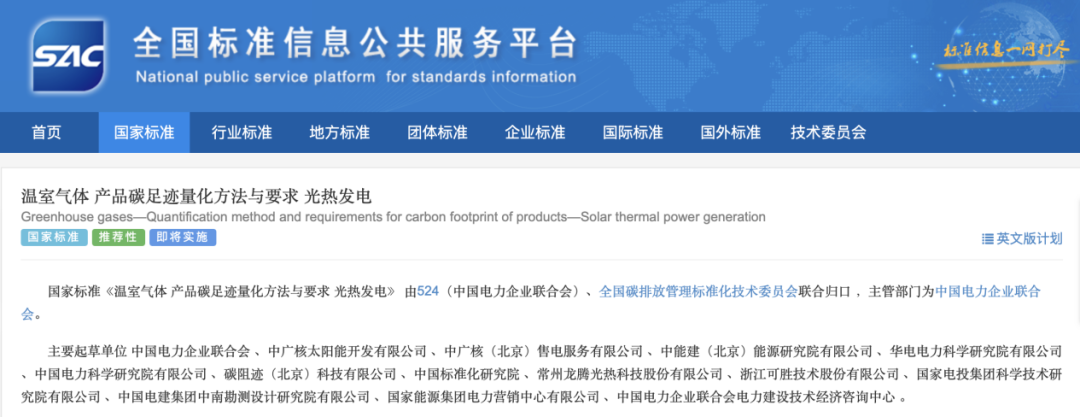
685On July 2, 2026, seven national standards for quantifying the carbon footprints of electricity products were approved and issued. They will take effect on February 1, 2027. The seven standards cover seven power-generation technologies—concentrated solar power, photovoltaic, nuclear, coal-fired, hydropower, wind, and gas-fired generation—including:
Greenhouse gases—Carbon footprint of products—Requirements and guidelines for quantification—Concentrated solar power generation (GB/T 47651—2026)
Greenhouse gases—Carbon footprint of products—Requirements and guidelines for quantification—Photovoltaic power generation (GB/T 47652—2026)
Greenhouse gases—Carbon footprint of products—Requirements and guidelines for quantification—Nuclear power generation (GB/T 47656—2026)
Greenhouse gases—Carbon footprint of products—Requirements and guidelines for quantification—Coal-fired power generation (GB/T 47657—2026)
Greenhouse gases—Carbon footprint of products—Requirements and guidelines for quantification—Hydropower generation (GB/T 47660—2026)
Greenhouse gases—Carbon footprint of products—Requirements and guidelines for quantification—Wind power generation (GB/T 47661—2026)
Greenhouse gases—Carbon footprint of products—Requirements and guidelines for quantification—Gas-fired power generation (GB/T 47671—2026)
The full suite of standards was coordinated by the China Electricity Council and jointly drafted by China General Nuclear Power Corporation, China Huadian Corporation, China National Nuclear Corporation, China Energy Investment Corporation, China Three Gorges Corporation, China Huaneng Group, State Power Investment Corporation, the China National Institute of Standardization, the Electric Power Research Institute, Carbonstop, and other organizations. Behind these seven standards were two years of debate over accounting boundaries, trial calculations to align data conventions, and repeated revisions to the text.
The drafting process lasted about two years. Throughout it, Carbonstop contributed in depth to work including using group standards as the starting point, feeding factor trial calculations back into the standards, balancing boundaries and emission sources by technology, demonstrating alignment with transmission and distribution, and supporting multiple rounds of expert review. Accounting for electricity carbon footprints is not as simple as attaching a carbon label to every kilowatt-hour: different generation technologies have different emission sources, data foundations, and use cases. Without a common yardstick, results cannot be compared; without data, rules are difficult to implement. Turning complex issues into repeatable accounting rules was the central challenge the drafting effort sought to solve.
01
● ● ●
Testing Standards with Data and Aligning Rules through Practice
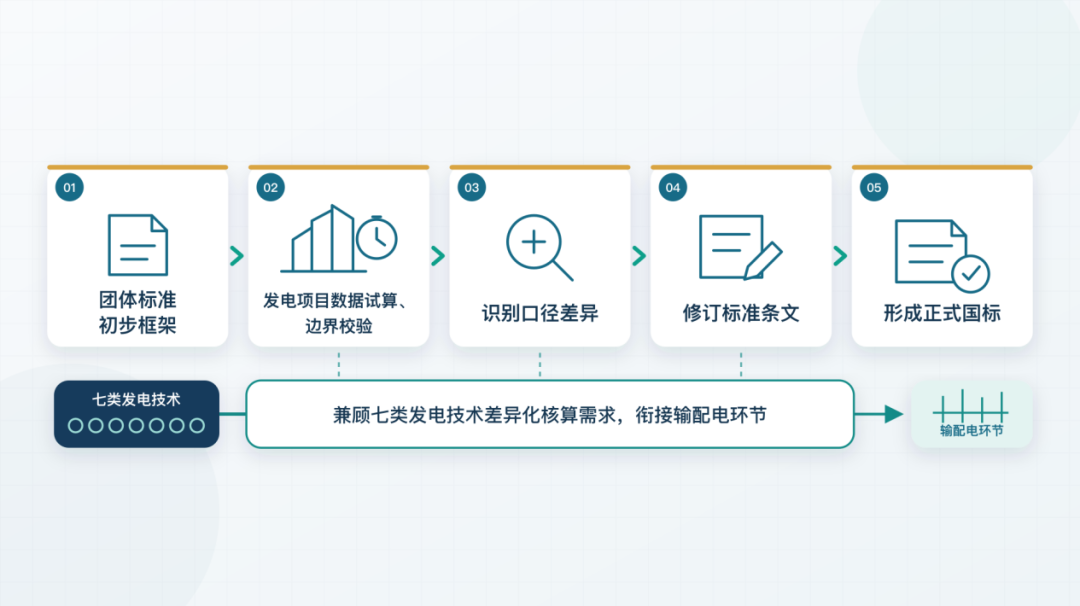
Looking back at the drafting process, one feature stands out: group standards came first, and the methodological framework was then tested against real-world data. Group standards provided a common starting point for early exploration, but could not replace subsequent validation. We conducted trial calculations for electricity carbon-footprint factors, matching the accounting approach to data from different generation projects and checking data sources, allocation principles, and boundary settings. The purpose was not to produce a pleasing number, but to test whether the rules were clear, the boundaries executable, and the results comparable. The trials also exposed gaps between the wording of the standards and real-world data conventions.
After the trial calculations, the findings were used to improve the standards: boundaries were clarified further, material emission sources were identified, and data that could not yet be fully standardized were handled in a workable way that balanced scientific rigor with practicality. This created a standards–data–standards closed loop: standards provide a common accounting basis, data tests whether it is reasonable, and the results drive further iteration. This approach prevents standards from remaining at the level of broad principles while also avoiding incomparable calculations based on each organization’s own data conventions.
Drafting the seven standards in parallel first required consistency in their basic rules and terminology. Yet the seven generation technologies follow different technical routes, and differ significantly in where their emissions arise and what data accounting requires. One method could not simply be applied to all of them.
Within a common framework, it was therefore necessary to map the key stages, main emission sources, and data challenges for each generation technology, while considering how accounting boundaries and data conventions would connect with transmission and distribution, laying the groundwork for extending the accounting chain. Only when common rules accommodate technological differences can accounting results become comparable.
02
● ● ●
Rules, Scope, and Data: Three Core Challenges in Developing National Electricity Carbon-Footprint Standards
At first glance, the task may seem to be merely defining an accounting method. Writing it into national standards, however, requires resolving three issues at once: how different generation technologies can be measured using the same rules, where the accounting boundary should be drawn, and how reliable results can be produced when data is incomplete.
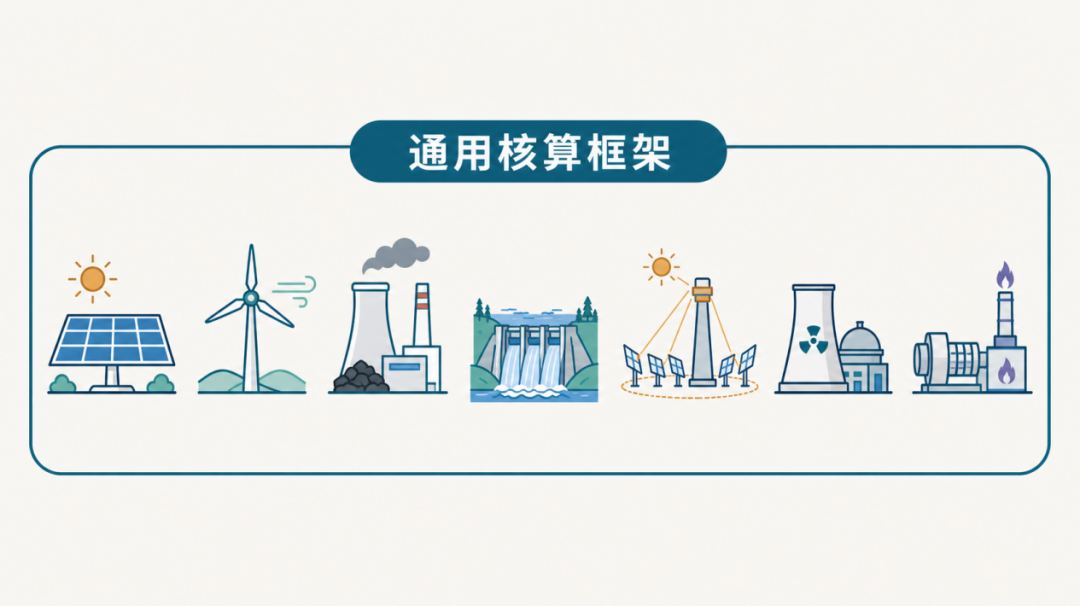
First, common rules cannot ignore technological differences. Carbon emissions from coal- and gas-fired power are concentrated mainly in the operation stage, while those from wind, photovoltaic, and concentrated solar power arise more from equipment manufacturing, project construction, and maintenance. The standards must use a common yardstick while still including the materially important emission stages for each type of generation.
Second, accounting boundaries must balance completeness with operability. A boundary that is too narrow may omit important emissions; one that is too broad can make data collection and implementation more difficult. The standards therefore need to specify which stages must be calculated and which may be treated differently under defined conditions, so results from different companies can be understood, compared, and reviewed.
Third, scientific rigor must be grounded in obtainable data. No matter how carefully rules are designed, they are difficult to apply if the data is inaccessible or untraceable. Yet ignoring material impacts for convenience would also reduce credibility. Multiple rounds of trial calculations and expert review continually tested whether the data was usable and the rules were reasonable.
Accordingly, developing the national standards required not only integrating data from more projects, but also finding a balance among scientific rigor, completeness, and implementability, and converting complex professional judgments into common rules that all parties can use.
03
● ● ●
Methods, Factors, and Applications: Three Levels of Value from the Seven National Electricity Carbon-Footprint Standards
The most direct significance of the seven national standards can be summarized in three points: they give accounting a common set of rules, enable electricity carbon-footprint factors to be updated continuously, and allow accounting results to genuinely support corporate management.
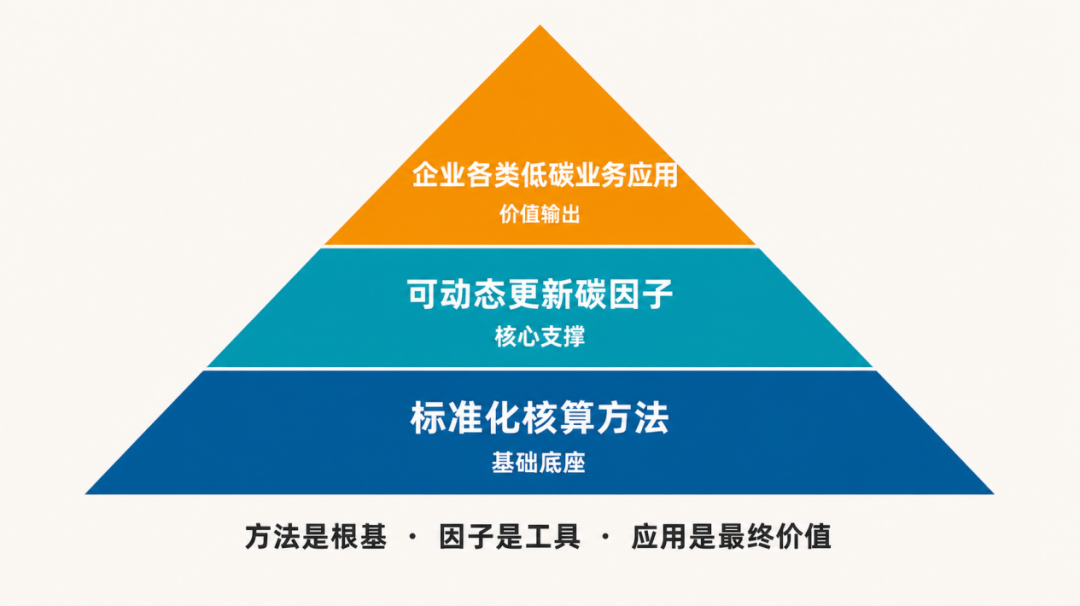
First, the standards allow different parties to use the same accounting method. Previously, organizations could differ in accounting boundaries, data processing, and calculation methods, making results difficult to compare directly. By defining the basic rules, the national standards help power generators, electricity users, and related service providers better understand, compare, and review accounting results.
Second, the standards provide a methodological basis for the continuous calculation and updating of electricity carbon-footprint factors. An electricity carbon-footprint factor is not a permanently fixed number; it is influenced by generation technology, equipment origin, operating efficiency, data quality, and other factors. With a relatively stable accounting method, future factor calculation, updating, and publication can follow common rules, making the results more transparent and reliable.
Third, the standards enable electricity carbon-footprint data to serve practical applications more effectively. Companies need electricity-related data for product carbon-footprint accounting, supply-chain carbon management, green procurement, and international disclosure. Common standards can reduce repeated communication caused by differing accounting conventions and make it easier for companies to use and explain the results.
The standards provide a common method and foundation for application, but their publication does not automatically deliver international mutual recognition. For China’s electricity carbon-footprint data to gain acceptance in more cross-border contexts, data quality and transparency must continue to improve, alignment with international rules must be strengthened, and the approach must be tested and refined through practical application.
04
● ● ●
Taking Publication as a Starting Point to Keep Improving the Electricity Carbon-Footprint Accounting System
As a team deeply involved in the drafting work, Carbonstop understands just how much effort these results required. Repeated discussions of boundaries, data trial calculations, and expert reviews did more than produce the seven standards; they also showed us that for electricity carbon footprints to become a usable management tool, methods, data, and applications must be continually calibrated.
Publication is not the end, but a new starting point for standardized, routine accounting. As the standards take effect on February 1, 2027, data accumulation, updates to electricity carbon-footprint factors, and application alignment will continue. The key is to make the standards work through transparent, practical implementation so the results can be understood, compared, and applied.


