


 72
72
For modern Chief Procurement Officers and global sourcing executives, corporate sustainability is no longer an exercise in branding—it is an operational, regulatory, and financial imperative. As enforcement tightens under the EU’s Corporate Sustainability Reporting Directive (CSRD) and Carbon Border Adjustment Mechanism (CBAM), enterprise risk is migrating directly into the supply chain.
For most multinational enterprises, Scope 3 Category 1 (Purchased Goods & Services) represents between 70% and 90% of total organizational greenhouse gas (GHG) emissions. Yet, procurement teams remain constrained by fragmented activity data, survey-weary suppliers, and high-level spend-based estimates that mask real risk and fail rigorous audit standards.
Transitioning from secondary estimates to auditable primary carbon data requires moving past spreadsheets. High-performing procurement organizations are deploying a digital carbon management platform and enterprise carbon management platform solutions that combine localized emission factor intelligence, automated supplier validation, and audit-ready reporting workflows.

The Strategic Shift: From Spend-Based Estimates to Primary Supplier Data
Historically, procurement departments relied on spend-based carbon accounting—multiplying procurement expenditure by top-down Economically Extended Input-Output (EEIO) emission factors. While sufficient for high-level baseline assessments, spend-based methodologies create systemic carbon data challenges:
• Distorted Carbon Footprints: Fluctuations in material prices or currency exchange rates artificially alter reported carbon footprints without any change in physical emissions.
• Penalized Supplier Decarbonization: Spend-based calculations cannot capture a supplier’s investments in clean energy or green raw materials, offering zero incentive for collaboration.
• Audit Non-Compliance: Regulations such as CSRD (under ESRS E1 standards) and ISSB explicitly demand traceable, verifiable primary activity data for material Scope 3 categories.
| Accounting Approach | Methodology | Regulatory Compliance | Operational Impact |
|---|---|---|---|
| Traditional Spend-Based | Financial spend × macro EEIO emission factors | Fails CSRD/CBAM audit requirements | High margin of error; masks supplier decarbonization |
| Hybrid Activity-Based | Supplier activity data + localized secondary factors | Compliant for baseline Scope 3 disclosures | Balances data coverage with auditability |
| Primary Supplier Activity Data | Direct facility/product primary data (ISO 14067 / PCF) | Full compliance with CSRD, CBAM, and GHG Protocol | Enables targeted supply chain decarbonization and procurement optimization |
To satisfy audit standards without overwhelming procurement workflows, enterprises need a structured carbon data management platform that systematically upgrades carbon data quality over time.

Bridging the Asian Supply Chain Blind Spot with Granular Emission Intelligence
A primary bottleneck in global supply chain carbon management is the localized data gap in primary manufacturing hubs—particularly across China and East Asia. Many Western carbon accounting platforms rely on generalized regional default factors that fail to reflect local energy grid dynamics, industrial process efficiencies, or specific manufacturing conditions.
Relying on generic global averages introduces significant financial risk under CBAM, where failure to demonstrate verified, actual embedded emissions subjects importers to penalty default values.
To resolve this imbalance, Carbonstop provides the China Carbon Database (CCDB)—an enterprise database housing over 510,000 carbon-related data entries across 200+ countries and regions. By incorporating granular, scenario-based emission factors tailored to Asian manufacturing workflows, China Carbon Database (CCDB) allows global procurement teams to:
• Replace inflated regional defaults with verified local emission factors.
• Calculate accurate Product Carbon Footprints (PCFs) for Tier 1 and Tier N components.
• Ensure calculation methodologies align seamlessly with both local regulatory frameworks and global accounting standards (GHG Protocol, ISO 14064, ISO 14067).

Operationalizing Supplier Engagement: The MERIT Methodology
Collecting carbon data from thousands of Tier 1 and Tier N suppliers cannot be achieved through passive email questionnaires. Procurement leaders face low response rates, inconsistent supplier data formats, and survey fatigue.
Carbonstop addresses these challenges through its enterprise platform, Carbon Cloud (Ccloud), a specialized supplier carbon management solution driven by the structured MERIT methodology.
• Quantification: Standardizes supplier carbon reporting through automated activity templates aligned with GHG Protocol Scope 3 standards.
• Engagement: Replaces static questionnaires with interactive supplier portals, providing suppliers with direct value, such as automated PCF benchmarks and emission factor libraries.
• Reduction: Identifies high-emission hotspots across purchased goods to co-develop joint supply chain decarbonization roadmaps.
• Investment: Informs sustainable procurement strategies, weighting carbon intensity alongside cost, quality, and delivery performance.
• Tracking: Delivers real-time dashboards for supply chain emissions tracking, allowing companies to monitor supplier reduction performance over time against Science Based Targets (SBTi).
By embedding carbon metrics directly into existing Supplier Relationship Management (SRM) and ERP systems, procurement teams can transform carbon management from a compliance burden into a strategic value driver.

Enterprise-Grade Intelligence: Automated Validation via Carbon AI Agent
Scaling Scope 3 data collection across vast global supply chains introduces significant verification bottlenecks. Manual review of supplier utility bills, ISO certificates, and product carbon footprint disclosures is labor-intensive and prone to human error.
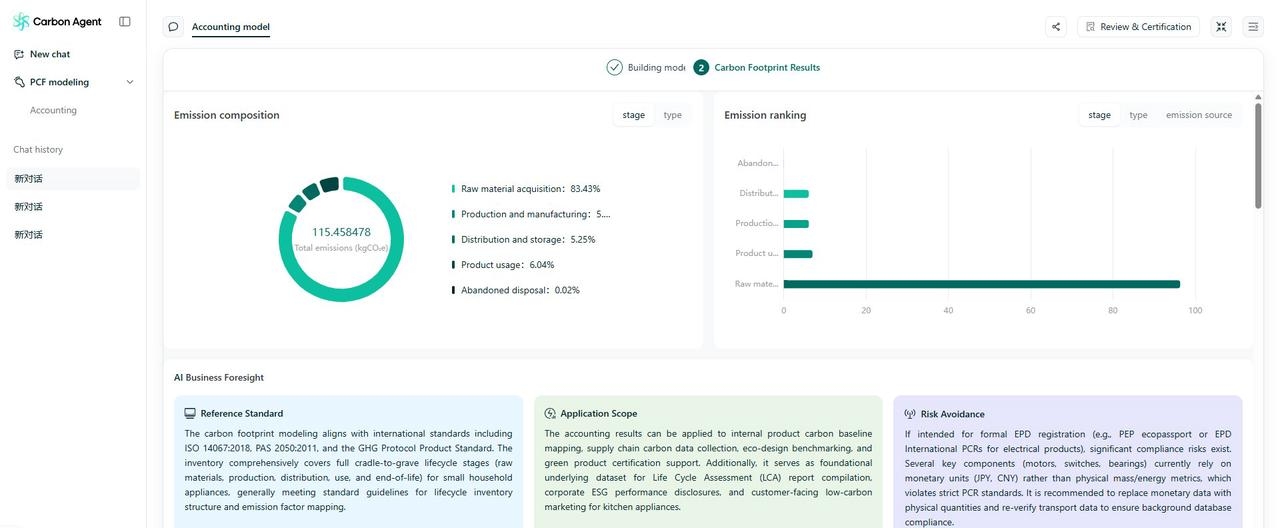
To automate this workflow, Carbonstop’s Carbon AI Agent functions as a specialized enterprise tool integrated with advanced carbon accounting software and carbon footprint management software capabilities.
• Automated Data Extraction: Parses unstructured supplier documentation—including energy bills, life cycle assessment (LCA) reports, and utility disclosures—to extract activity metrics automatically.
• Intelligent Factor Matching: Maps complex supplier activity data to appropriate emission factors within the 510,000+ entry CCDB repository.
• Audit Trail Generation: Logs calculation logic, underlying assumptions, and data provenance automatically, ensuring every data point is fully auditable under ISO 14064 and CSRD requirements.

Future-Proofing Procurement for CSRD, CBAM, and ISSB
As carbon metrics become as financially material as cost and lead time, enterprise procurement requires an infrastructure capable of supporting changing regulatory demands.
Whether deploying via secure SaaS, customized enterprise software, or hybrid cloud architecture, Carbonstop combines digital platform capabilities with technical consulting expertise. By pairing localized database precision (CCDB), AI-driven workflow validation (Carbon AI Agent), and structured supplier enablement (MERIT), Carbonstop enables global enterprises to transform fragmented data into a strategic advantage through enterprise carbon management software, advanced carbon reporting platform functions, and scalable carbon data collection workflows.

FAQ
How does primary activity data differ from spend-based carbon accounting in Scope 3 Category 1?
Spend-based accounting estimates emissions by applying financial expenditure to macro-economic input-output tables. Primary activity data uses actual physical quantities—such as kilowatt-hours consumed, metric tons of raw material processed, or direct facility product life cycle assessments (ISO 14067). Primary data provides more accurate inputs for CSRD compliance and product-level decarbonization.
How does Carbonstop’s CCDB database address data gaps in Asian manufacturing supply chains?
Western databases frequently lack localized emission factors for Asian manufacturing hubs, creating significant carbon data challenges. Carbonstop’s CCDB contains over 510,000 localized emission factor entries, providing granular, scenario-specific data for China and East Asia.
How does CBAM compliance impact global procurement strategies?
CBAM requires importers of covered goods to declare actual embedded emissions. Carbonstop helps procurement teams collect, validate, and report facility-level emissions data through a structured carbon reporting platform to reduce compliance risks.
What role does AI play in reducing supplier survey fatigue and validating activity data?
Specialized AI tools like Carbonstop’s Carbon AI Agent automate data extraction, improve carbon data collection efficiency, and match supplier information with verified emission factors, improving accuracy across global supply chains.
Ready to eliminate Scope 3 data blind spots across your global supply chain?
Request an Enterprise Demonstration of Carbon Cloud (Ccloud) or explore how an integrated carbon management platform can support measurable supplier decarbonization.


