


 36
36Key Takeaway
The Guidance Catalogue for Carbon Emissions Measurement Capacity Building (2026 Edition) is not simply a checklist for purchasing equipment. It provides a pathway for turning enterprise carbon data from a one-off reporting exercise into a measurable, traceable, reviewable and reusable business capability. Companies that can connect on-site parameters, product batches, energy accounts and management actions into a coherent evidence chain will be better positioned to take the initiative in carbon inventories, product carbon footprints, zero-carbon development, disclosure and export compliance.
01 Policy at a Glance: What Companies Should Really Take Away from the Catalogue
In August 2026, China’s State Administration for Market Regulation, National Development and Reform Commission, and Ministry of Ecology and Environment jointly issued the Guidance Catalogue for Carbon Emissions Measurement Capacity Building (2026 Edition) (the “Catalogue”). At the policy level, its defining themes are broader coverage and a more systematic framework. For companies, the key message is to bring carbon data down to the operational and product levels - and make it verifiable. Intended for key emitting entities, emission-reduction project owners and measurement technology institutions, the Catalogue is not a single-point methodology. It is a capability map spanning parameters, methods, equipment, calibration and public traceability resources.
It should therefore not be treated as another static compliance burden. A more accurate interpretation is that, as regulators, customers, financial institutions and overseas buyers increasingly ask where a carbon figure comes from, why it is credible and whether it can be reused, the Catalogue provides the conditions needed to answer those questions at the production site. Carbon inventories, product carbon footprints, carbon disclosures and the Carbon Border Adjustment Mechanism (CBAM) may appear to involve different forms, but they ultimately depend on the same underlying data chain.
1.1 Expansion Across Five Categories of Resources Means More Granular Measurement Coverage
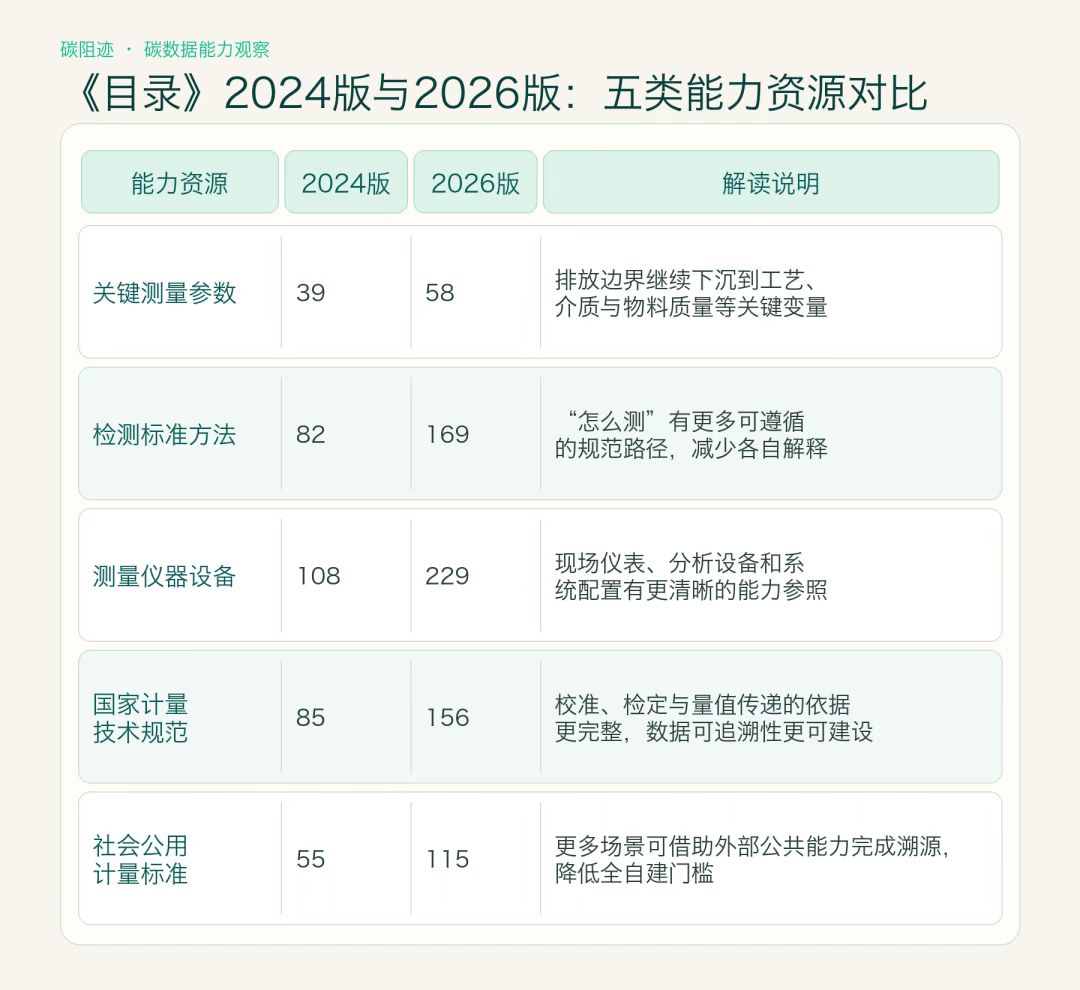
Comparison of the five categories of measurement capacity resources in the 2024 and 2026 editions
These figures do not automatically mean that companies must increase investment fivefold. Rather, they show that China is refining the measurement framework for carbon emissions and connecting what to measure, how to measure it, which instruments to use, how to calibrate them and where traceability should be established. The most important step for a company is not to reproduce the Catalogue item by item, but to map its own emission sources, products and management scenarios to these five categories and identify the small number of critical points that genuinely affect data credibility.
1.2 The Catalogue’s Five-Part Structure Corresponds to Five Questions Every Company Should Ask
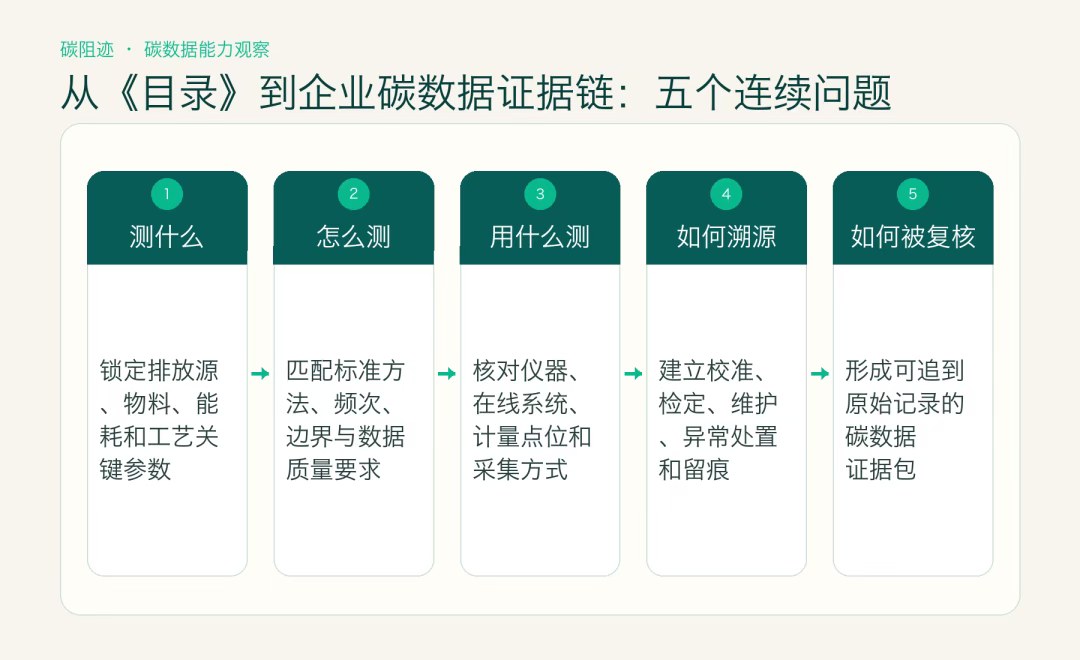
Five questions for building an enterprise carbon-data evidence chain
In carbon management practice, many problems do not arise because companies cannot calculate emissions. They arise because the upstream inputs to those calculations are not properly managed. Electricity, gas, coal and materials may each have separate records; production batches may not correspond to measurement points; instruments may produce readings without calibration records; and once data enters a report, the original evidence may no longer be available. A break anywhere in this chain turns product-footprint verification, ESG assurance and overseas customer enquiries into last-minute data searches and repeated explanations.
1.3 Moving from “Calculated Results” to “Measurement Evidence” Does Not Mean Abandoning the Emission-Factor Method
Emission factors and estimation methods remain essential tools for carbon accounting, especially where direct measurement is not possible or would not be cost-effective. The Catalogue does not require companies to install a new instrument for every tonne of emissions. Its value lies in encouraging companies to prioritise on-site measurement and traceability for data points that have a major impact on results, fluctuate significantly, frequently cause verification disputes, or directly affect product and compliance costs.
Companies should adopt a context-specific, tiered approach to evidence: directly measure high-impact parameters wherever possible, use authoritative factors for common activities, and retain reasonable assumptions and version records for data gaps.
*A practical test for companies* The question is not whether a carbon report exists, but whether its critical figures can answer four follow-up questions: Where is the measurement boundary? Which system or original record produced the data? Are the instruments controlled and traceable? Can changes in the current period be linked to actual operational or process changes?
02 Why This Is the “Underlying Operating System” of Enterprise Carbon Management
China’s national carbon market, product carbon-footprint labelling and certification, zero-carbon park and factory programmes, sustainability disclosure, green supply-chain procurement and the EU CBAM are driven by different authorities, customers and market rules. Yet they all impose the same fundamental requirement: data must be explainable, reviewable and reusable. Without credible activity data and parameter management, even the most advanced model can produce only results that appear precise.
At the national level, the Catalogue strengthens the measurement and technical foundation of carbon data. At the enterprise level, it changes the sequence of carbon-management projects: first establish the data sources, measurement boundaries and evidence chain; then connect those capabilities to carbon inventories, product carbon footprints, carbon disclosure, carbon-asset transactions, certification and supply-chain collaboration. This avoids having to rebuild datasets, re-engage advisers and repeatedly explain methodologies whenever a new requirement appears.
2.1 Carbonstop CREOS: Translating the Catalogue into Enduring Business Capabilities
Carbonstop’s CREOS carbon-neutrality pathway comprises five interconnected stages: Calculating, Reducing, Engaging, Offsetting and Spreading. These are not five one-off projects, but a continuous cycle. Calculating establishes the factual foundation; Reducing translates facts into improvement actions; Engaging brings supply chains and employees into the system; Offsetting addresses hard-to-abate emissions once the boundary is clear; and Spreading turns robust practices into communication that customers, investors and society can understand. External feedback then helps improve the quality of the next round of calculation.
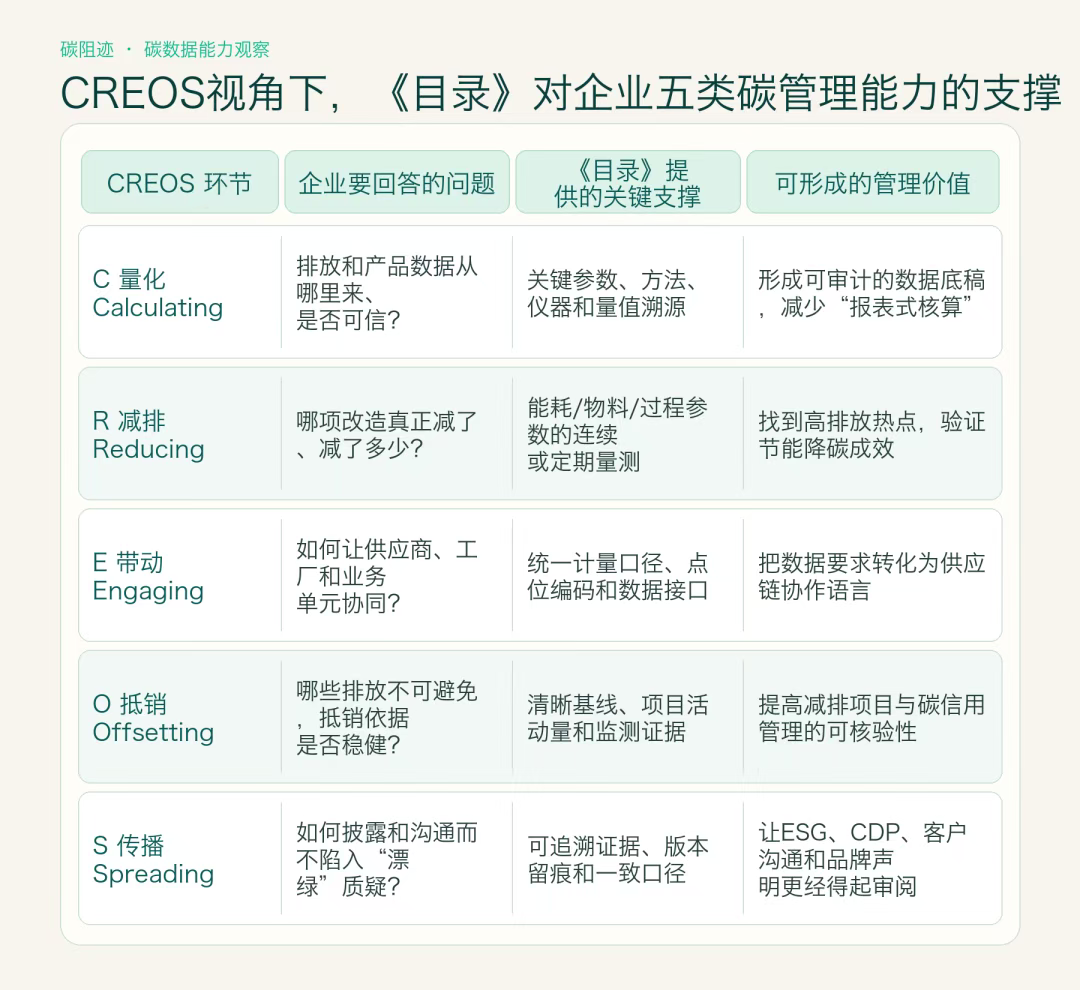
How the Catalogue supports five categories of enterprise carbon-management capability through the CREOS lens
When CREOS is applied to the Catalogue, it becomes clear that measurement does not serve only C (Calculating). It also determines whether R (Reducing) can be quantitatively verified, whether E (Engaging) has an actionable data language, whether O (Offsetting) is built on a reliable baseline, and whether S (Spreading) can maintain a consistent methodology. Measurement capacity is therefore not a minor preliminary step in the carbon-management chain; it is a shared capability running through the entire chain.
2.2 Measurement Capacity Is Not Merely “Equipment Investment” - It Is Data Governance and Operational Collaboration
Companies commonly fall into two traps: equating measurement capacity with purchasing instruments, and treating carbon data as an annual report owned solely by the EHS team. Instruments are only the starting point of data generation. Measurement data becomes useful management information only when measurement points are linked to processes, batches, products, cost objects, responsible departments and calibration records.
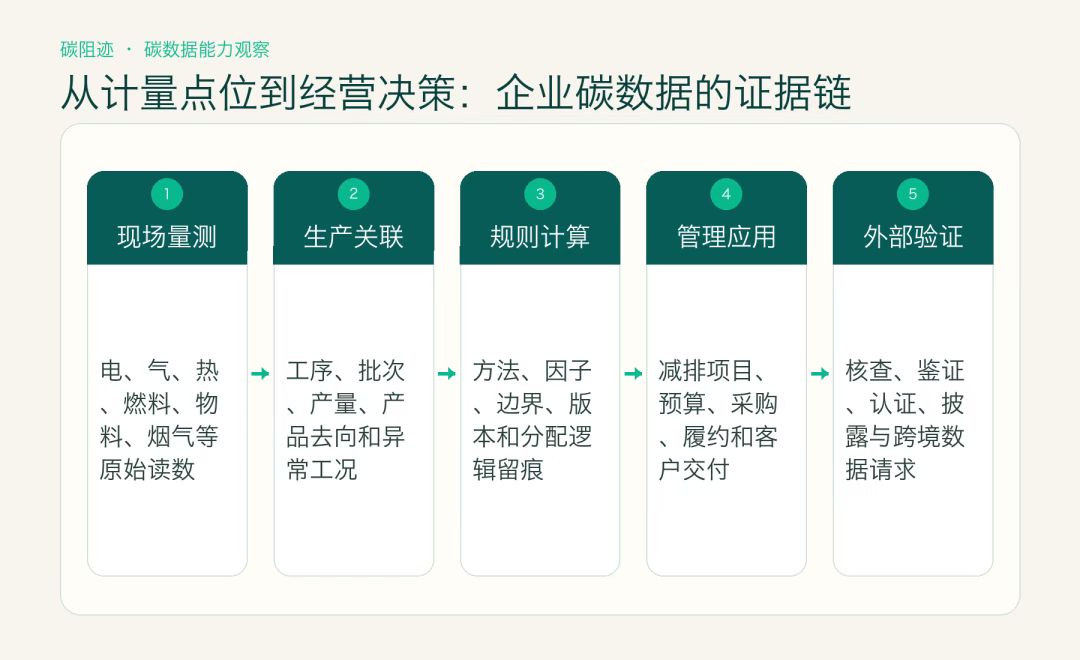
From measurement points to business decisions - the enterprise carbon-data evidence chain
03 From “Compliance Cost” to “Competitive Asset”: What Tangible Value Can Companies Gain?
Carbon management often feels costly because every new requirement seems to start from scratch - one of the practical pain points Carbonstop frequently encounters when supporting companies. The Catalogue offers a more economical route: build reliable capabilities once around high-frequency, high-impact data sources, and then use them across multiple business scenarios. Calling carbon data an “asset” does not mean that it can be traded freely without governance. It means the data can be reused, continuously updated, applied in decision-making and accepted in reviews.
3.1 Compliance Value: Move Pre-Verification “Firefighting” into Routine Control
For companies covered by emissions-control obligations, a major risk is discovering shortly before verification that coal quality, flow, production output or purchased-electricity data cannot be reconciled. For suppliers, the risk is receiving an unexpected request for product carbon data from a customer. For industrial parks, it is finding overlapping energy-data boundaries during an application or assessment. Building measurement capacity converts these risks into routine controls: who collects the data, how often instruments are calibrated, how anomalies are reviewed and how versions are archived are all defined before problems occur.
3.2 Cost and Efficiency Value: One High-Quality Dataset, Multiple Compliance Uses
A master-meter reading has limited value if it is used only for energy statistics. When linked to production batches, energy bills, electricity-purchase records, calibration records and emissions-calculation models, the same data can support organisational carbon inventories, product carbon footprints, customer questionnaires, ESG indicators and emission-reduction project assessments. Reuse does not mean copying and pasting the same report. It requires raw data and evidence packages that can be extracted according to different boundaries and rules.
3.3 Operational and Financing Value: Make Low-Carbon Investment Measurable, Comparable and Communicable
Management needs more than an annual total-emissions figure. It needs data that can answer operational questions: How much fuel or electricity did a specific retrofit actually save? Was the emission reduction obscured by production-volume changes? Did the change in emissions per unit of product come from a process improvement, a change in the energy mix or a change in the calculation method? Answering these questions requires more granular measurement and data traceability.
Only when a company manages the baseline, implementation-period data and influencing factors for an emission-reduction project can it turn low-carbon action into a credible project ledger, management KPI and external communication material.
*Important reminder* Measurement data can create a stronger connection between carbon accounts and operational or financial information, but it does not automatically result in financial recognition or eligibility for green finance. When carbon data is incorporated into budgets, costs, audits or financing materials, the applicable accounting standards, disclosure rules, internal controls and financial-institution requirements must still be followed.
04 Priorities and Challenges: Avoid Turning “Precision Measurement” into an Asset-Heavy Trap
Companies vary widely in their measurement foundations, process complexity, product structures and external pressures. The right principle is not to build a system that is “large and comprehensive”, but to focus on business scenarios and prioritise high-impact data. Carbonstop recommends conducting a gap assessment in the sequence of scenario, boundary, critical parameters, evidence and application - rather than beginning with an equipment procurement list.
4.1 Four Priorities: Parameters, Instruments, Evidence and Governance
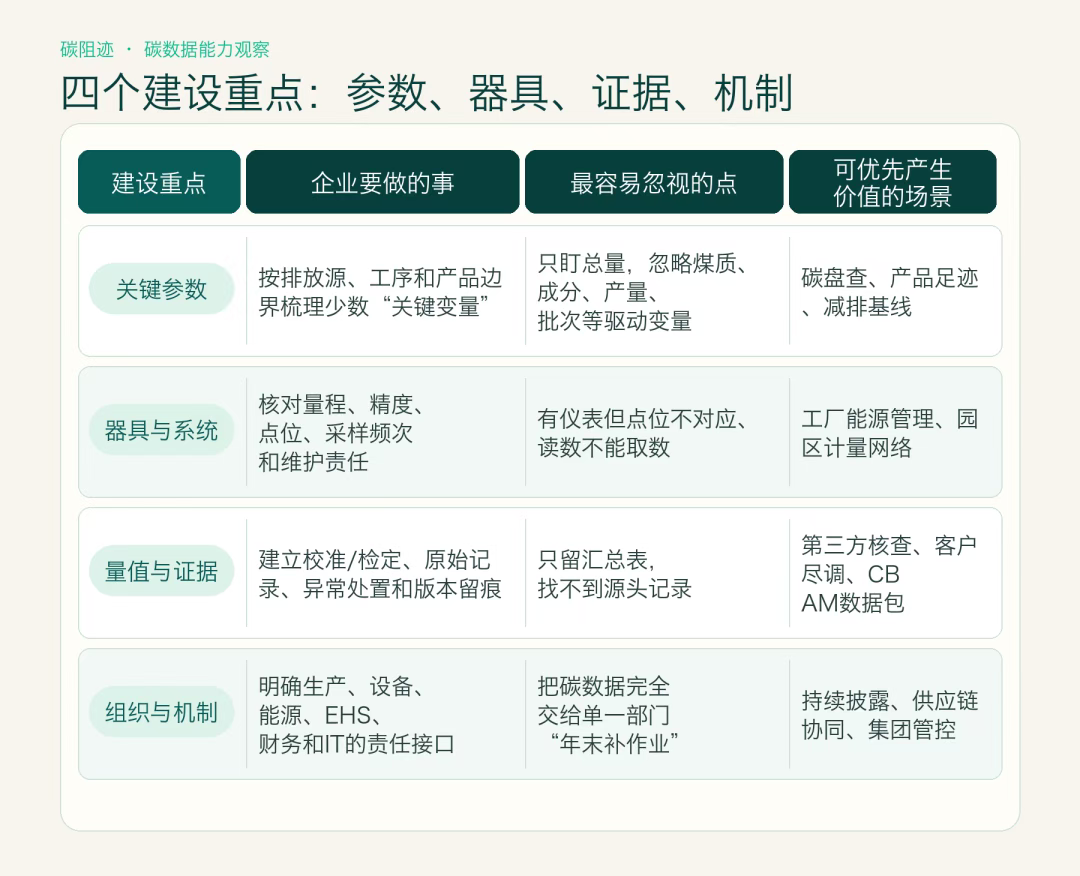
Four priorities for building enterprise carbon-data capability
4.2 Four Common Hurdles: The Challenges Are Not Merely Technical
*Hurdle 1: Unclear boundaries.* The same energy data may be used simultaneously by a factory, an industrial park and a product. Without boundary and purpose tags, duplicate accounting or omissions can easily arise later.
*Hurdle 2: Insufficient measurement-point granularity.* A master meter can show how much energy a company purchased, but it cannot explain the contribution of a particular production line, product or retrofit. Excessive reliance on average allocation increases the burden of explanation.
*Hurdle 3: Disconnected data systems.* Instrument data may sit at the equipment layer, production output in MES, procurement in ERP and accounting in spreadsheets. Without automated reconciliation, every figure must be manually pieced together whenever it is challenged.
*Hurdle 4: Treating external rules as one-off assignments.* Customer requirements, product rules, disclosure boundaries and overseas requirements all change over time. Without version control and clearly assigned process responsibilities, companies must start their explanations from scratch each time.
*Implementation principle* In the first stage, SMEs generally do not need to add large amounts of new hardware. They should first identify critical parameters, verify the validity of existing instruments, consolidate data ledgers and calibration records, and then select one high-priority scenario for a pilot. Companies with complex processes or significant emissions-control obligations should prioritise online or continuous monitoring of high-impact parameters, measurement networks and system integration.


