


 69
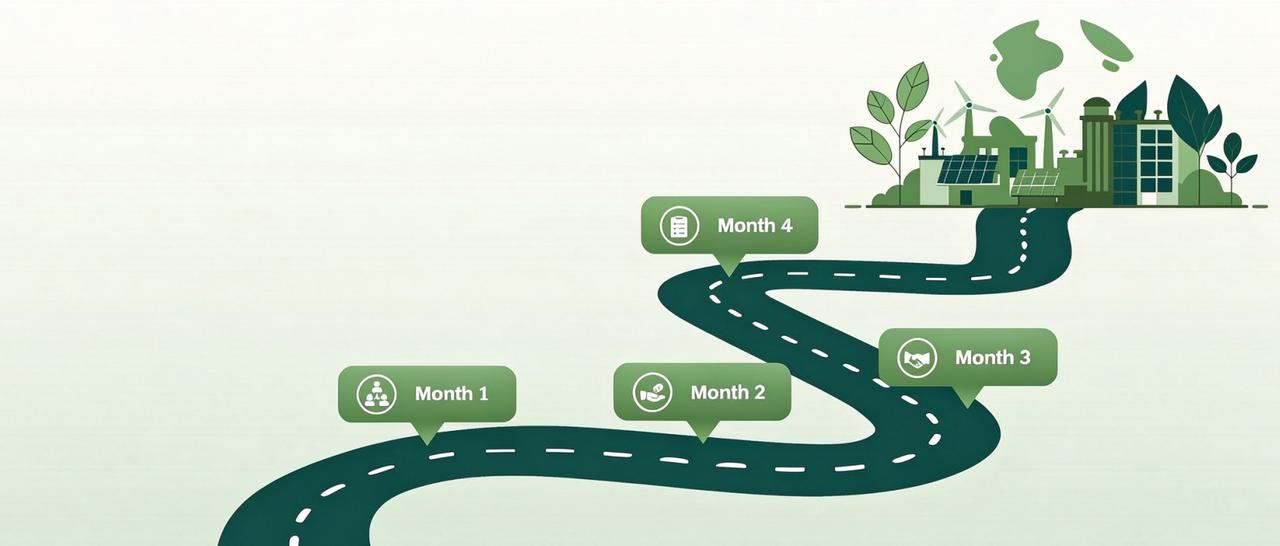 Your company’s next machinery investment decision may determine its emissions profile for decades to come. But at no point in the approval process will anyone consider whether this investment matches your firm’s climate ambition. This gap has become a strategic risk, as consumers, investors, and regulators push for a credible transition strategy.
The combination of carbon management technology, Chinese emissions databases, and consulting services offered by Carbonstop can be used to create an enterprise decarbonization strategy based on the connection between measurement and decision-making.
A carbon management system provides the basis for it. Corporate leadership decides what changes result from it.
 Begin with the Decisions Your Roadmap Must Influence
A useful roadmap translates climate ambition into business choices. Define those choices before selecting software features.
Connect Targets to Investment Cycles
Carbon reduction roadmaps require benchmarks that align with the reality of the business’s expenditure and operations.
- Destination set: Benchmark emission limits, timelines, milestone checkpoints, and accountable persons.
- Decision opportunities: Map out equipment renewal and upgrades, plant expansion, electricity agreements, and other key procurement renewals.
- Accountability: Finance should be responsible for investment evaluation; operations should implement; while sustainability ensures accurate accounting.
For instance, if a company wants to make a boiler replacement, the future heat demands, electrification options, and the electricity agreements have to be taken into account because even minimal efficiency could cost much in the future.
 Build a Baseline That Can Withstand Scrutiny
Long-term planning depends on consistent measurement. A shifting baseline can make apparent progress difficult to interpret.
 Make Data Quality an Operating Discipline
Prior to configuring the sustainability roadmap software, determine how emissions data will be collected, analyzed, and archived.
- Set boundaries: Employ a consistent GHG Protocol consolidation methodology and track organizational changes.
- Archive documentation: Link activity data to invoices, meters, calculation methods, and emission factor versions.
- Select proper factors: Evaluate geography, technology, report timeframe, and applicability, especially when dealing with operations in China.
- Manage revisions: Set responsibilities and policy for base year recalculation.
When calculating Scope 2, follow the relevant GHG Protocol requirements for location-based and market-based reports. Contractual evidence is required for renewable electricity.
Chinese emission factors from Carbonstop can help increase local relevance. The use of AI for factor matching and data validation can save time, while experts still have to evaluate special inputs, methodologies, and approve results.
 Turn Targets into a Funded Project Portfolio
The hardest part of net zero transition planning is choosing what to implement, when, and with which resources.
Compare Pathways Before Committing Capital
Utilize decarbonization scenario planning to validate assumptions related to significant investments.
- Model demand: Account for production growth, relocation, and anticipated energy use.
- Analyze dependencies: Review grid limitations, technological preparedness, downtime, and power availability.
- Perform economic analysis: Evaluate capital expenditure, operational cost savings, financial constraints, and applicable carbon price exposure.
- Test for uncertainties: Look at alternative energy prices, timelines, and policy assumptions.
Do not just add savings on the project side. Energy efficiency measures lower the electricity demand in respect of which the value of a renewable energy procurement project is calculated.
In considering decarbonization roadmap software, insist on clear assumptions and calculation reproducibility. Benchmarking will help find inefficient sites, yet comparisons must consider product mix and conditions of operation.
Translate the Preferred Pathway into Action
A carbon reduction action plan helps make the chosen route implementable.
Document for every individual project the responsible owner, approval date, budget cost, estimated carbon savings, dependencies, and means of validation. Distinguish those projects that are approved investments from other proposal projects in order for the management to be aware of the portion of the goal that has not been funded yet.
 Combine Carbonstop’s Technology with Customized Services
Software creates consistency across facilities; specialist services help resolve the operational and methodological questions behind the numbers.
 Define the Product and Service Requirements Clearly
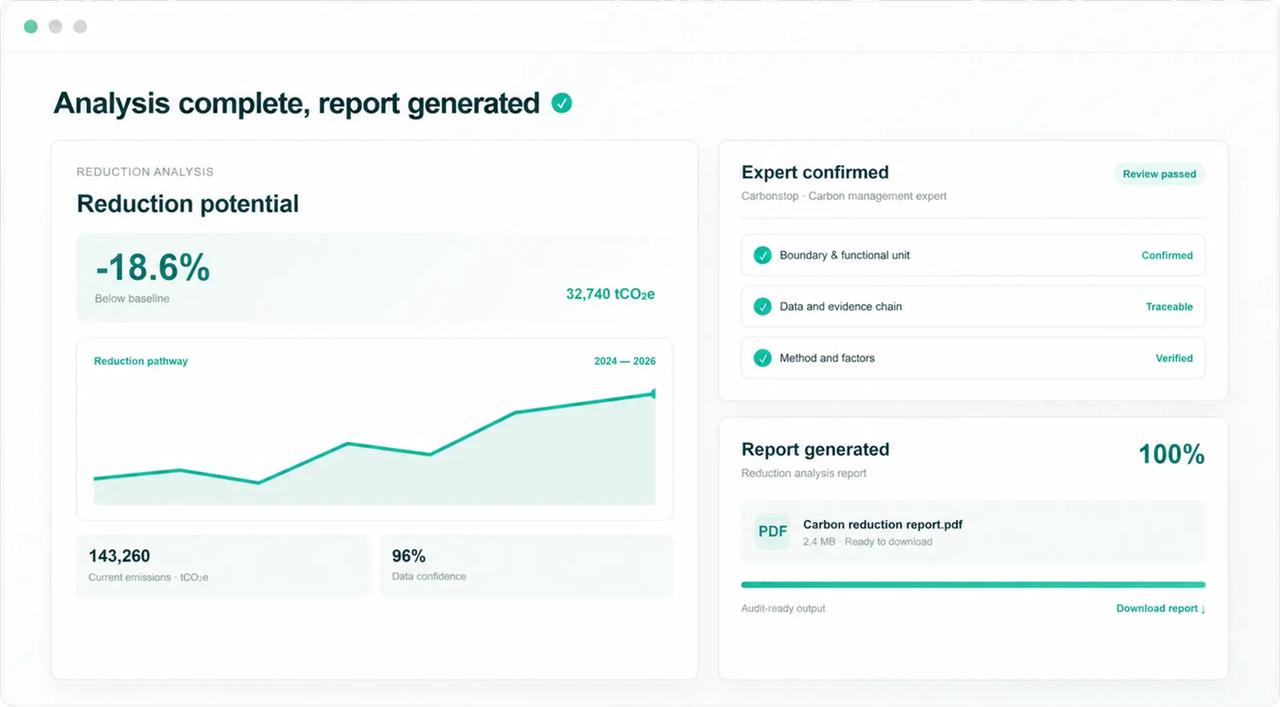
The Ccloud from Carbonstop is a combination of carbon inventorying functionality, AI, and Chinese emissions factor data. The consulting services provided include enterprise carbon accounting, transition strategy development, SBTi services, and ESG reporting.
A customized approach will need to define specific deliverables, namely:
- Baselines methodology: Agree on boundaries, data responsibilities, calculation rules, and evidence requirements.
- Implementation support: Define data templates, review processes, user training, and escalation.
- Roadmap development: Assess reduction potential, implementation constraints, and milestone ownership.
- Reporting preparation: Organize calculations and evidence for internal review and assurance.
Agree which functionality will be provided with the chosen deployment and which will require advisory services. Enterprise carbon management software provides governance through methodologies and evidence; assurance requires independent professional judgment.
Keep Supply Chain Planning in a Separate Workstream
Scope 3 lies beyond the capabilities of the product and calls for separate procurement and specializations.
The roadmap for decarbonizing the supply chain should consider relevant categories of emissions, suppliers, purchases, and suppliers' targets. Link the above activities to the corporate roadmap without suggesting that the platform deals with Scope 3.
 Track Delivery and Adapt to Reporting Requirements
A roadmap is effective when the team consistently compares what was planned to be reduced against what was achieved and makes adjustments to its decision-making process.
 Review Performance Against the Business Calendar
Choose emissions reduction tracking software that helps make anomalies clear.
- Monthly: Check for data gaps, anomalies, and implementation lags.
- Quarterly: Correlate emissions trends with production, acquisitions, weather, and completed projects.
- Yearly: Review assumptions, investments, and reporting needs.
The carbon reduction tracking process should reveal both absolute emissions and the appropriate intensity measures. Reduced emissions resulting from lower production must be separated from performance gains.
Preserve the Differences Between Frameworks
Source data can be used for several different disclosures; however, there are specific requirements that each disclosure has.
The EU Corporate Sustainability Reporting Directive employs European Sustainability Reporting Standards depending on the relevant scope and period. IFRS S2 from the International Sustainability Standards Board is focused on climate-related financial disclosures, and applicability will depend on adoption or voluntary use by jurisdictions. CDP maintains the disclosure program.
EU Carbon Border Adjustment Mechanism relates to embedded emissions in eligible products; therefore, corporate inventory won’t be sufficient for fulfilling the requirement. The SBTi transition plan must transform science-based targets into milestones of delivery; SBTi target validation doesn’t confirm the whole transition plan.
 Make the Roadmap Part of How the Business Runs
A valid roadmap links reliable data, investment decisions, ownership accountability, and periodic reviews. The technology enables this discipline, while leadership sustains it.
Begin with one plant and one investment decision. Talk about a custom roadmap with Carbonstop based on your baseline, limitations, and reporting requirements to determine the first phase.
FAQ
How Far into the Future Should Manufacturers Plan?
Plan within the lifetime of assets and set interim targets, with annual investment appraisals.
Are Emissions Decreasing Even Though Carbon Intensity is Increasing?
Yes. Less production leads to fewer emissions, but more fixed energy use means higher carbon intensity.
Will Renewable Electricity Purchasing Eliminate All Emissions?
No. Combustion of fuel, process emissions, and leakages of refrigerants must be dealt with individually.
Should Exporters Base CBAM on Corporate Emissions?
No. Embedded emissions need to be calculated according to the particular CBAM methodology.


