


 10
 The supplier provides the spreadsheet on schedule. The emission number appears reasonable. However, no one can determine which plant produced the carbon, how the number was calculated, or obtain the documentation. The request is fulfilled; the process of compliance is not.
The approach used by Carbonstop in this regard is to combine carbon data technology with expert analysis. As the EU’s Carbon Border Adjustment Mechanism has come into its definitive phase on 1 January 2026, poor documentation may impact the compliance process and carbon cost exposure.
Successful collection of CBAM supplier data relies on creating links between purchasing decisions, production, emissions calculation, and verification before sending out the questionnaire.
 Define Scope and Ownership First
A reliable CBAM data collection process starts with goods and installations, then assigns accountability across the business.
Map Goods to Their Producers
Create a register that follows imported goods back to production.
- Confirm Combined Nomenclature codes, origin, quantities, applicable coverage, and exemptions with customs specialists.
- Identify the installation operator and production route behind each supplier, including goods purchased through traders.
- Link products to relevant production processes, reporting periods, and required precursor inputs.
One commercial supplier may represent several installations. Combining them into a single average can obscure the evidence needed for compliant reporting.
Establish Clear Responsibilities
Give each function a defined decision.
- Procurement secures participation and escalates delays.
- Sustainability specialists define methodologies and review emissions evidence.
- Operations teams resolve production and energy questions.
- Trade compliance controls declarations; finance assesses certificate exposure and carbon price evidence.
The authorized CBAM declarant retains responsibility for its declaration, even when suppliers or advisers prepare the underlying information. Build a Questionnaire Around Evidence
CBAM supplier data requirements should determine the questionnaire. A generic sustainability survey rarely captures enough production detail.
 Request Information That Supports Calculation
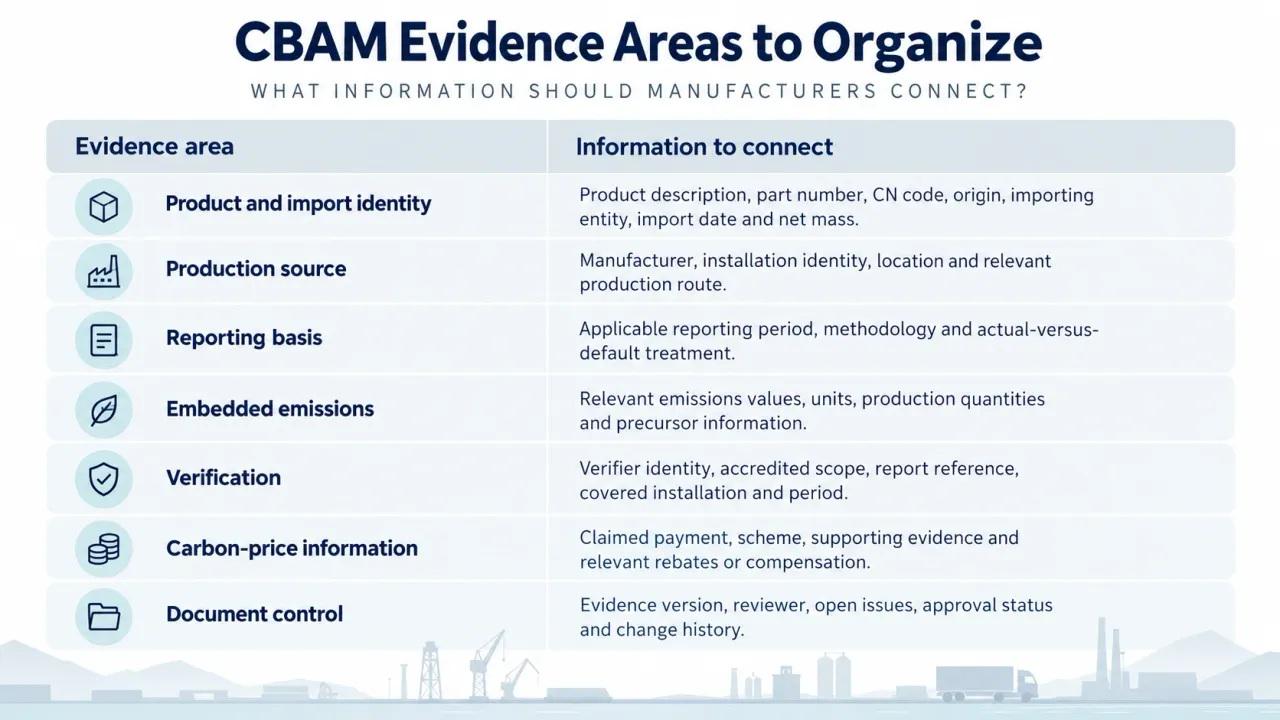
Structure the CBAM supplier questionnaire into practical modules.
- Identity: Operator, installation address, goods, production route, and reporting period.
- Activity: Production quantities, fuel consumption, process inputs, electricity where relevant, and allocation methods.
- Emissions: Direct emissions, indirect emissions where applicable, relevant precursor quantities and emissions, calculation methods, and factor sources.
- Evidence: Meter records, invoices, production logs, monitoring documentation, calculation files, and verification status.
- Carbon pricing: Evidence of carbon prices effectively paid, including applicable rebates or compensation, for assessing any deduction.
Require units, document references, and explanations for missing fields. Keep confidential production evidence in controlled channels, with appropriate access for reviewers and verifiers.
Preserve the Correct Accounting Boundary
Embedded emission data according to CBAM is subject to the specific production boundaries and sector rules.
The creation of a GHG Protocol Scope 3 inventory or LCA cannot be considered equivalent to the calculation of embedded emissions based on CBAM rules. CSRD, ESRS, or ISSB standards reporting does not imply compliance with CBAM either. Source documents can be used where relevant, but with separate calculation rules.
 Make Supplier Engagement Operational
CBAM supplier engagement works when suppliers understand both the request and how to answer it.
Prioritize Support by Exposure and Capability
Segment suppliers before launching collection.
- Start with installations associated with significant import volumes, potential emissions exposure, or incomplete records.
- Give experienced operators a clear template and evidence checklist.
- Offer less prepared suppliers short training sessions, worked examples, and named technical contacts.
- Require traders to establish communication with the actual producers.
Determine deadlines for submission, correction, and escalation. Consider using monthly data collection and quarterly internal review, when appropriate, ensuring that the calculation aligns with the CBAM reporting period.
Monitor coverage of import data through supported and usable data. Response rates to questionnaires may not reveal any compliance gap.
 Validate Before Preparing the Declaration
Data on CBAM actual emissions should be subjected to methodological analysis as well as mathematical verification. A neat spreadsheet may still have an incomplete boundary.
Apply Three Layers of Control
Embed CBAM data validation in every submission.
- Completeness: Verify installation, goods, time periods, precursors, and supporting documentation.
- Consistency: Verify units, sum up total energy and production, and look for abnormalities in emissions intensities.
- Methodology: Evaluate boundaries, allocation, factors, and the treatment of indirect emissions against the relevant guidelines.
A case can be cited of a steel fabricator who submits gas consumption for the finishing processes but excludes the emissions from purchasing the pertinent steel precursors. Even correct invoices would not replace missing emission calculations.
If possible, apply Commission default values where appropriate and explain why. Avoid labeling generic estimations as emissions at all costs.
Build Verification Readiness Into the Workflow
The audit trail of CBAM outcomes must permit the reconstruction of all the outcomes that have been reported.
Maintain the source data, factor data, calculation methods, authorization, correction information, and relationships between items and installations. Prepare CBAM outcomes for verification by resolving gaps before independent verification.
In the final approach, the actual emissions that have been reported will be verified by independent verifiers. Though the internal controls and software support this process, they cannot substitute for this.
 Combine Technology With Customized Support
Technology reduces repetitive work when its outputs remain traceable and technical decisions receive expert review.
Use Carbon Agent for Evidence Preparation
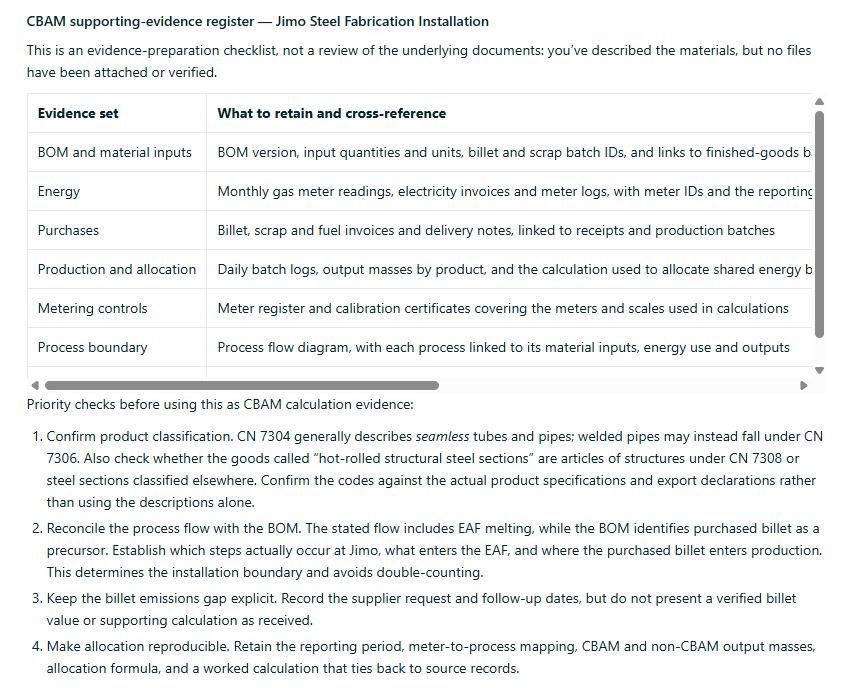
Carbonstop’s Carbon Agent brings AI document processing and expert review to product carbon accounting and evidence preparation.
- It extracts fields from PDFs, spreadsheets, images, and bills of materials.
- It standardizes units, flags gaps and anomalies, and preserves source traceability.
- It recommends emission factors with source and version information.
- Human experts review key data, boundaries, and model outputs, with revisions recorded.
Carbonstop’s China Carbon Database provides China-specific emissions information that can improve local data interpretation. Any factor selected for CBAM must still meet the applicable methodology.
Specify Services and Software Around Deliverables
A customized engagement should address the supplier’s actual evidence gaps. Agree deliverables such as a completed request template, a gap register with owners and deadlines, reviewed calculations, and an organized evidence pack.
Carbonstop’s technical and consulting support can help structure requests, interpret Chinese production records, review calculation boundaries, and prepare documentation for independent verification.
When evaluating CBAM data management software or CBAM reporting software, require evidence links, access controls, version histories, and exports compatible with current reporting requirements. Define these deliverables before implementation.
 Turn Collection Into a Repeatable Business Process
Effective CBAM supply chain compliance depends on the following three fields of expertise: installation identification, gathering evidence, and exception handling before verification.
Begin with a single product and its suppliers. Make sure that every number is traceable and explainable, and then proceed to increase the scope of the process.
In order to find out what your next step should be, have a discussion about a custom data readiness review with Carbonstop. Come prepared with a supplier response and an import record.
FAQ
Can Traders Provide CBAM Supplier Emissions Data?
Yes, but the information must remain traceable to producing installations. A trader’s corporate footprint is insufficient.
Must Every Sector Include Electricity Emissions?
No. Indirect emissions treatment varies by goods and applicable rules. Confirm the required boundary before requesting calculations.
Can Suppliers Use Default Values?
Where permitted, applicable Commission default values can be used. Record their source and distinguish them from actual verified emissions.
When Should Manufacturers Prepare for Verification?
During data collection. Agree on monitoring methods, retain evidence, and resolve calculation gaps before engaging the accredited verifier.


